





FGN bond reopening accrued interest settlement starts with a cash-budget question: how much must leave the account, and when? Face value alone cannot answer it when a bond trades away from par and accrued interest is added. This guide separates verified offer terms from a fictional teaching model.
The DMO November circular, published on 10 November 2026, advertises four reopenings totalling ₦2 trillion. It schedules the auction for 16 November and settlement for 18 November. Those are offer terms, not proof of a completed allocation or money raised.
FGN bond reopening accrued interest settlement: read the offer first
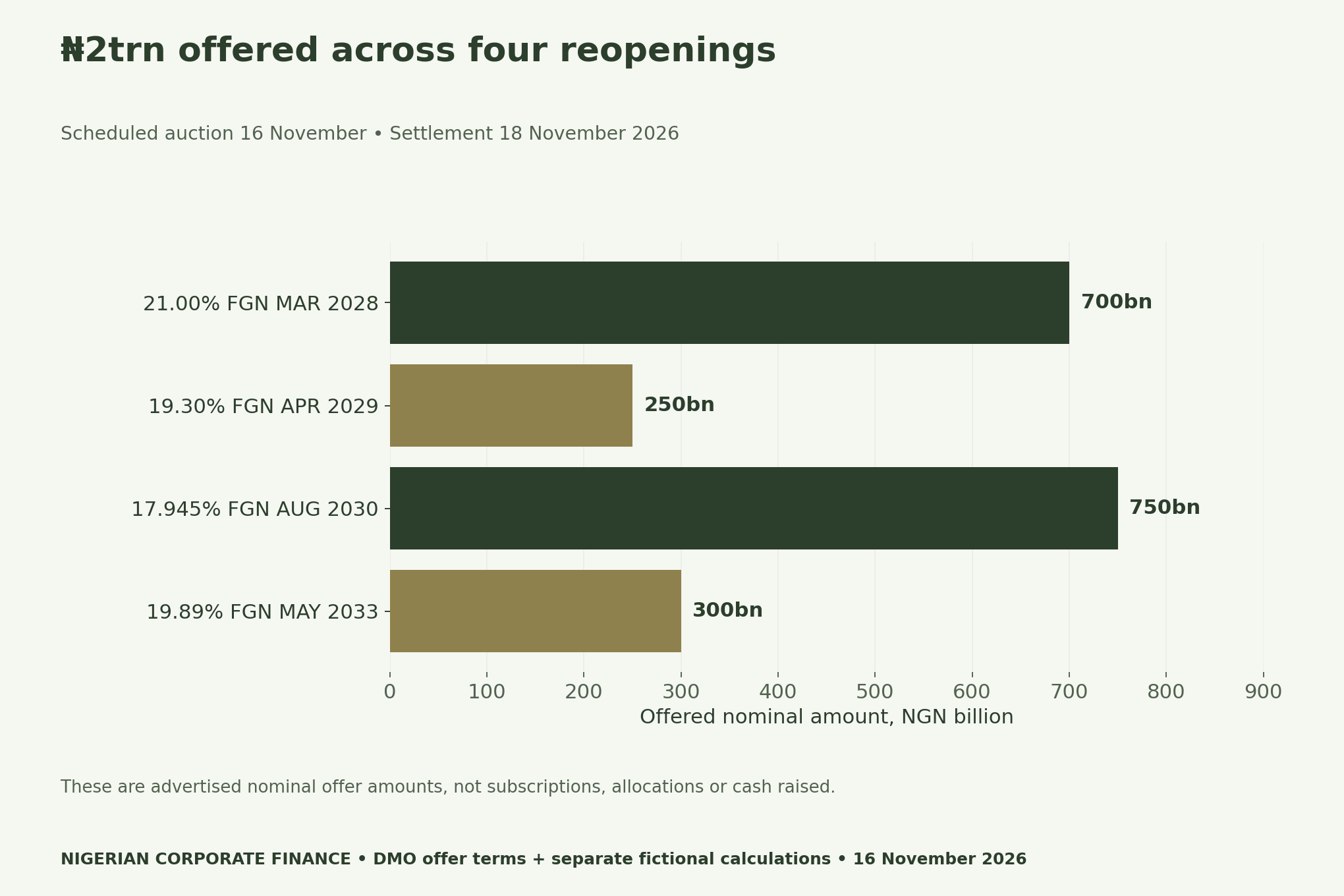
The circular lists coupons of 21%, 19.30%, 17.945% and 19.89%. Interest is paid twice yearly. For a reopening, it says the successful bidder pays a price linked to the clearing yield plus accrued interest. A headline coupon therefore does not specify the settlement debit.
The official auction-results index was checked on 16 November during preparation. Its newest listed conventional-bond result was October. No November conventional auction result was located in that check. Results can appear later; this article does not substitute a savings-bond result, dealer comment or offer amount for an allocation notice.
| Stage | Date or input | What it establishes |
|---|---|---|
| Offer publication | 10 November 2026 | Terms advertised |
| Auction scheduled | 16 November 2026 | Auction date, not an allocation outcome |
| Settlement scheduled | 18 November 2026 | Budget deadline in the offer |
| Execution confirmation | Obtain actual quote and allocation | Security-specific price, accrual and cash due |
Separate face value, clean consideration and accrued interest
Face value is the nominal principal represented by the holding. Clean consideration applies the quoted clean price to that nominal amount. Accrued interest accounts for the elapsed portion of the coupon period under the relevant security convention. Separately charged fees or taxes may add another cash requirement.
Start by establishing whether a quote is clean or already includes accrued interest. Adding the same accrual to an all-in amount would double count it. Record the price unit as well: a quote per 100 face is a different input from a total naira consideration amount.
Reproduce the fictional ₦113.5m settlement example
Assume ₦100 million face value, a clean price of 110 per 100 and an annual coupon of 21%. Also assume an elapsed fraction of 60/180 of a half-year coupon period. The price and fraction are invented for learning. They are not verified November auction inputs or an actual security-specific accrual.
Clean consideration is ₦100m × 110 ÷ 100 = ₦110m. A half-year coupon is ₦100m × 21% ÷ 2 = ₦10.5m. Applying the assumed 60/180 fraction gives ₦3.5m of illustrative accrued interest. The resulting cash amount is ₦113.5m before other charges.
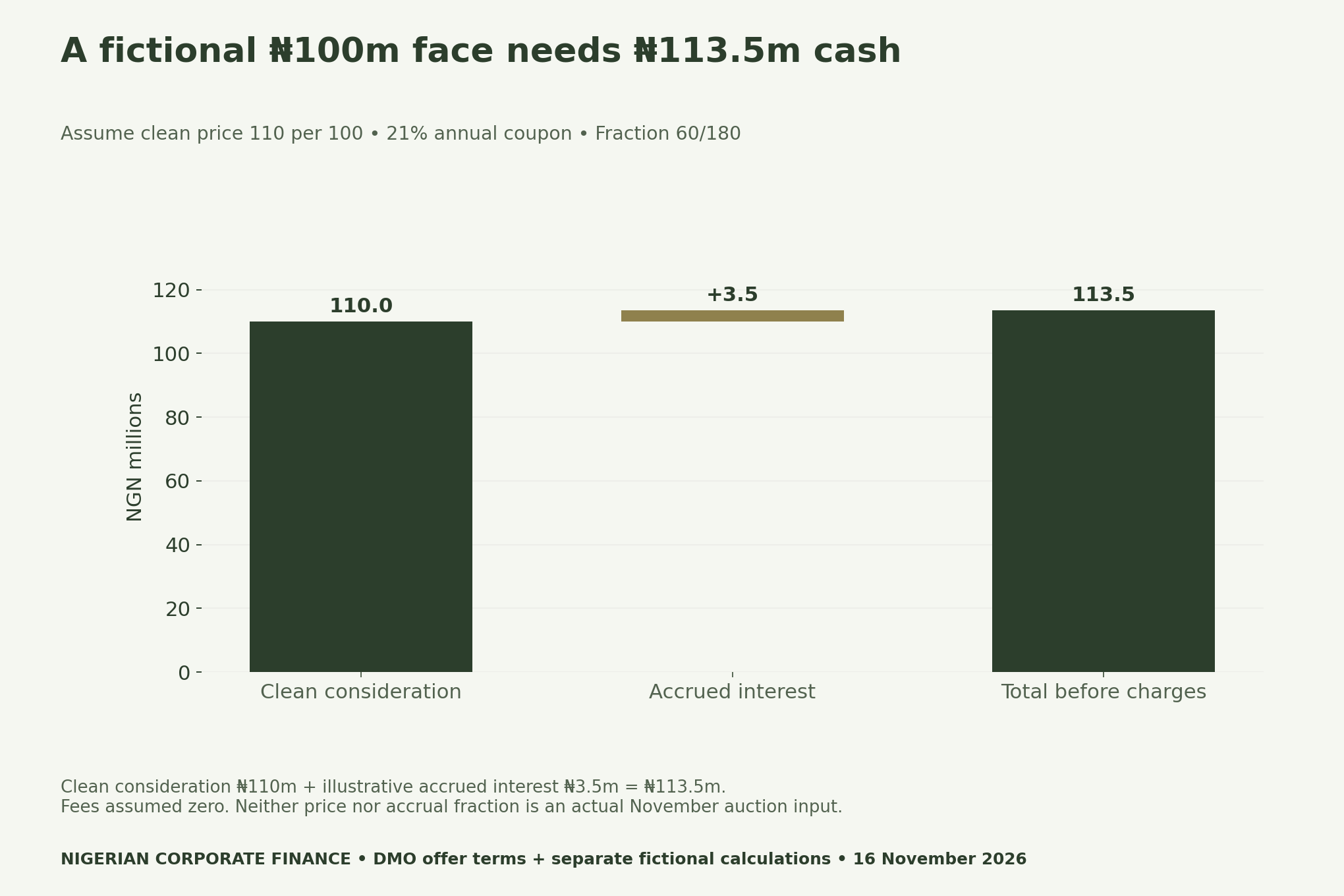
A budget that reserved only the ₦100m nominal amount would be ₦13.5m below this fictional cash requirement. That gap combines a ₦10m clean-price premium and ₦3.5m of assumed accrual. It is not a forecast of the auction outcome or a measure of investment loss.
Try the teaching arithmetic checker
Change the fictional inputs below to see the arithmetic. This checker does not price a bond from yield, determine the correct day count or validate a dealer quote. Its output is always a learning scenario, never an operational settlement estimate. The blank verification worksheet records the additional evidence needed for real cash use.
Fictional settlement arithmetic
Learning only. Enter assumptions, not personal financial information.
Press Calculate to display the fictional arithmetic.
A coupon is not the same as an investor yield
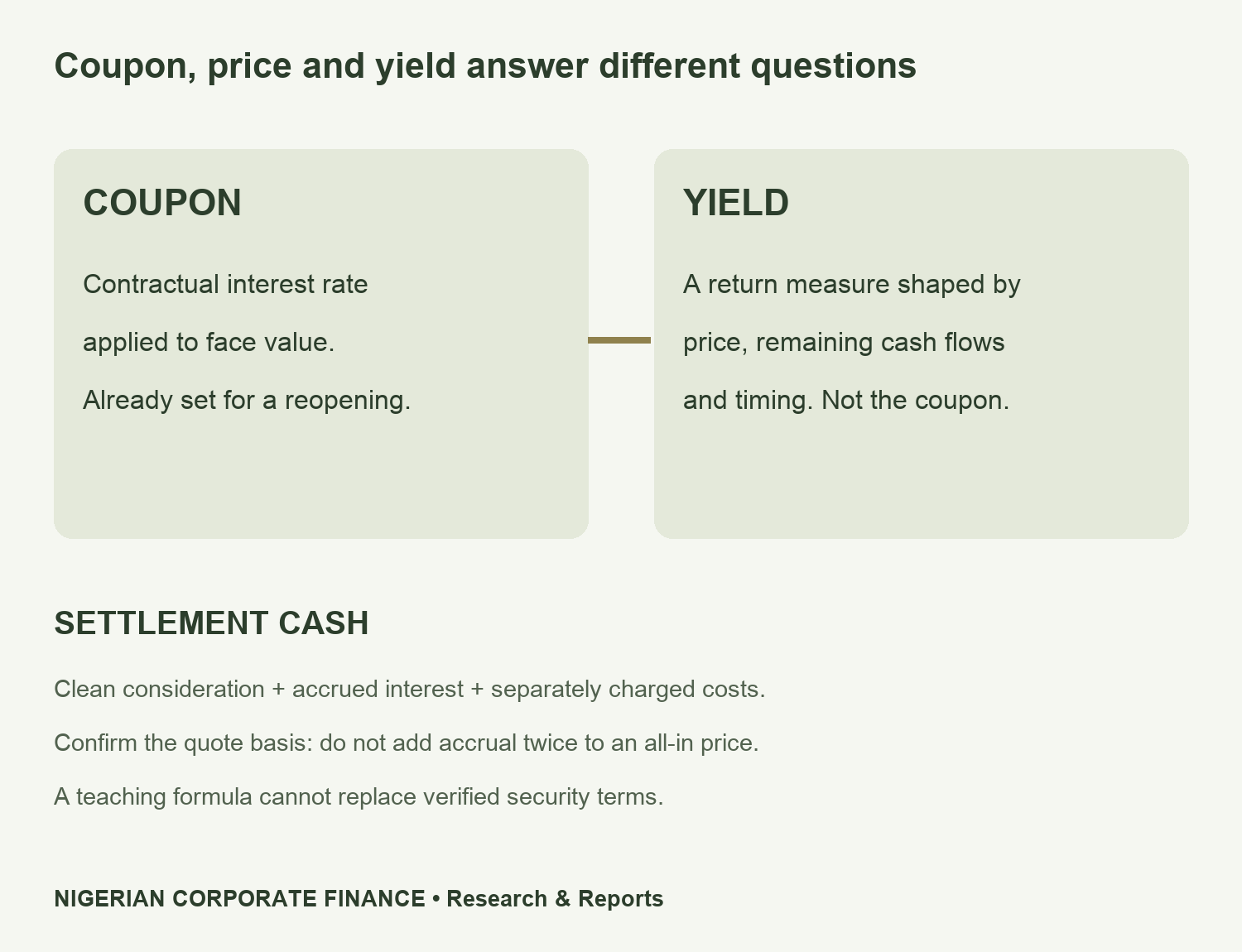
In the fictional model, a 21% annual coupon gives ₦21m of annual coupon cash on ₦100m face before any relevant deductions. Paying a clean premium does not increase that contractual face-value coupon. It changes the price paid for the remaining cash flows. A yield calculation also needs maturity, timing and the appropriate conventions.
Dividing a coupon by clean cost can produce a current-income ratio, but that is not automatically yield to maturity. This article does not compute either an actual auction yield or a suitability assessment. Do not relabel the circular’s coupon as a guaranteed investor return.
Stress-test the price input without inventing an auction forecast
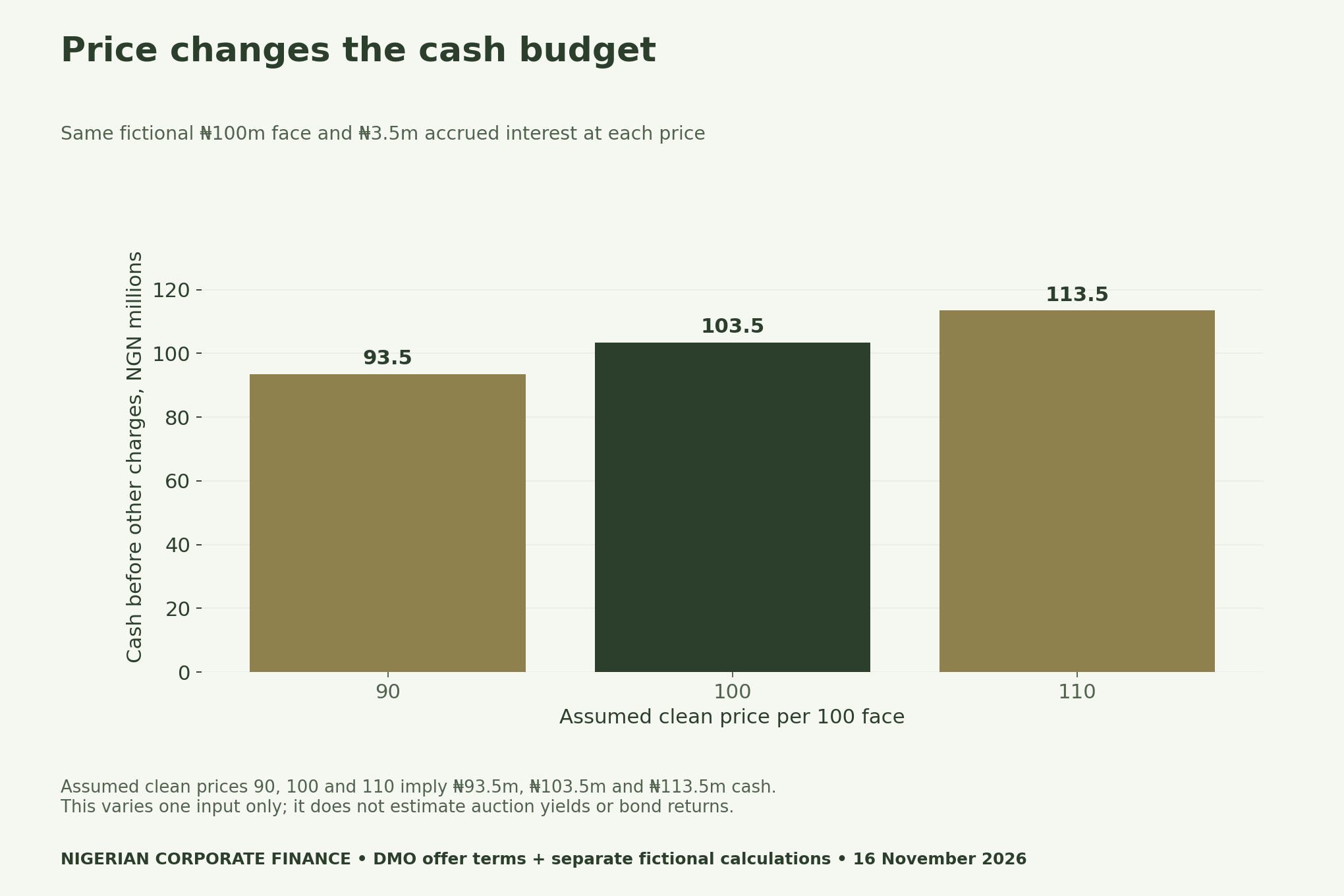
Testing several prices is useful for checking a budget model, but it cannot supply a missing quote. Nor does an official liquidity classification mean a bond has no market-price risk. Cash availability on the settlement date and ability to sell at a particular price are different questions.
Build the evidence pack before using real cash
For operational use, identify the exact security and obtain its current coupon dates, settlement date and day-count convention. Confirm the actual allocation, price basis and dealer-calculated accrual. Add separately charged costs, check payment instructions through established controls and obtain the organisation’s treasury approval.
Keep the supporting quote and its timestamp beside the calculation. If the price already includes interest, document that fact instead of adding accrual again. Leave unknown inputs blank rather than copying a teaching assumption. The capital-markets research archive provides related instrument context; each transaction still needs its own evidence.
Tax treatment depends on the investor and applicable rules. This guide does not turn the circular’s summary wording into a universal corporate tax exemption. It also does not recommend allocating operating cash, bidding at a particular yield or selecting an investment.
Methods, source limits and downloads
The offer chart transcribes the four nominal amounts and sums them to ₦2trn. All settlement examples use invented prices and a declared 60/180 half-period fraction. The model uses clean consideration = face × price ÷ 100; illustrative accrual = face × annual coupon ÷ 2 × fraction. Separate fees are then added.
No November allocation, clearing yield, exact accrued amount or investor eligibility was verified. The calculator is restricted to teaching arithmetic for that reason. Obtain professional treasury review and current execution documents before using any model with real money.
- November offer terms and source register (CSV)
- Fictional settlement examples and calculations (CSV)
- Blank verified-input settlement budget (CSV)
- Operational input verification checklist (CSV)
Suggested citation: Nigerian Corporate Finance, “FGN Bond Reopenings: Budget Settlement Cash, Not Just Face Value”, 16 November 2026. DMO offer circular published 10 November; separate editorial teaching calculations.


