





Dangote Cement secondary offering proceeds cannot be reconstructed from a listing headline alone. An additional trading venue, a shareholder’s sale and a company’s issue of new shares describe different things. Therefore, the useful first question is who would receive the money.
The company’s board-resolution notice dated 10 November 2026 says Dangote Cement and selling shareholder Dangote Industries Limited will not proceed with the proposed London secondary listing and offering at that time. It cites market conditions and strategic priorities. The notice also says the ordinary shares remain listed on NGX.
Dangote Cement secondary offering proceeds: establish the evidence boundary
The notice gives no offer size, price, primary-versus-secondary allocation, fees or expected net proceeds. It therefore cannot support a numerical lost-funding estimate. Its statement that operations and business plans are unaffected is the company’s statement, not an independent operational test conducted for this report.
For historical context, the July AGM resolutions authorised consideration of an international listing and a majority-shareholder offer for sale, subject to approvals. However, authority to consider a transaction is not a completed sale. The later board notice changes the stated execution position without supplying final offer economics.
| Evidence | Date | What it says |
|---|---|---|
| AGM held; resolutions issued next day | 2–3 July 2026 | Authority to consider listing and shareholder offer, subject to approvals |
| Board-resolution notice | 10 November 2026 | Not proceeding at that time; NGX listing remains |
| This teaching analysis | 16 November 2026 | Separates published status from fictional cash-flow cases |
Separate the listing venue from the shares being sold
A secondary listing concerns an additional market venue for the company’s shares. A secondary sale concerns existing shares changing hands. Despite that similar wording, the two concepts are not interchangeable. The offer documents must identify which shares are new, which already exist and who is selling them.
A transaction could combine primary issuance and sales by current holders. In that case, split the share quantities and cash recipients before adding totals. Do not assume that every naira mentioned in a deal headline reaches the issuer’s bank account.
Compare two fictional ₦500m gross-proceeds cases
The examples below are wholly fictional and do not estimate Dangote’s proposal. Start with a company that has 100 million shares outstanding. Assume a price of ₦50 per share and a transaction involving 10 million shares. For clarity, the model excludes fees and tax.
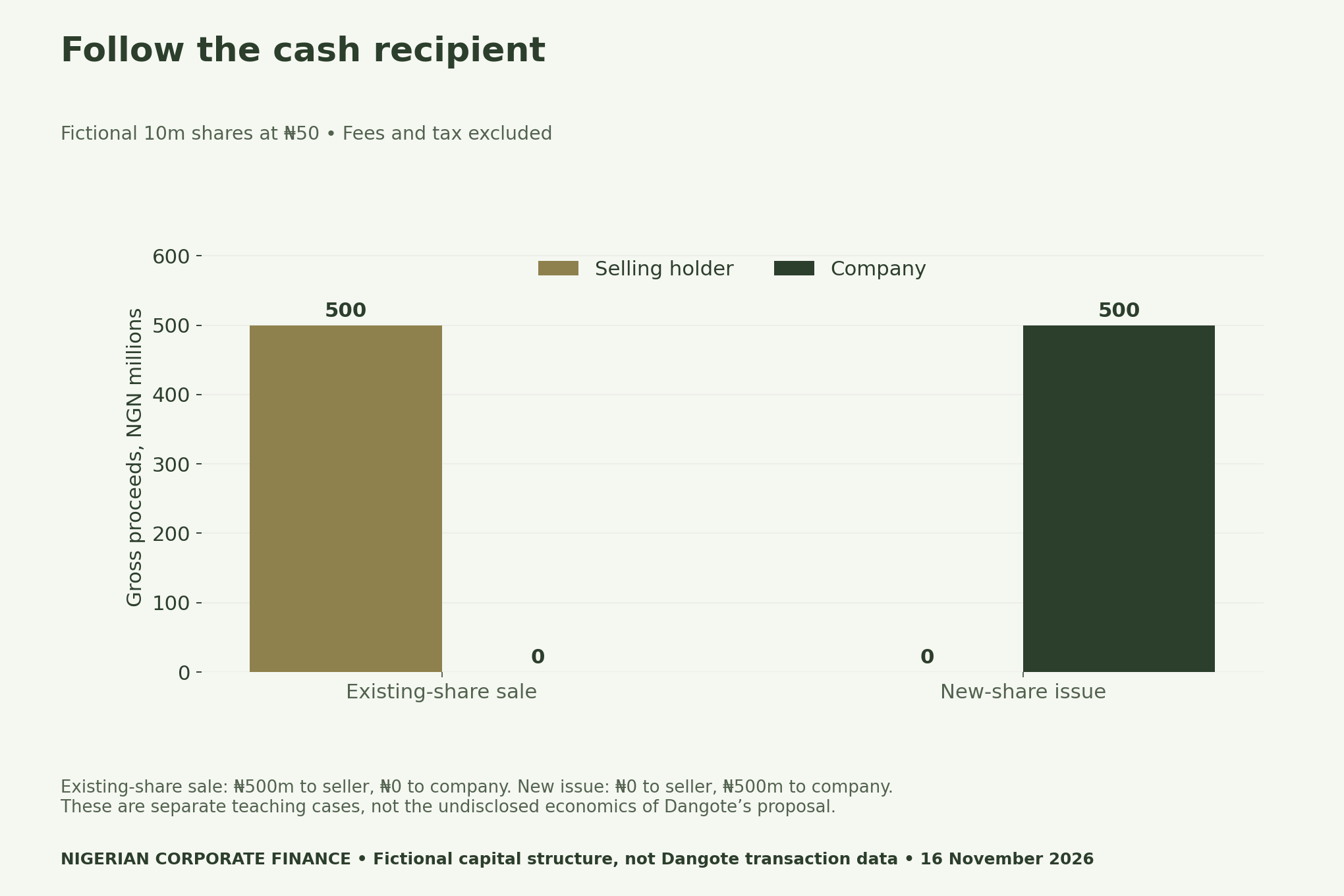
In the existing-share case, an owner sells 10m of its existing shares to a buyer. The buyer pays ₦500m to that owner before costs. Consequently, the company receives no gross sale cash in this simple case. Ownership changes between holders, but the transaction does not create another 10m company shares.
In the new-issue case, the company creates and sells 10m new shares at the same assumed price. As a result, it receives ₦500m gross before costs. A current holder receives no sale proceeds unless it separately sells shares. The issuer’s share count now increases to 110m.
Check the share-count denominator
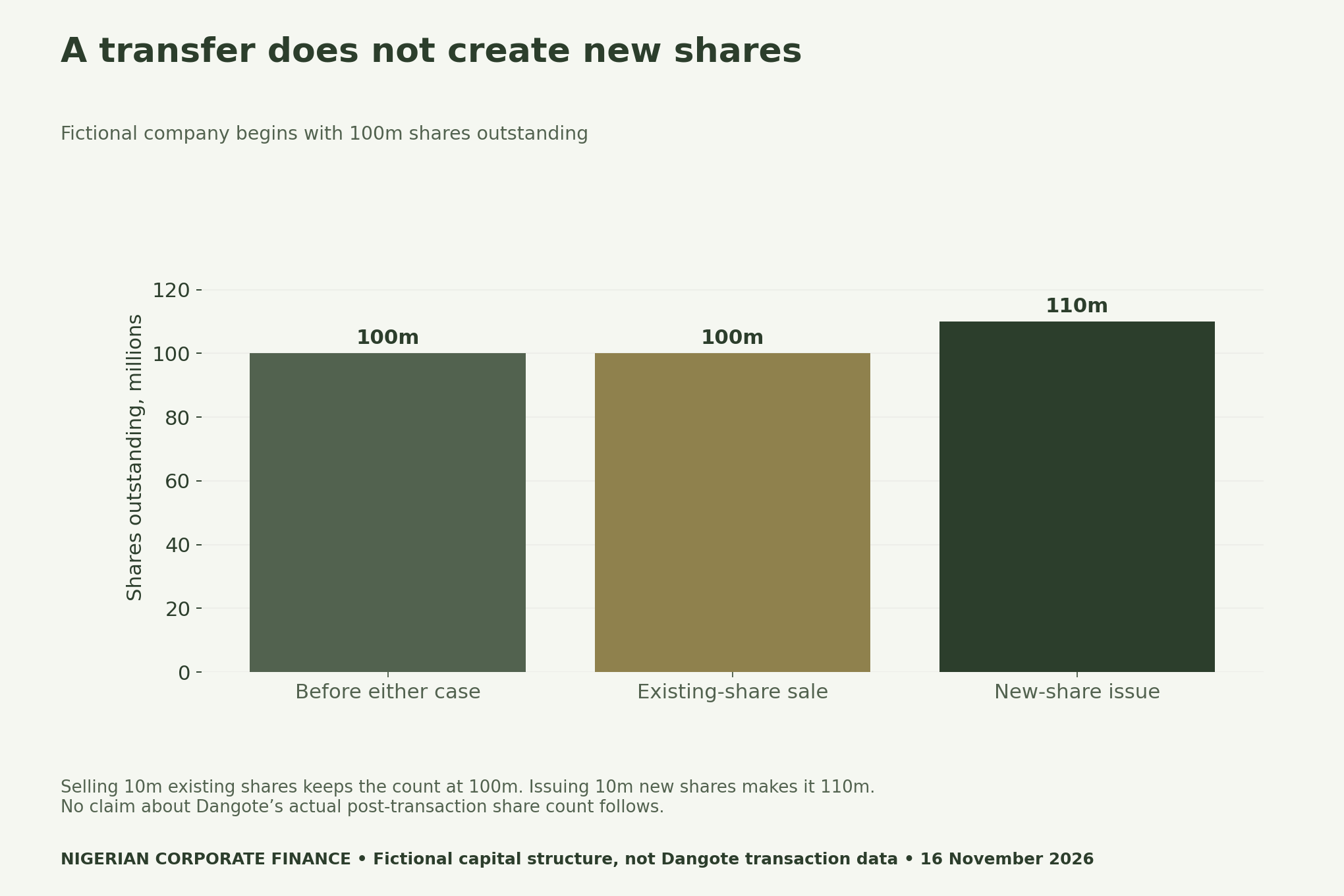
Now introduce a separate observer who owns 10m shares and neither buys nor sells. Before either case, that observer holds 10m ÷ 100m = 10%. A transfer between other holders leaves its percentage unchanged in this simplified model. In contrast, a new issue changes the denominator.
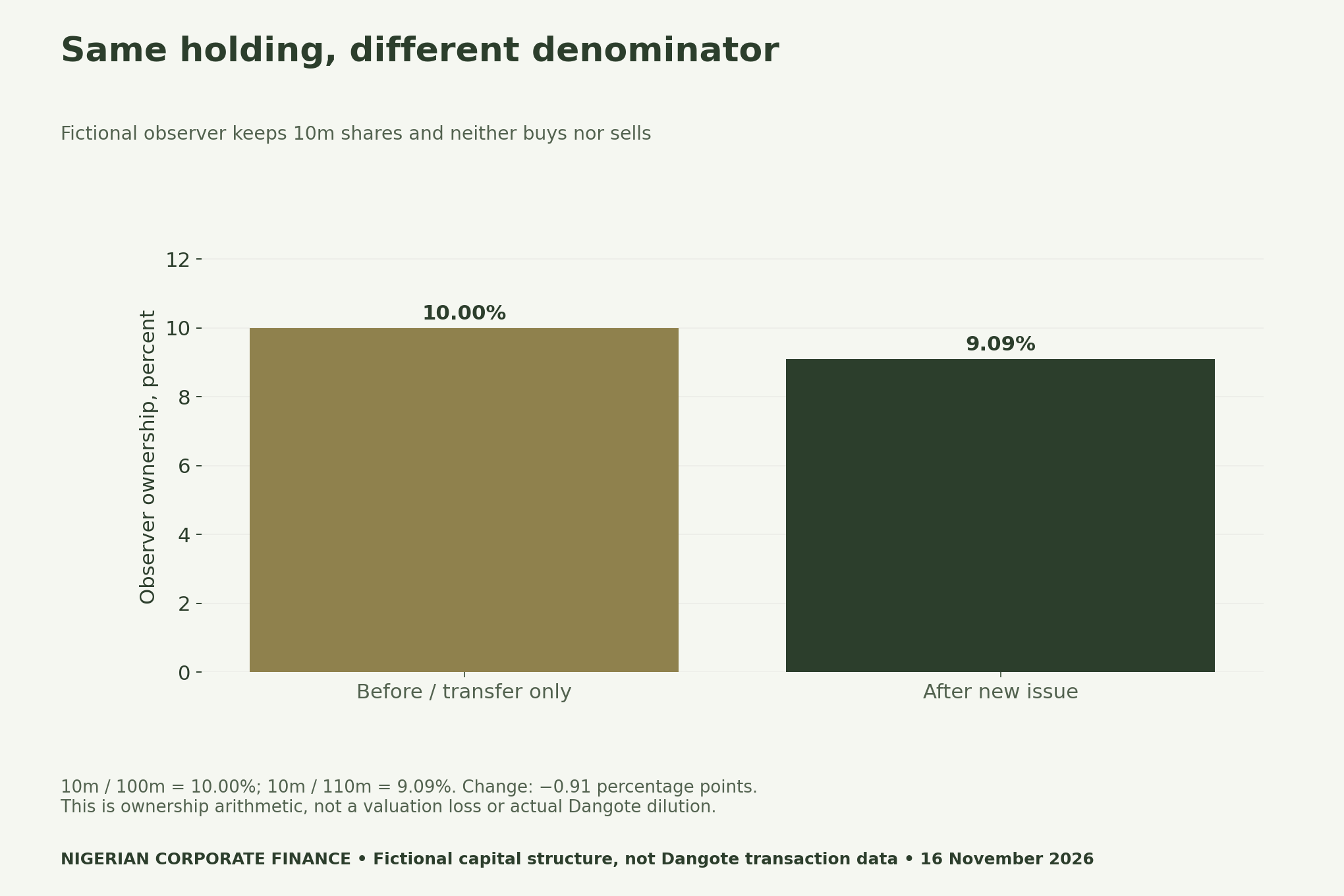
After the new issue, the observer’s 10m ÷ 110m is approximately 9.09%. That explains a denominator effect, not the full economic effect of a transaction. The company has also received new cash in the model. Valuation, issue costs, use of proceeds and future performance require separate analysis.
Crucially, the observer is not the seller in the first example. Keeping those roles distinct prevents an inconsistent comparison in which the same holder supposedly sells shares yet retains an unchanged holding. The CSV records each scenario and its assumptions explicitly.
Use a recipient map for mixed offerings
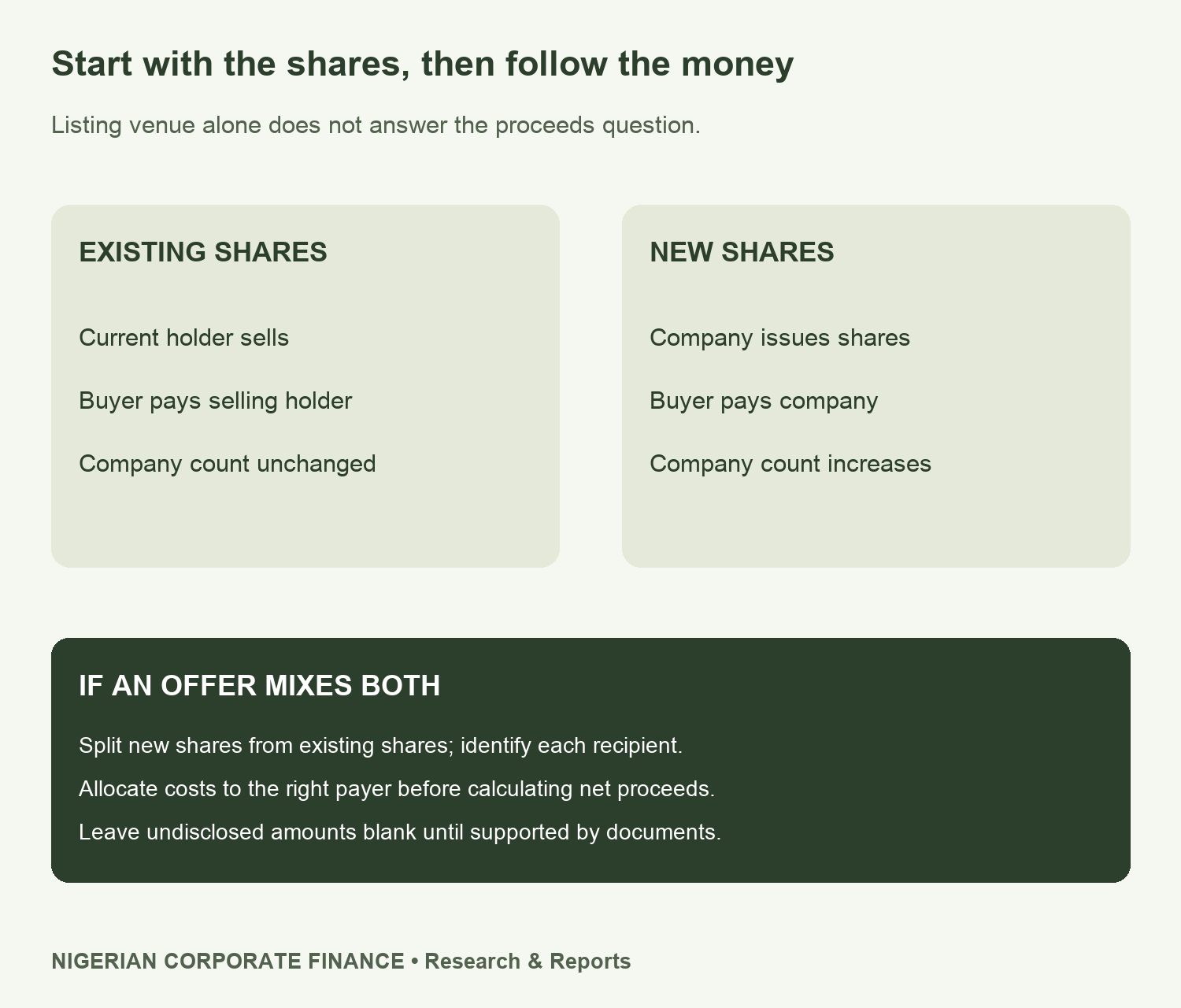
For a mixed offer, begin with a schedule showing the number of new shares and the number sold by each existing owner. Multiply each supported quantity by the appropriate price, respecting currencies and any different price terms. Then assign those gross amounts to the correct recipient.
Next identify who pays each cost. Issuer proceeds less issuer-paid costs are a different subtotal from seller proceeds less seller-paid costs. Do not subtract every transaction expense from both parties or use one total as if it were each recipient’s net cash.
The blank allocation worksheet leaves unknown values unfilled. Instead, use it to organise questions and evidence without treating empty source fields as answers. A later offer document could provide a different mix from a teaching model or an earlier proposal.
What the November notice cannot quantify
| Unknown term | Why it matters |
|---|---|
| Share quantity and price | Needed for gross proceeds |
| New/existing split | Identifies issuer versus seller receipts |
| Fees and payer | Needed for separate net receipts |
| Final share count | Needed for a supported ownership denominator |
| Any restart date | Requires a later formal announcement |
Do not relabel a decision not to proceed at a particular time as permanent cancellation without further evidence. Equally, do not present a potential future revival as scheduled. Preserve the dated wording and check later formal announcements when reusing this report.
Our broader guide to Nigerian corporations accessing capital markets discusses funding routes. This case adds a narrower discipline: follow the share type and cash recipient before interpreting a fundraising headline.
Methods, limitations and downloadable tools
The real-case register transcribes the scope and status of two public company notices. All numerical charts use an invented 100m-share starting structure, 10m-share transaction and ₦50 price. In both cases, gross proceeds equal shares times price. Ending share count adds only newly issued shares; the observer percentage divides its unchanged 10m holding by that count.
We have not verified actual London offer economics, fees, valuation effects, a funding shortfall or a market-price response. The examples are corporate-finance education, not an investment, legal or transaction recommendation.
- Dated company-source facts and limits (CSV)
- Fictional proceeds and denominator calculations (CSV)
- Blank proceeds-allocation worksheet (CSV)
- Undisclosed terms and evidence register (CSV)
Suggested citation: Nigerian Corporate Finance, “Dangote Cement’s Paused London Offering: Who Would Receive the Proceeds?”, 16 November 2026. Company notices dated 3 July and 10 November; separate fictional editorial calculations.


