





Chams insider dealings November 2026 analysis needs both sides of the disclosed trading record. A purchase notice alone is incomplete when the same holder also reports sales over the same window. Reconcile gross flows first, then explain what the documents cannot establish.
Two NGX-listed notices, each dated 9 November and listed on 10 November, identify Creditville Nigeria Limited as a related party to a non-executive director. They cover 3–5 November 2026. Our reconstruction uses only that entity’s purchase notice and sale notice; another holder’s dealings remain outside the ledger.
Chams insider dealings November 2026: reconcile gross shares
The purchase rows are 1.5 million shares at ₦3.18, 1 million at ₦3.22 and 1.2 million at ₦3.20. They total 3.7 million shares. The sale rows are 17.5 million at ₦3.20, 10 million at ₦3.18 and 20 million at ₦3.10, totalling 47.5 million shares.
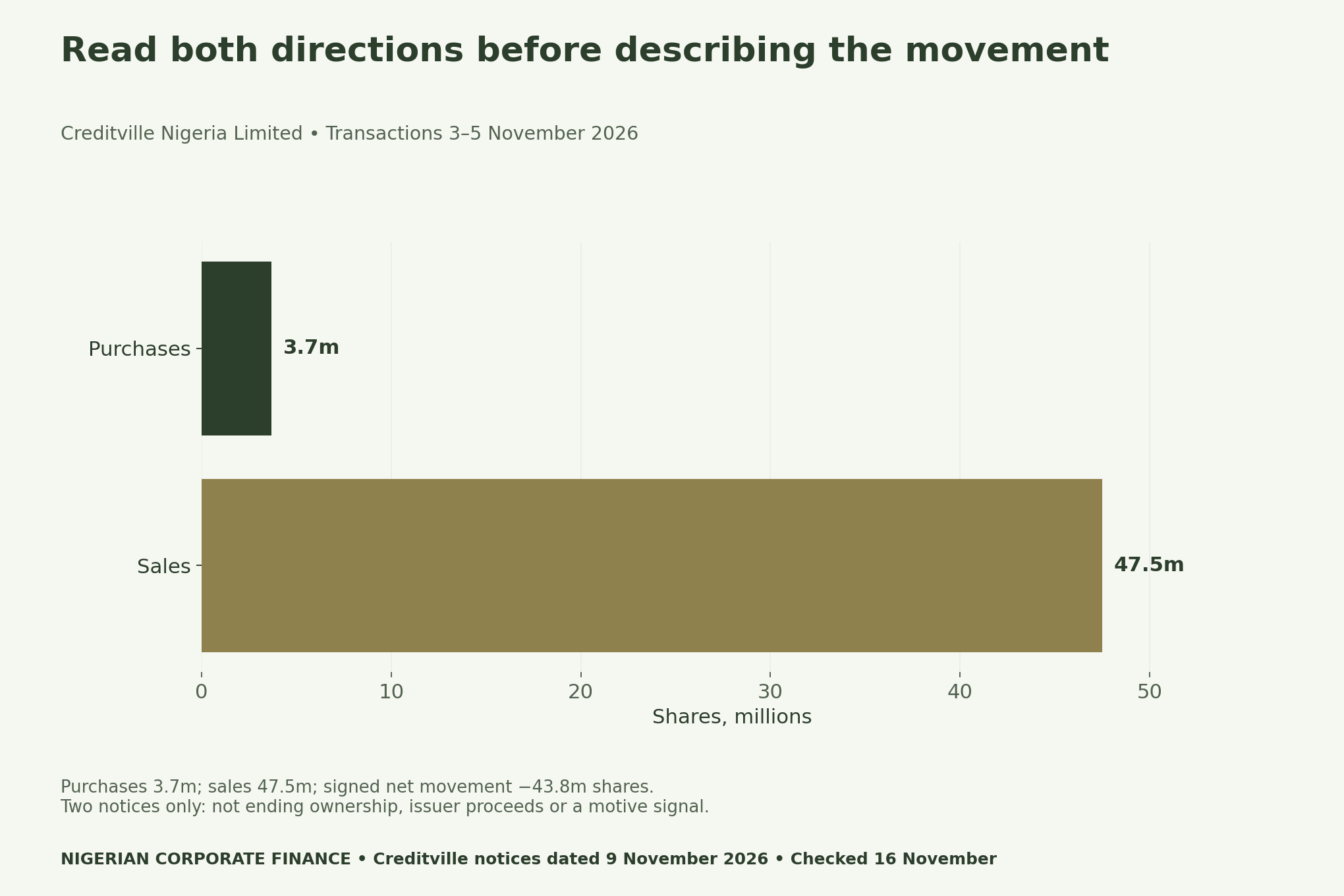
Use a declared sign convention: purchases add shares and sales subtract them. The net movement across these two notices is 3.7 − 47.5 = −43.8 million shares. The negative sign describes this limited movement. It does not say the holder has a negative share balance or establish its final ownership percentage.
The documents give a transaction window rather than a separate date for every price-volume row. Our CSV therefore preserves 3–5 November for each row. Row references identify positions in a notice, not a verified chronological sequence of trades. Do not manufacture a day-by-day trading narrative from an aggregated window.
Multiply each row before computing consideration
For purchases, the row products are ₦4.77 million, ₦3.22 million and ₦3.84 million. Together they equal ₦11.83 million. For sales, the products are ₦56 million, ₦31.8 million and ₦62 million, giving ₦149.80 million. These are row-level consideration estimates before costs.
| Direction | Shares | Price per share | Row consideration |
|---|---|---|---|
| Purchase | 1,500,000 | ₦3.18 | ₦4,770,000 |
| Purchase | 1,000,000 | ₦3.22 | ₦3,220,000 |
| Purchase | 1,200,000 | ₦3.20 | ₦3,840,000 |
| Sale | 17,500,000 | ₦3.20 | ₦56,000,000 |
| Sale | 10,000,000 | ₦3.18 | ₦31,800,000 |
| Sale | 20,000,000 | ₦3.10 | ₦62,000,000 |
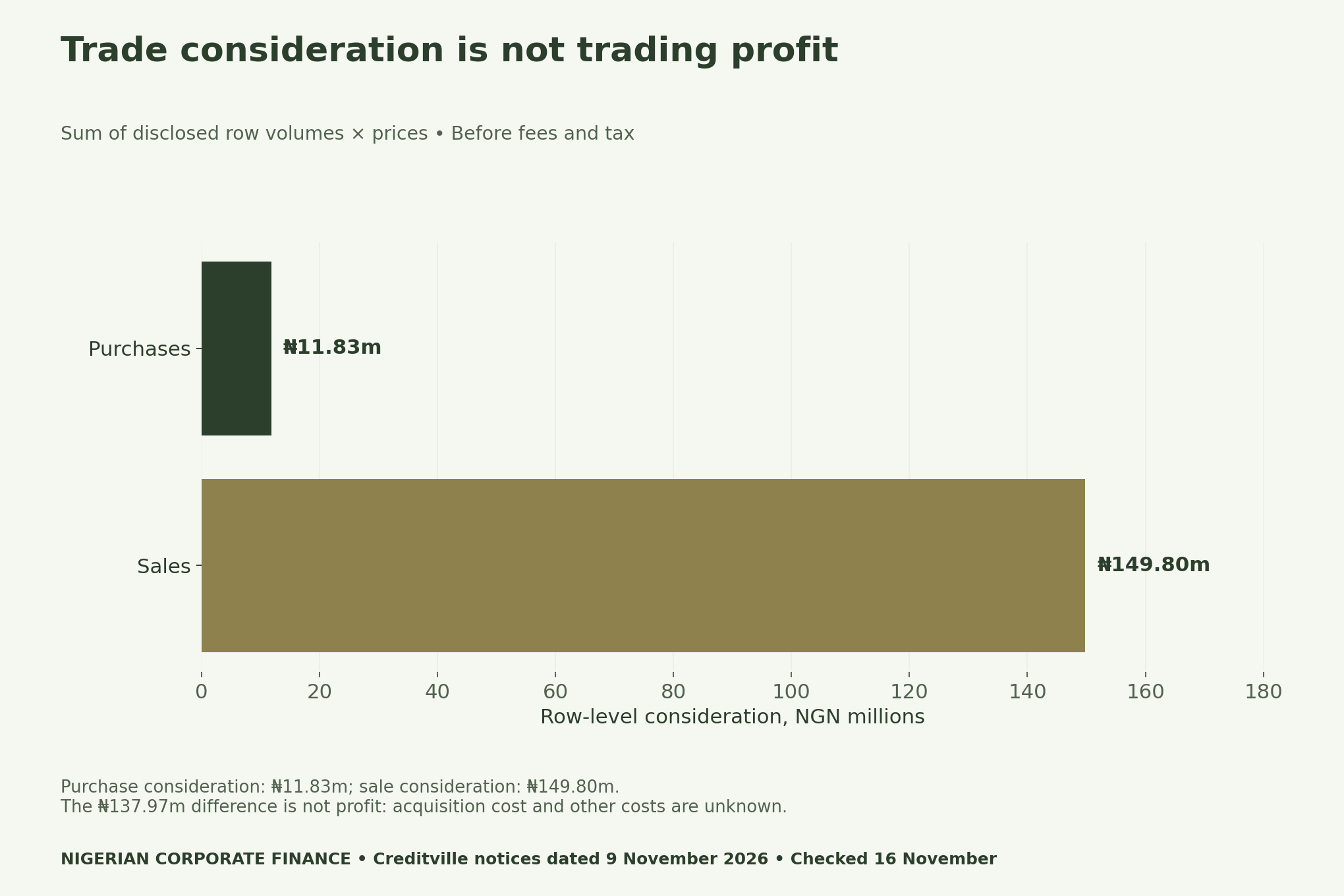
Subtracting purchase consideration from sale consideration gives ₦137.97 million. That is a net difference between the two disclosed consideration totals, not a realised profit calculation. The shares sold need not be the same shares purchased in this short window. Their acquisition history, cost basis and transaction costs are unknown.
It is also not company fundraising. These notices describe a holder’s purchases and sales. Do not add the holder’s sale consideration to Chams’s cash balance, or treat its net trading amount as proceeds from an issue of new company shares.
Check the weighted prices against the printed aggregate field
A row-weighted purchase price is ₦11.83 million ÷ 3.7 million shares = approximately ₦3.1973. That rounds to ₦3.20 at two decimal places, consistent with the purchase notice’s printed aggregate Price field. A simple average of the three prices would ignore their different volumes.
For sales, ₦149.80 million ÷ 47.5 million shares gives approximately ₦3.1537. Conventional two-decimal rounding gives ₦3.15, whereas the notice prints ₦3.16. We retain both values as an unresolved reconciliation point. We do not silently replace the issuer’s field or assume its intended definition has been clarified.
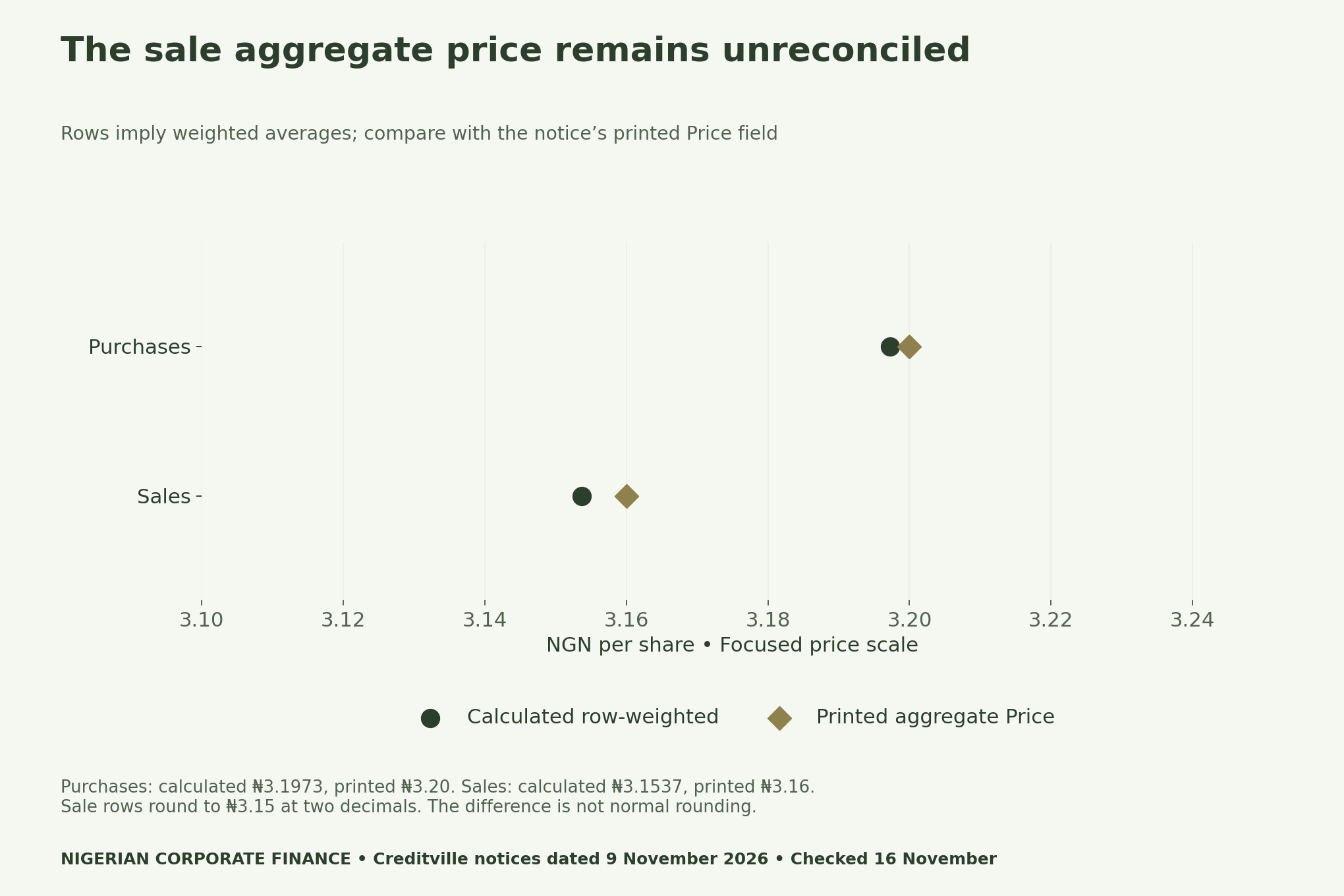
As another check, multiplying the printed sale price by 47.5 million shares produces ₦150.10 million, which is ₦300,000 above the sum of row products. This diagnostic identifies a residual. It does not tell us which input, label or aggregate definition should change. Only an appropriate clarification or amended disclosure can settle that.
Check the rendered instrument row, not only extracted text
The rendered first pages identify ordinary shares and display NGCHAMS00001. Machine-extracted PDF text also returns stray NGUCAP000004 text that is not visible in the rendered identification row. We retain that extraction issue in the source notes rather than treating it as another traded security. The visible instrument row is the authority for this reconstruction.
Both retrieved notices are labelled initial notifications. The official index was checked on 16 November; no later matching amendment was located in that check. This is a dated version check, not a promise that no correction can appear. Recheck the issuer and exchange before reusing the reconstruction.
Why the two notices do not establish ending ownership
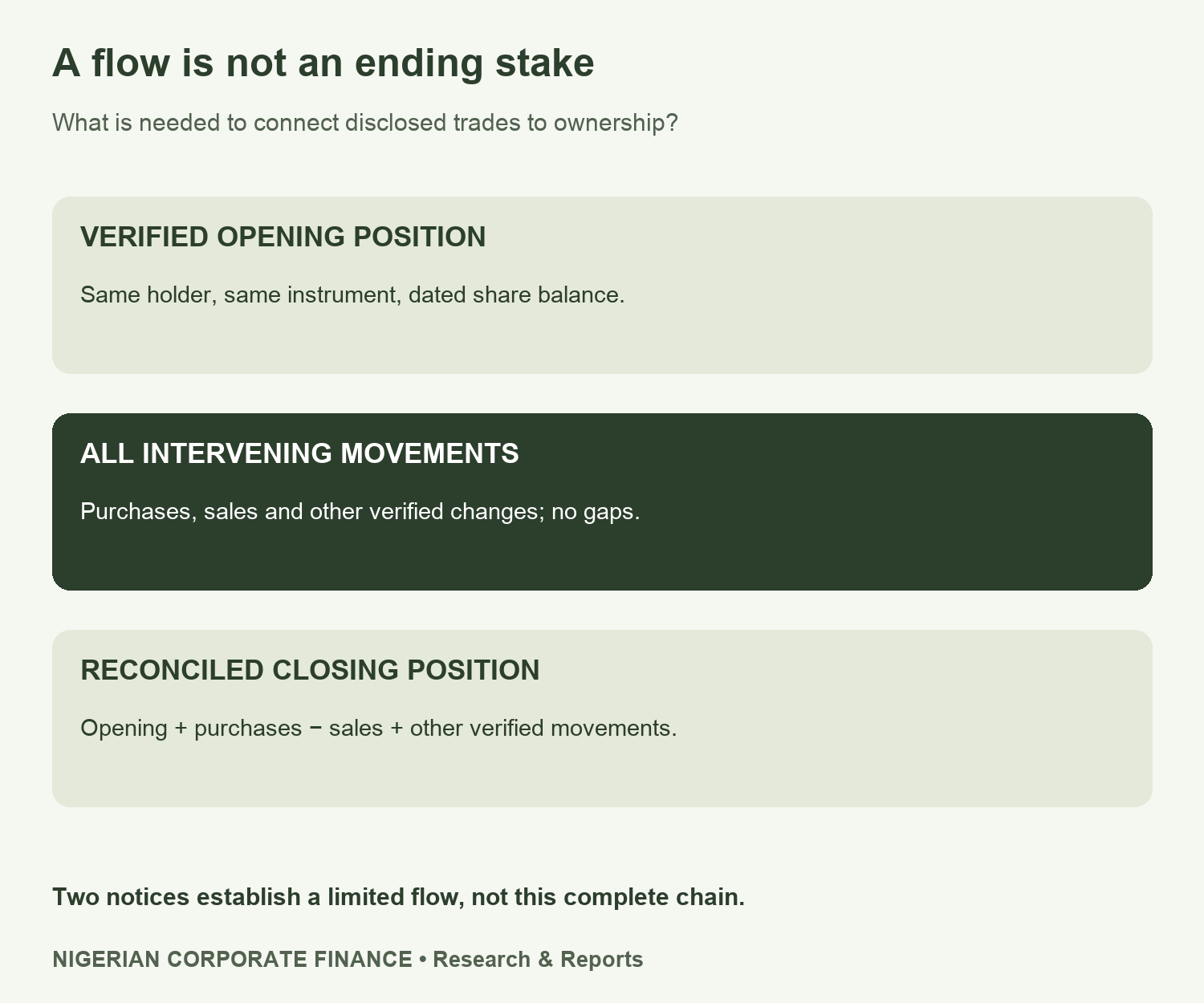
An ending stake needs a verified starting balance for the same holder and instrument, all relevant intervening movements and the appropriate share-count denominator. Missing transactions, corporate actions or other ownership changes can break a simple bridge. A net-flow total alone cannot supply those missing inputs.
The blank movement ledger leaves the opening and closing positions empty. Fill them only when supported by a complete, consistently dated record. Keep a source and amendment status beside each entry. Do not convert an unknown starting balance into zero merely to make the spreadsheet produce a number.
Use a disclosure audit rather than a motive story
An analyst can report the holder, window, disclosed directions, quantities and reproducible calculations. Those facts do not establish why the entity traded, whether its outlook changed or how the share price will behave. Buying is not automatically a confidence signal, and selling is not automatically a warning about the company.
For governance teams, the reusable task is to match entity, instrument, period and version before aggregation. Retain unresolved differences, identify the evidence needed and distinguish trade flows from ownership. Our related corporate governance coverage provides broader context; this case focuses on two-way notice reconciliation.
Methods, limits and downloadable tools
Calculations sum the six disclosed price-volume rows. Share movement uses purchases minus sales; consideration uses shares times row price; weighted prices use total consideration divided by total shares in each direction. Calculations retain unrounded values in the CSV and round the presentation separately.
No private trading ledger, acquisition-cost record or complete beneficial-ownership reconciliation was accessed. This is not a return calculation, compliance verdict, allegation or investment recommendation. The templates organise public evidence and questions without making a decision about an individual or predicting a market outcome.
- Six disclosed rows with dates and sources (CSV)
- Share, consideration and price reconciliation (CSV)
- Blank holder-movement evidence ledger (CSV)
- Price, extraction and ownership evidence checks (CSV)
Suggested citation: Nigerian Corporate Finance, “Chams Insider Dealings: Reconcile Purchases, Sales and Net Movement”, 16 November 2026. Sources: Creditville purchase and sale notices dated 9 November, listed by NGX on 10 November; calculations by this publication.


