




Unilever Nigeria interim dividend cash flow in 2026 provides a useful test for finance teams: profit, current-period cash generation and accumulated liquidity must be reviewed separately. The company reported ₦26.403bn profit after tax for nine months, but net operating cash was ₦10.261bn. That difference starts an investigation; it does not establish whether a dividend is safe or unsafe.
Our analysis reconstructs every reported cash-flow class, reconciles opening and closing cash, and provides a source register and private dividend-review worksheet. The aim is a better board discussion, rather than a recommendation to buy or sell shares.
Research edition: checked 27 October 2026. Company accounts cover the nine months ended 30 September 2026 and are unaudited. The dividend notice is dated 23 October. Values below are in naira billions unless the table specifies naira thousands.
Unilever Nigeria interim dividend cash flow: the 2026 announcement
The 23 October issuer notice proposes an interim dividend with qualification on 30 October and electronic payment scheduled for 18 November, subject to its stated registration and withholding-tax conditions. The issuer-authored earnings release carried by Proshare states ₦2.00 per ordinary share, totalling approximately ₦11.5bn.
A source-reading detail matters: the notice combines “N2.00” with the word “kobo”. We retain that wording issue in our source notes and use the issuer release’s explicit ₦2-per-share description. We do not interpret it as ₦0.02 or use a third-party dividend calendar to resolve the amount.
Crucially, this October announcement follows the September reporting date. The cash-flow statement’s dividend outflow through September belongs to earlier transactions. Treating the October proposal as already deducted from that closing balance would mix periods.
Reconcile the full cash movement before interpreting it
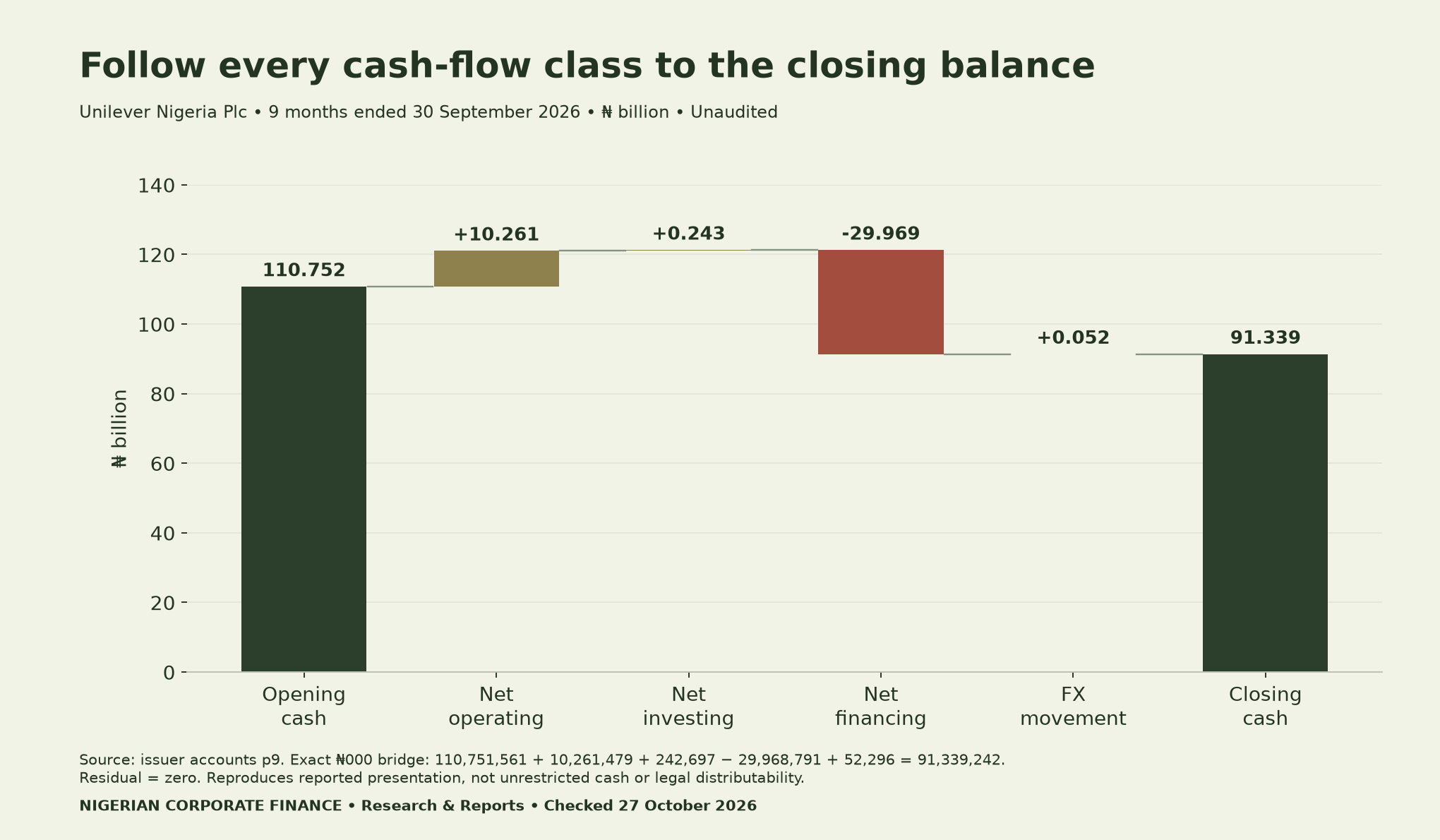
Page 9 of the primary interim accounts reports opening cash of ₦110.752bn and closing cash of ₦91.339bn. The difference is explained by operating, investing and financing cash flows plus exchange effects. Our calculation uses the original ₦000 values before rounding.
| Reported bridge line | Signed amount (₦000) |
|---|---|
| Opening cash, 1 January 2026 | 110,751,561 |
| Net operating cash | 10,261,479 |
| Net investing cash | 242,697 |
| Net financing cash | -29,968,791 |
| Exchange effects | 52,296 |
| Closing cash, 30 September 2026 | 91,339,242 |
| Reconciliation residual | 0 |
Each cash-flow section also reconciles to its reported subtotal. The operating section starts with cash generated from operations, then deducts retirement benefits, long-service obligations and tax payments. Tax paid alone is ₦20.403bn. Therefore, the final operating figure should not be confused with the earlier cash-generated subtotal.
The financing section includes a line described as additions to lease liabilities. We preserve the issuer’s published classification and every signed amount. This is a reproduction of the reported bridge, not an independent audit or a decision to reclassify that line.
Compare profit with cash without inventing a safety threshold
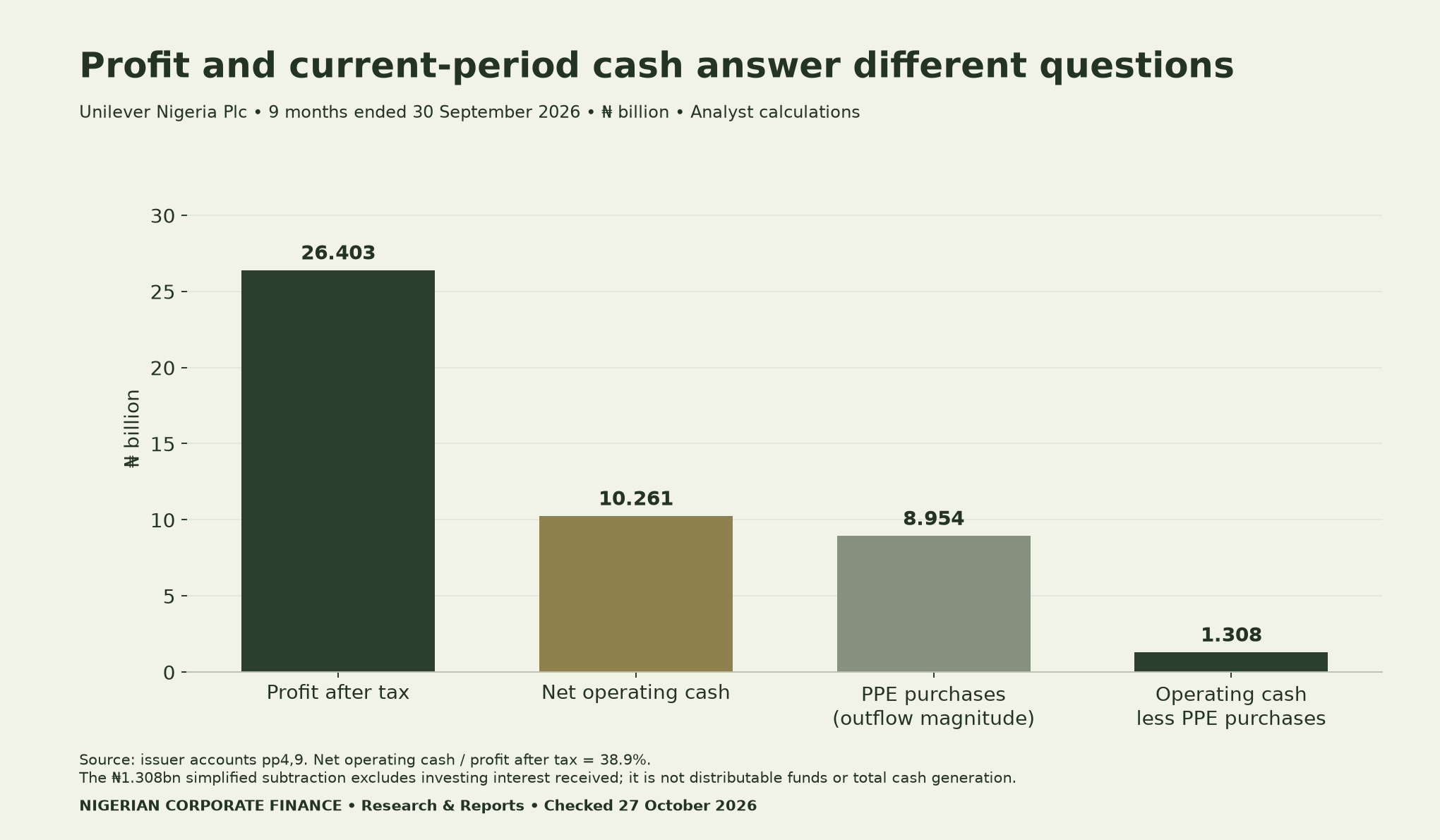
Net operating cash divided by profit after tax is 38.9%, calculated as 10,261,479 ÷ 26,402,720. The ratio describes this nine-month reporting period. It does not say that every naira of future profit will convert at the same rate, nor establish a universal payout limit.
Subtracting PPE purchases of ₦8.954bn from net operating cash leaves ₦1.308bn. More precisely, the difference is ₦1,307,688,000. We call this a simplified subtraction because other investing movements matter. It is not a measure of statutory distributable reserves or all funds available to the board.
For a finance director, the next questions concern timing: when will receivables be collected, which supplier payments are committed, and how much investment cannot be delayed? A single ratio cannot answer those questions. Avoid mechanically annualising nine-month figures to produce an unsupported year-end forecast.
Keep investing interest in the right place
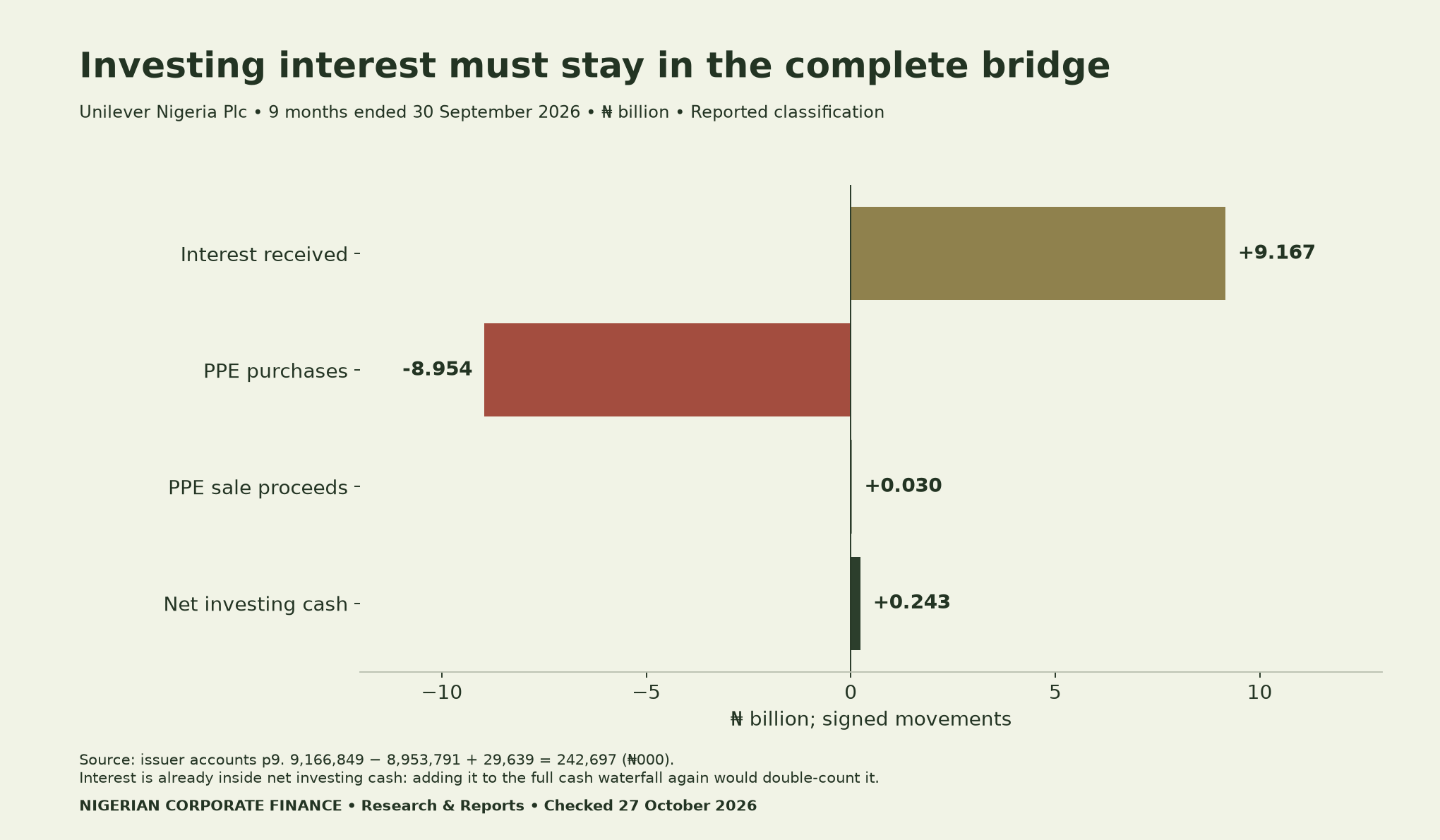
The company classifies ₦9.167bn interest received within investing cash flow. PPE purchases and asset-sale proceeds bring that section’s net movement to ₦0.243bn. The complete waterfall already includes that subtotal.
Consequently, adding the interest receipt again to the full cash bridge would double-count it. Conversely, describing operating cash less PPE purchases as the whole period’s cash generation would omit it. The useful approach is to name each measure and its boundary before discussing the result.

Reported cash and retained earnings need separate checks
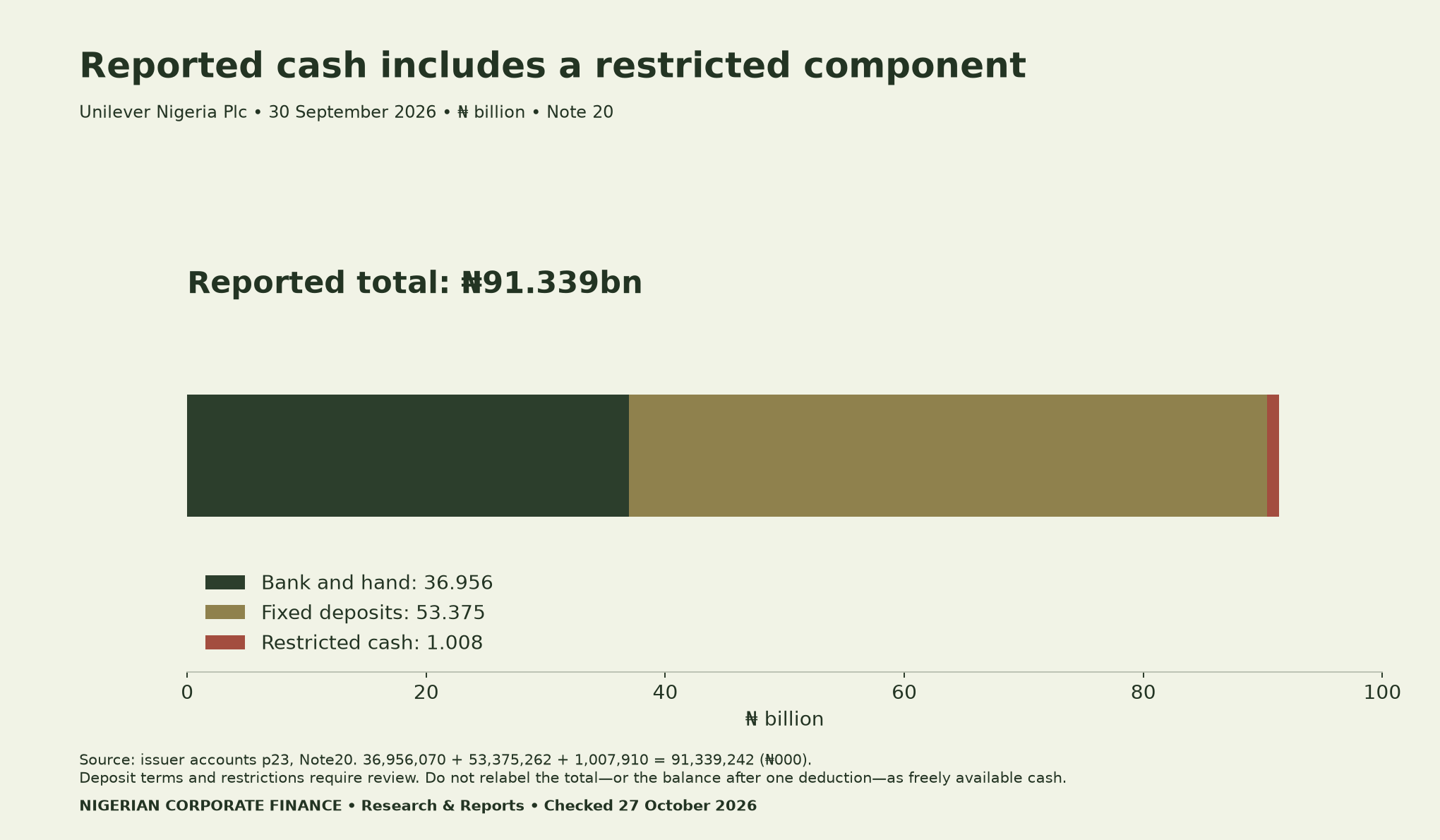
Note 20 splits the September cash balance into ₦36.956bn at bank and in hand, ₦53.375bn in fixed deposits and ₦1.008bn restricted cash. Those components sum to the reported ₦91.339bn. A label such as cash and cash equivalents does not make every component freely available for a distribution.
Removing only the restricted-cash line would still not establish immediate access to the remainder. Treasury needs deposit maturity, currency, restrictions and operational-payment information. The interim report cannot substitute for that internal schedule.
Likewise, reported retained earnings of ₦44.012bn are an accounting balance. We do not equate that balance with a qualified assessment of statutory distributability. Relevant legal, accounting and covenant questions belong with the appropriate professional reviewers and supporting documents.
Historical dividend payments are not the October proposal
Page 9 presents ₦30.161bn under dividend paid. Note 21.1 separately presents approximately ₦27.208bn paid to shareholders and ₦2.953bn withholding tax; together they match the cash-flow amount. Use the disclosure to trace the total, rather than adding both presentations as separate outflows.
The note also tracks dividend payable, including amounts with the registrar. A finance team should distinguish declared distributions, company cash transfers, withholding tax and final shareholder receipt. The simplified chart does not certify the last of those events.
Stress the assumptions explicitly
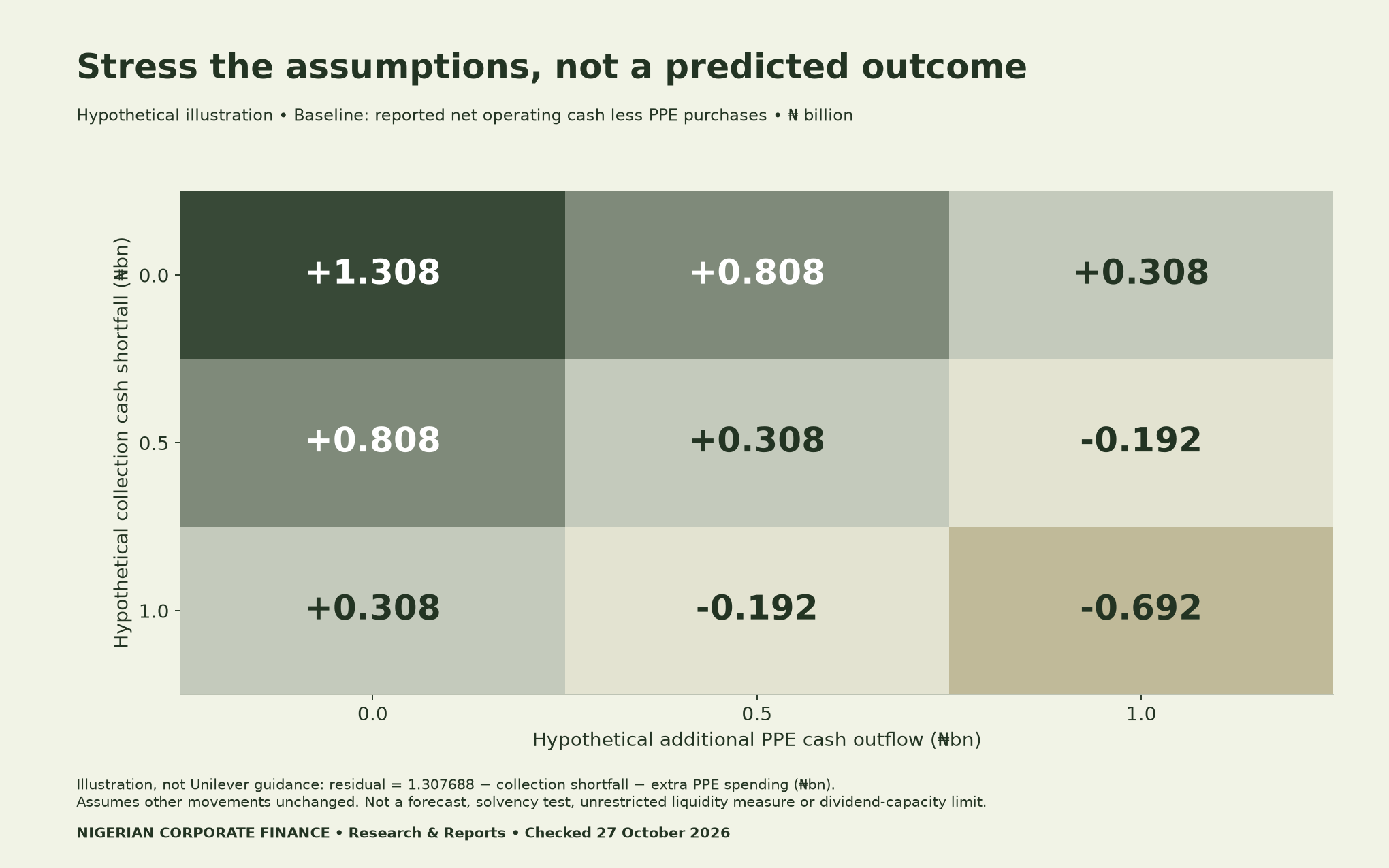
Figure 5 starts with the ₦1.307688bn operating-cash-less-PPE subtraction. It then deducts hypothetical collection shortfalls and additional PPE spending of zero, ₦0.5bn or ₦1bn. The figures are chosen illustrations, not company guidance, estimated probabilities or evidence that these shocks will occur.
For example, a ₦0.5bn collection shortfall and ₦0.5bn additional expenditure reduce that simplified residual to ₦0.308bn. Two ₦1bn changes produce −₦0.692bn. A negative cell is not a finding of insolvency: this deliberately narrow calculation excludes accumulated liquidity and other cash movements.
Before using this approach internally, replace the assumptions with a dated cash forecast and prevent overlap. A collection delay already embedded in forecast operating cash must not be deducted a second time. Record who owns each assumption and when it will be reviewed.
Use the Unilever Nigeria dividend cash-flow review worksheet
- Unilever cash source register and reconciliation values (CSV)
- Private dividend-review questions and evidence worksheet (CSV)
The register preserves original signed amounts, reporting units, source pages and classifications. The worksheet separates legal distributability, usable liquidity, covenants, committed investment, working capital and events after the reporting date. Keep confidential company inputs in your own copy; do not submit them to the website.
For the wider control process, see our guide to automating financial controls in Nigerian businesses. Our discussion of corporate reporting transparency provides context for documenting definitions and evidence.
Methodology and limits
We transcribed the issuer’s original naira-thousand values, checked section subtotals and the closing-cash identity, then divided by one million for billion-naira charts. Ratios use unrounded inputs. Historical accounts, the later announcement and hypothetical sensitivities remain separate throughout.
The analysis does not establish unrestricted availability, legal distributability, covenant compliance or future cash generation. It offers neither a dividend-safety verdict nor investment advice. Cite Nigerian Corporate Finance, analysis of Unilever Nigeria Plc’s unaudited nine-month 2026 accounts, pages 4, 7, 9 and Notes 20–21.1; checked 27 October 2026.


