





Paystack payout reconciliation Nigeria work needs three separate records: verified customer transactions, payout batches and bank credits. A successful payment is not the same record as cash arriving in your bank. A reliable reconciliation connects the records with evidence and leaves any unexplained difference visible.
Paystack payout reconciliation Nigeria: the current guidance
Paystack’s Getting your money help article, edited 19 November 2026, describes payout details, transaction activity and batches. It lists NGN automatic payouts in Nigeria as typically arriving the next working day, excluding weekends and public holidays. This is documented practice, not a new policy announced by the edit date.
Scope matters. An automatic bank payout is different from a manual balance arrangement. A typical schedule is also different from a universal twenty-four-hour promise. Check the actual payout status and the arrangement that applies to your business before treating an expected date as a confirmed bank receipt.
Verify payment before using it as a paid-order record
The official verification documentation distinguishes the API call’s success from the transaction status inside the response. The payment-flow guidance also explains why a callback or redirect alone is not proof of payment. Verification should use the confirmed transaction result and relevant amount and currency checks.
For a reconciliation export, retain stable order and transaction references. Decide how repeated notifications or repeated export rows are handled before summing amounts. A row that appears twice is not automatically a second sale. Equally, an order identifier and a provider transaction reference are not interchangeable keys.
Connect three ledgers with explicit matching rules
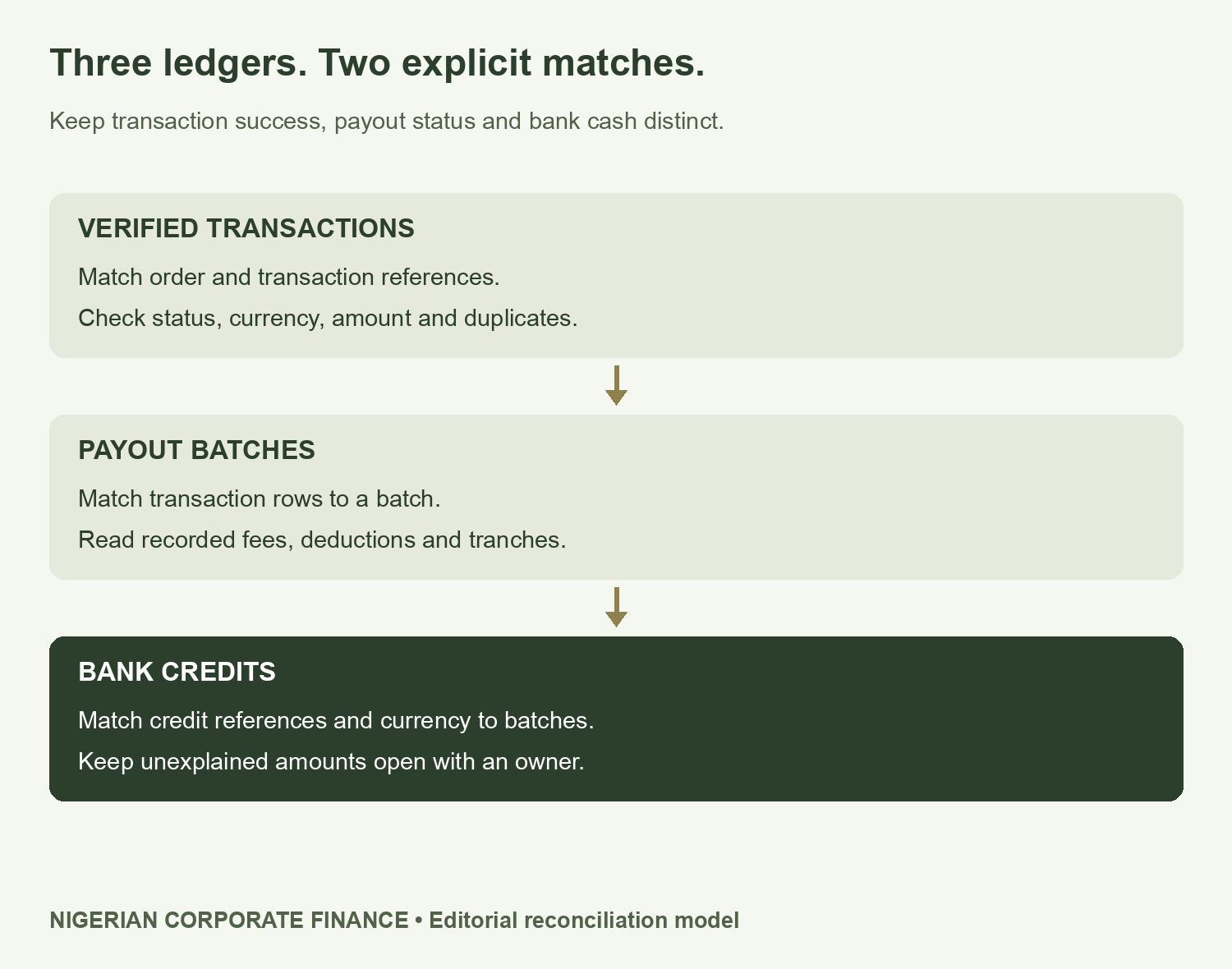
Start with the verified transaction ledger. Next, identify which batch contains each transaction and inspect the recorded deductions. Finally, match the batch to the relevant bank credits. Keep unmatched transactions, split credits and ambiguous references available for review rather than forcing every row into a single match.
Our files use invented references beginning EX. The baseline contains six NGN transactions totalling ₦1 million. Separate control-test rows deliberately repeat one reference and introduce a USD amount. Their role field tells you to exclude them from the baseline while testing whether your controls detect them.
A fictional batch: ₦1 million is not the expected bank credit
The baseline records ₦15,000 of fees and a ₦20,000 refund deduction. Subtracting both from ₦1 million leaves an expected net payout of ₦965,000. A matched bank credit of ₦950,000 leaves ₦15,000 unexplained. These are invented amounts, not a Paystack pricing example, a reported incident or evidence of loss.
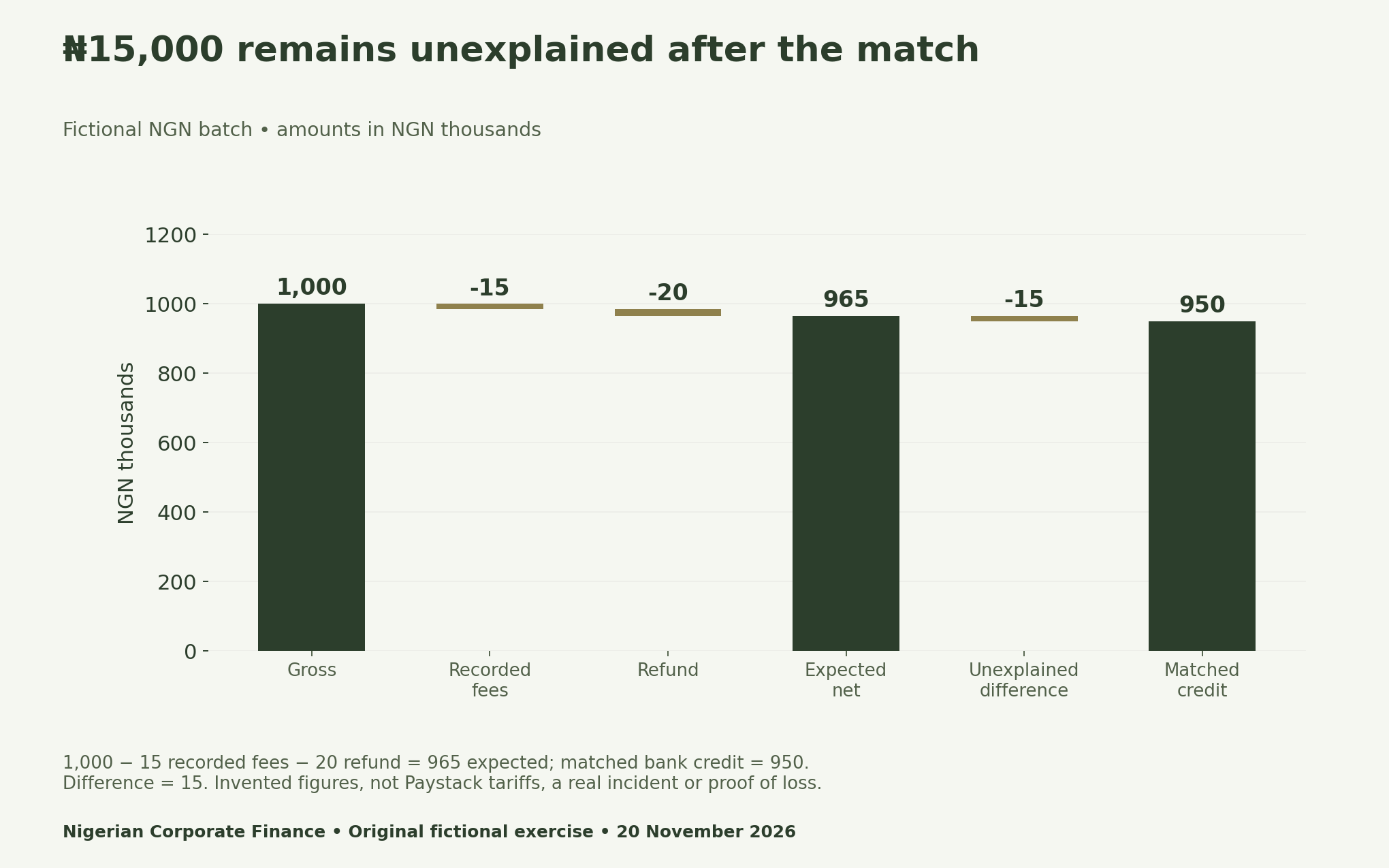
| Fictional item | NGN |
|---|---|
| Gross baseline transactions | 1,000,000 |
| Recorded fees | 15,000 |
| Refund deduction | 20,000 |
| Expected net | 965,000 |
| Matched bank credit | 950,000 |
| Unexplained difference | 15,000 |
Investigate the gap without inventing an adjustment
First check whether the bank match covers all relevant tranches and dates. Then inspect the batch’s actual deductions and status. Review reference formatting, currency and duplicate handling. A timing issue, incomplete match or missing export row needs evidence; do not label one as the cause just because it makes the figures fit.
If an amount is unresolved, give the exception an owner, an opening date and a next action. The example ageing file counts calendar days, not payout working days. Its one-day age is a tracking field and does not establish that a provider has missed its typical settlement schedule.
Test duplicates and mixed currencies separately
The duplicate test repeats EX-T01. A unique-reference check should flag it before aggregation. Review whether any repeated reference represents a duplicate export, a correction or another legitimate record type in your actual system. Do not delete a real row solely because the exercise uses a simple one-reference rule.
The USD test row must stay outside the NGN total. Adding unlike currencies produces a number with no useful monetary unit. Keep each currency separate until an explicit conversion policy, rate, date and accounting purpose are supplied. Our exercise performs no foreign-exchange conversion.
Keep operational evidence private
The public files contain no real customer names, emails, bank details, secrets or transaction identifiers. A business investigation should use approved access and secure evidence channels. Share the necessary batch context with the relevant support team without publishing customer records in a public spreadsheet or portfolio.
Our UAC disposal accounting analysis applies a related habit: distinguish the amount you have from the amount you want to infer. For payouts, a verified sale, an expected settlement and matched bank cash are different evidence points.
Download the fictional reconciliation files
- Fictional transaction ledger with two control-test rows (CSV)
- Fictional payout batch and reconciliation calculation (CSV)
- Fictional matched bank-credit ledger (CSV)
- Fictional examples and blank exception-ageing row (CSV)
Methodology and limits
We checked the linked Paystack help and developer documentation on 20 November 2026. All exercise transactions, references, deductions and credits were created for this article. The baseline uses only rows labelled baseline and NGN. Recorded fees sum to ₦15,000; the refund deduction is recorded at batch level.
This Paystack payout reconciliation Nigeria guide teaches matching and exception controls. It does not audit a merchant account, identify a real provider fault or authorise an adjustment to live books. Use actual exported evidence and your organisation’s review process before resolving a real difference.


