





UAC disposal accounting starts with a distinction: a completed sale is not a disclosed disposal gain. UAC’s November notices confirm two exits. The earlier September accounts supply carrying-value schedules. Those documents answer different questions, and combining them carelessly can produce a confident but unsupported profit headline.
UAC disposal accounting: what the completion notices confirm
UAC’s 17 November notice confirms the sale of its 73.29% interest in Livestock Feeds to Sunbeth Treenuts and Sesame Limited. Its 18 November notice confirms the sale of its 43% DP World Logistics interest to 22 Plus Invest Limited, a TGI Group member. Neither notice states consideration or a disposal gain.
Keep those statements bounded to the documents. “Not disclosed in these notices” is different from “no price exists” or “no price has been published anywhere.” Our exercise reconciles the selected accounts and notices; it does not estimate a transaction price or replace completion-date financial reporting.
Read the September statement boundary first
The unaudited statements for the period ended 30 September 2026 predate both November completion notices. Notes 16 and 33 distinguish an associate investment from a subsidiary disposal group. The source schedules use NGN thousands. Our charts convert to NGN millions by dividing each value by one thousand.
A reporting date is a measurement boundary. A later completion announcement does not automatically update every September balance to its value at completion. Retain the original date beside each extracted figure so a reviewer can see whether two numbers actually belong in the same calculation.
Rebuild the associate-investment bridge
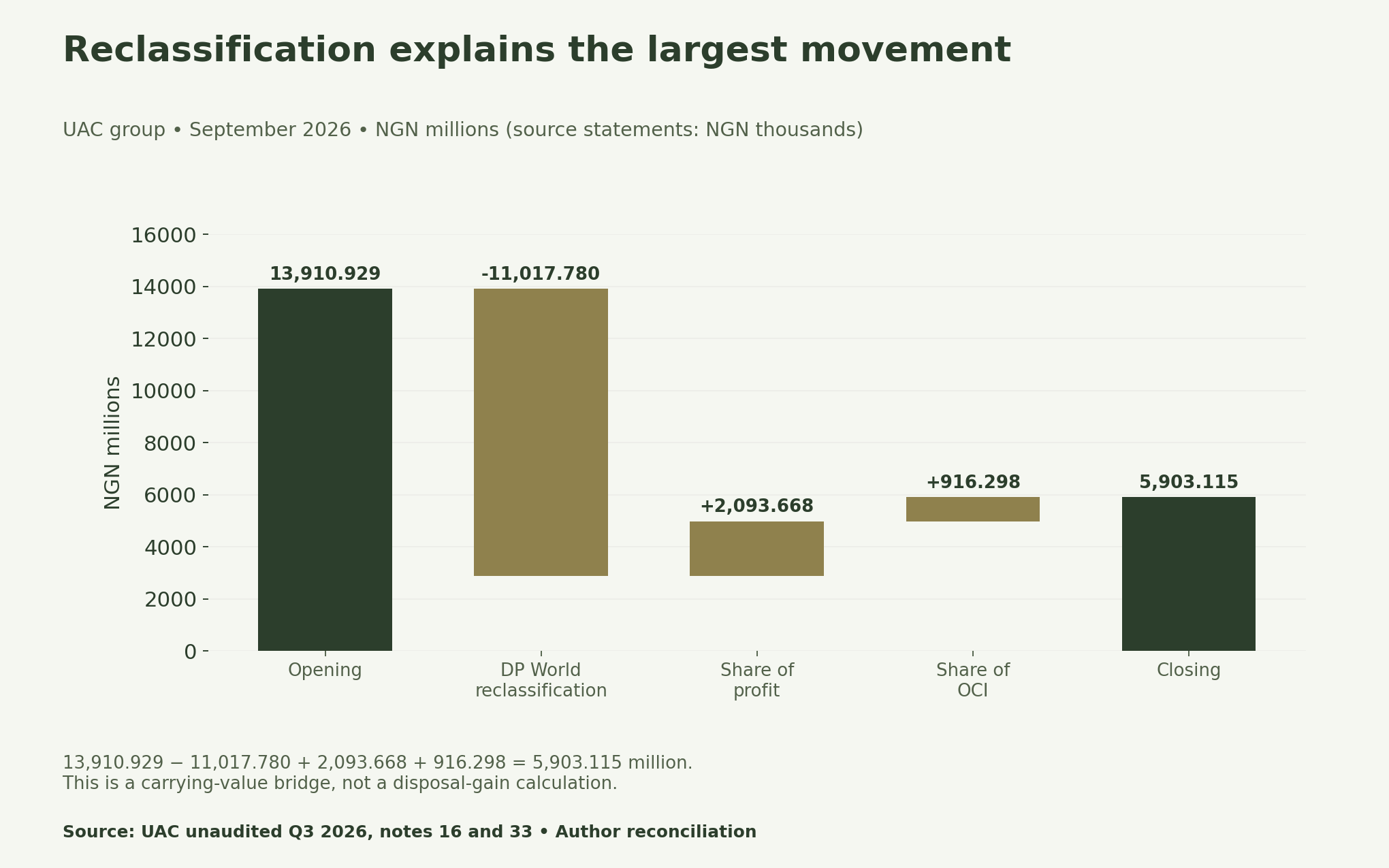
In source units, the bridge is 13,910,929 minus 11,017,780 plus 2,093,668 plus 916,298, giving 5,903,115. The main reduction is the reclassification of the DP World carrying amount. Do not describe the entire decrease as cash leaving the group or a disposal loss.
A bridge should identify every movement and its destination. Here, the transferred amount appears in the held-for-sale schedule. If you only compare opening and closing associate balances, you miss that connection and risk confusing a classification change with an economic result.
Follow the same transfer into held-for-sale assets
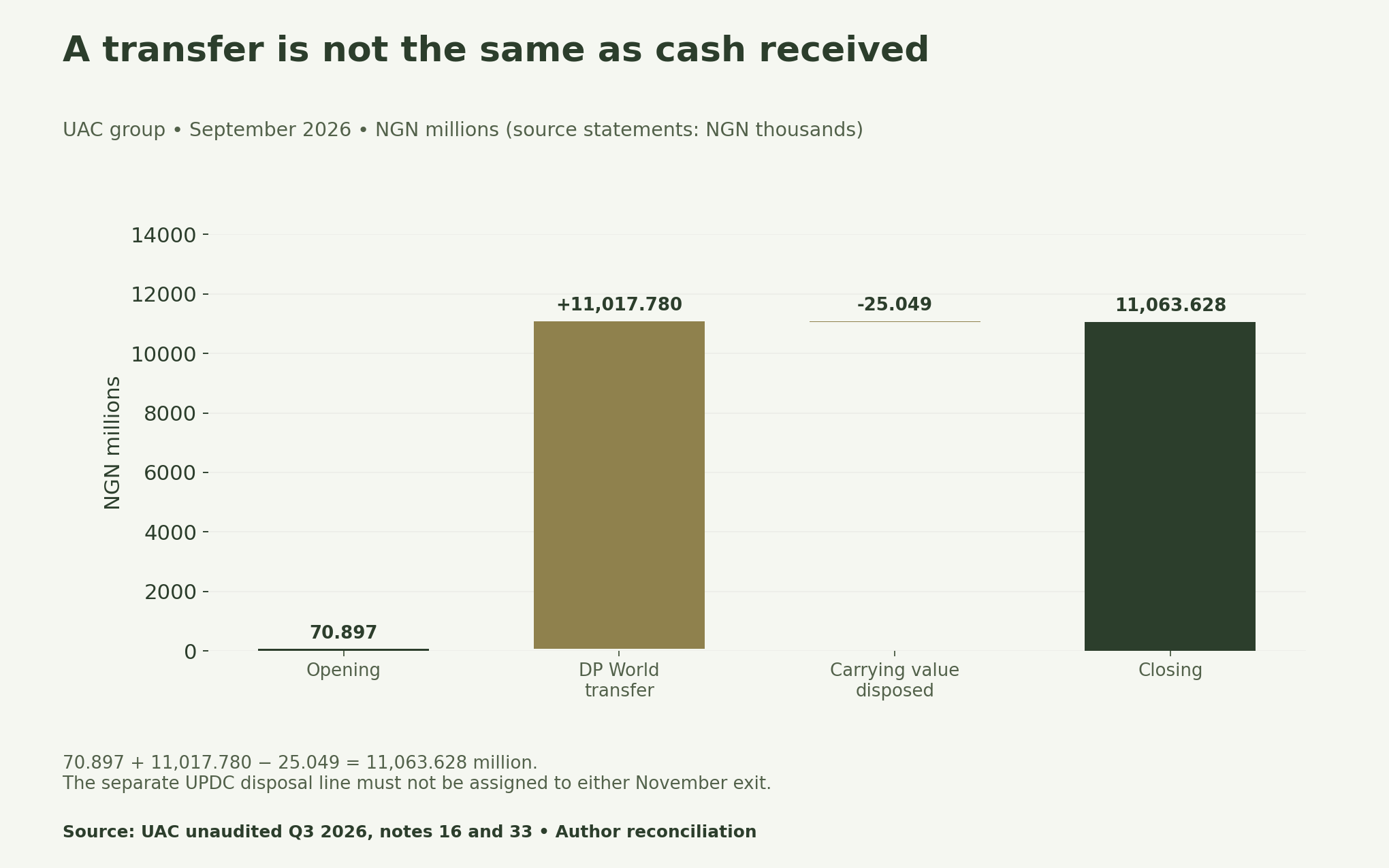
The second source-unit calculation is 70,897 plus 11,017,780 minus 25,049, giving 11,063,628. It connects the two notes without inventing a sale receipt. Note 33 separately associates the reported NGN 146.9 million gain with UPDC share disposals, rather than either November exit.
Assign an extracted gain to its named transaction before using it in a headline. Nearby text and a similar accounting label are not enough. Your register should retain the business, note, date, unit and description so another analyst can challenge a mistaken join.
Do not turn the Livestock group balance into UAC’s price
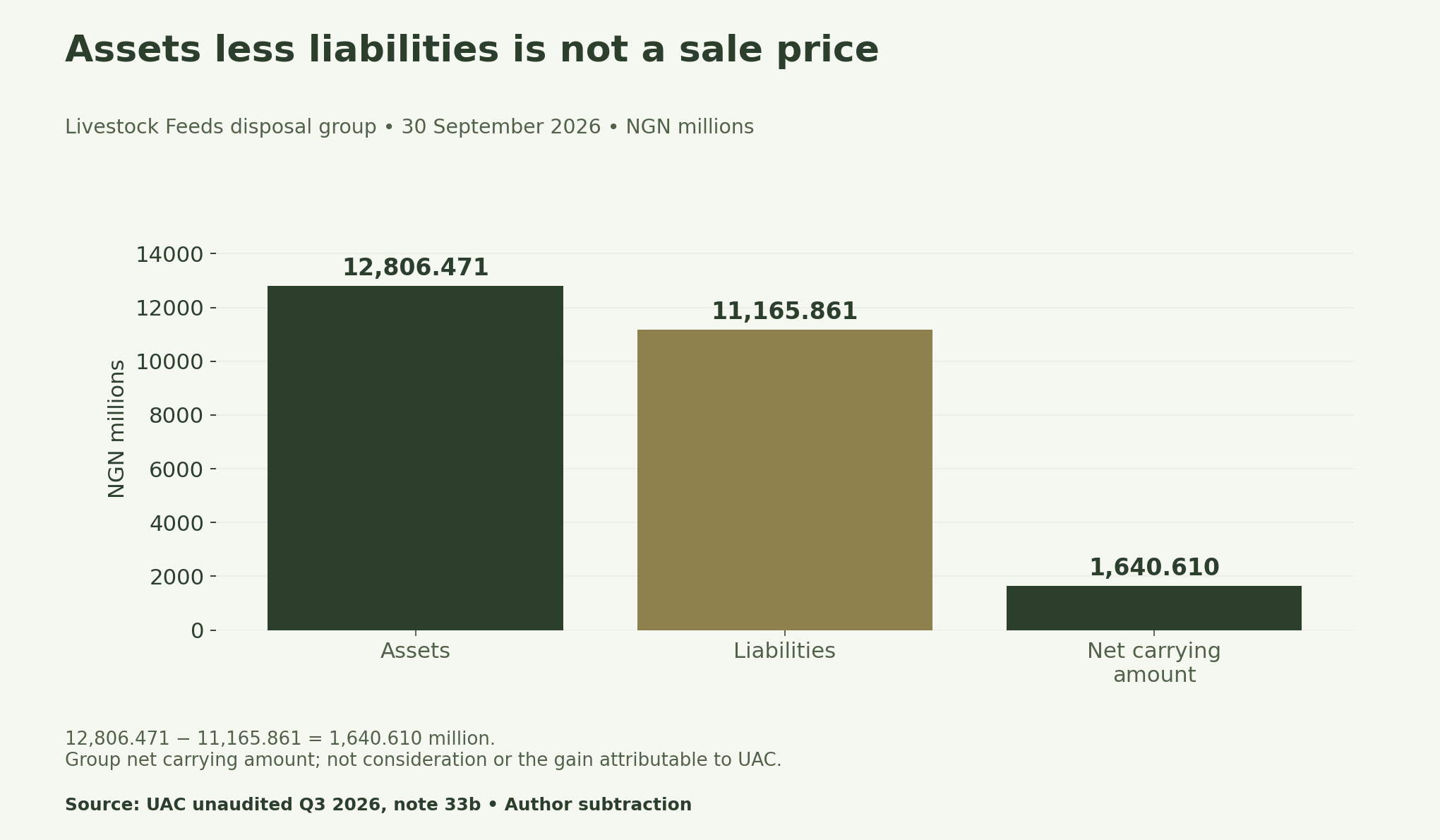
The subtraction gives a useful check on the disposal-group schedule. It does not establish consideration. Multiplying a book balance by the percentage sold does not recover a negotiated price, and it cannot supply missing costs, tax, completion-date balances or other required accounting adjustments.
Use a dated evidence register before claiming a gain
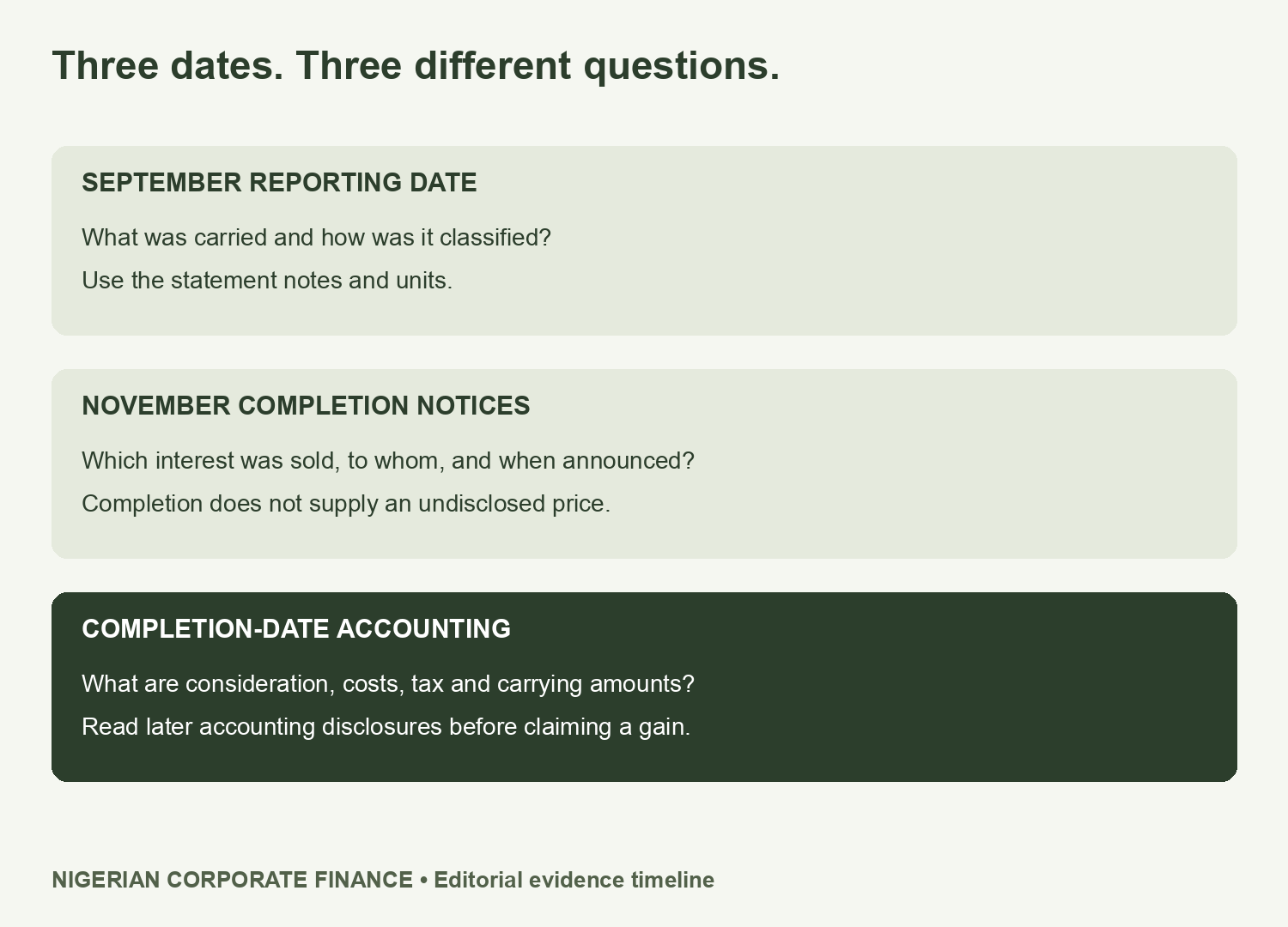
For a gain analysis, identify the completion-date accounting basis, consideration, relevant carrying amounts and any costs, tax or other adjustments. In a cash analysis, establish what was received and when. For a debt-reduction claim, find the actual financing and cash-flow evidence. One question’s evidence does not automatically answer the others.
Mark an unavailable item as unknown. Do not use zero as a substitute for an undisclosed fee or tax amount. Zero is a numerical claim, while unknown describes an evidence gap. A clear gap is more useful to a reviewer than a model that balances only because missing inputs were silently removed.
Download the source register and reconciliations
- September source values with note references (CSV)
- Reproducible bridge and net-carrying calculations (CSV)
- Two completion notices and disclosure fields (CSV)
- Blank disposal evidence register with example (CSV)
Methodology and limits
We checked the linked issuer notices and statement notes on 20 November 2026. We transcribed the selected figures at source precision, retained their units and recomputed the bridges. Charts show millions; CSV calculations retain thousands and include naira conversions. These checks reconcile selected disclosures, rather than audit the full accounts.
For further context, see our guide to reading financial-statement notes. This UAC disposal accounting analysis is an educational document-reconciliation exercise, not a valuation, transaction-accounting opinion or investment recommendation. Later disclosures may supply evidence absent from the selected notices.


