





Nigerian payment integration ROI starts with a cash-flow question: which bills change if the business buys the system? Faster reconciliation may release useful staff time. However, it does not automatically reduce payroll or recover an implementation outlay.
This report keeps three evidence types separate: a dated company survey, a fictional payback model and a proposed pilot worksheet. The examples show how to challenge a software business case. They do not establish that a particular platform will save money for your business.
Nigerian payment integration ROI: read the survey base first
Visa’s company-issued release, hosted by Premium Times on 11 November 2026, describes March–April face-to-face research across 11 markets, including 251 Nigerian SMEs. It reports 29% using integrated tools and 94% finding an all-in-one solution appealing. Its 88% efficiency-gain figure concerns existing users, not all 251 businesses.
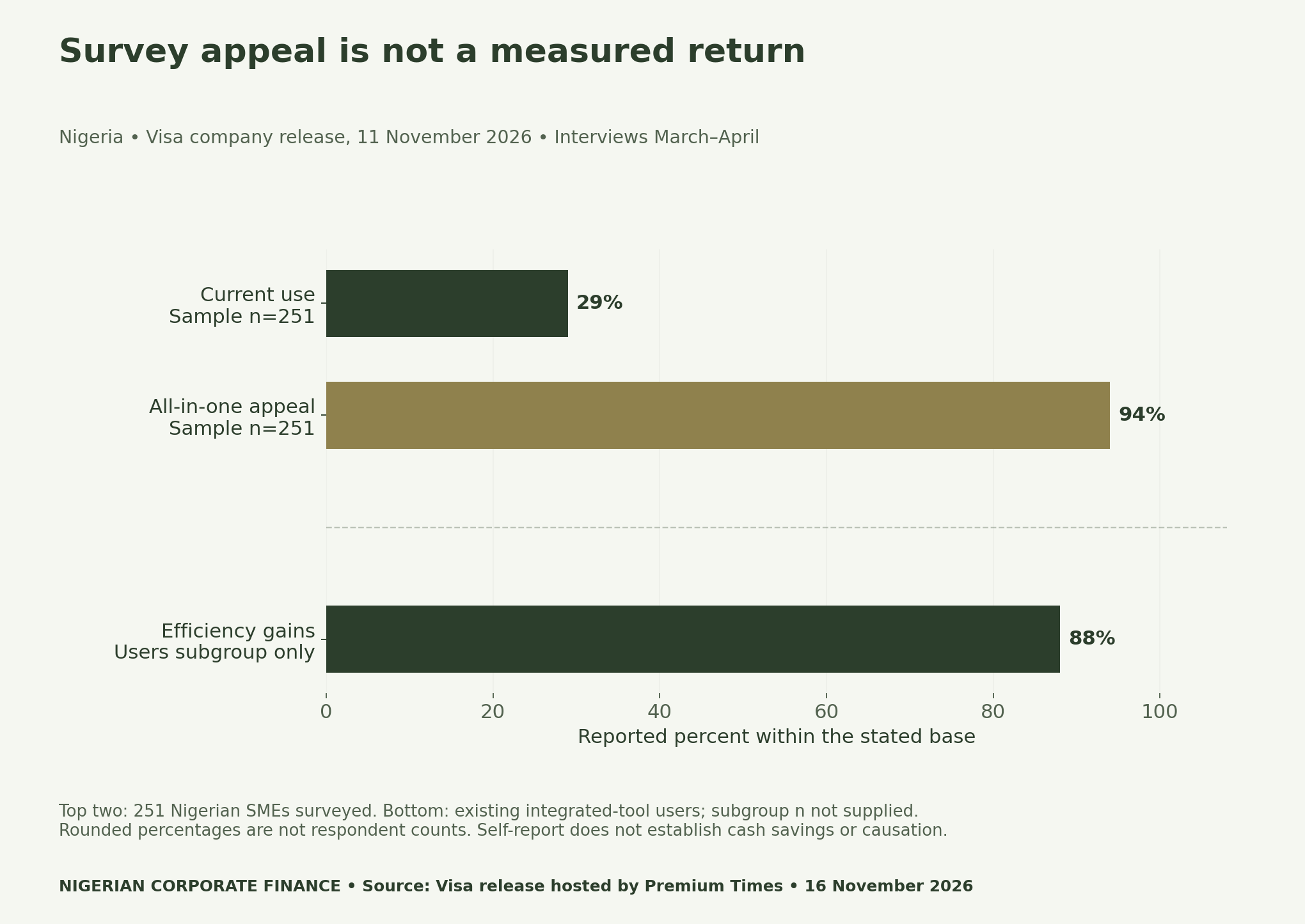
The full questionnaire, raw responses and detailed sampling information were not retrieved. This promotional first-party source does not demonstrate representative national ROI, causal savings or purchase intent. Rounded percentages should not be converted into exact respondent counts.
Separate cash avoided from capacity released
Begin with the current workflow. Record the task, its owner, the cash cost and the evidence supporting that cost. Then write down exactly what changes under the proposed arrangement. A subscription cancelled after migration differs from a salary that continues unchanged.
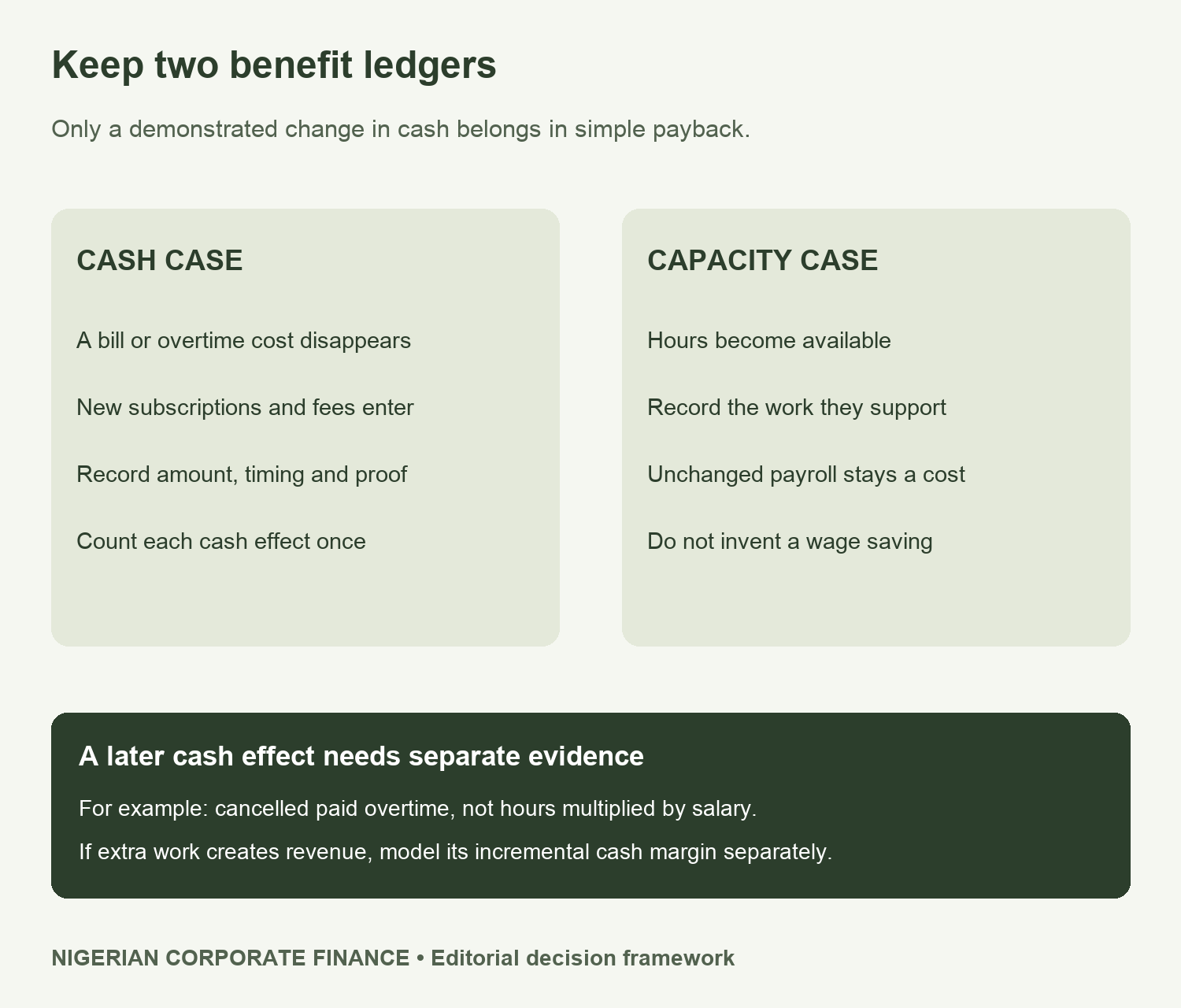
For example, staff might spend fewer hours matching receipts but remain on the same salary. Those hours can improve service or allow other work. Record that capacity benefit separately. If paid overtime genuinely ends, the cancelled payment may support a cash saving, provided the underlying records confirm it.
Likewise, a claim that extra capacity will generate sales needs its own evidence. Revenue is not cash margin: additional stock, fulfilment and collection timing may matter. Do not add the value of released hours and the same avoided wage payment to one benefit total.
Build the incremental cost schedule
Compare the proposed system with a documented baseline over the same activity volume and time period. Include costs that arise because of the change, and remove costs only when they actually stop. This prevents a lower headline subscription from hiding migration or transaction charges.
| Cost area | Question for the cash case | Evidence to retain |
|---|---|---|
| Setup and migration | Which one-off payments are incremental? | Scope, quote and payment dates |
| Training and parallel operation | Are these paid costs or existing staff capacity? | Invoices, overtime approval and transition schedule |
| Subscriptions and transaction fees | What changes at the same stated volume? | Both fee schedules and volume assumptions |
| Retired services | Will the old charge actually cease? | Cancellation terms and end date |
| Exit and data export | What would switching away cost? | Contract, export test and priced exit terms |
Keep any working-capital timing change in a separate dated schedule. For instance, collecting a receipt earlier differs from reducing a recurring expense. It may improve cash timing without creating an equal permanent monthly saving. Avoid combining a one-time release with a repeating benefit.
Reproduce the fictional 40-month payback
Assume a wholly fictional upfront cost of ₦1.2m. Also assume ₦60,000 of monthly cash costs really disappear and added recurring charges are ₦30,000 a month. The net recurring benefit is ₦60,000 − ₦30,000 = ₦30,000. At a constant benefit, ₦1.2m ÷ ₦30,000 gives 40 months.
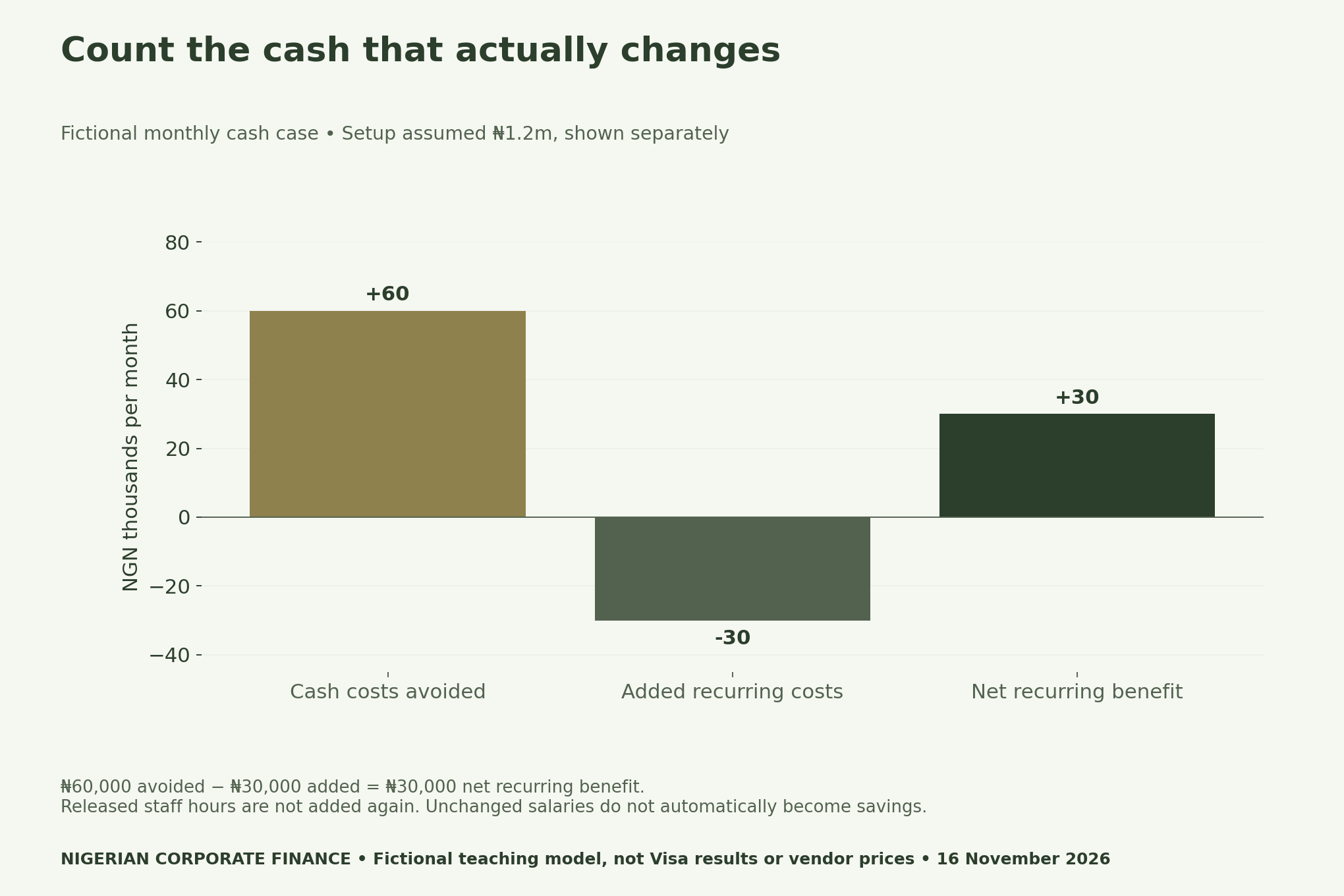
The fraction assumes cash benefit accrues evenly through each month. If receipts arrive only at month-end, recovery occurs at the relevant completed monthly payment. A delayed start, changing volume or later outlay requires a dated cumulative cash schedule instead of this division.
Stress-test the savings before calling the case attractive
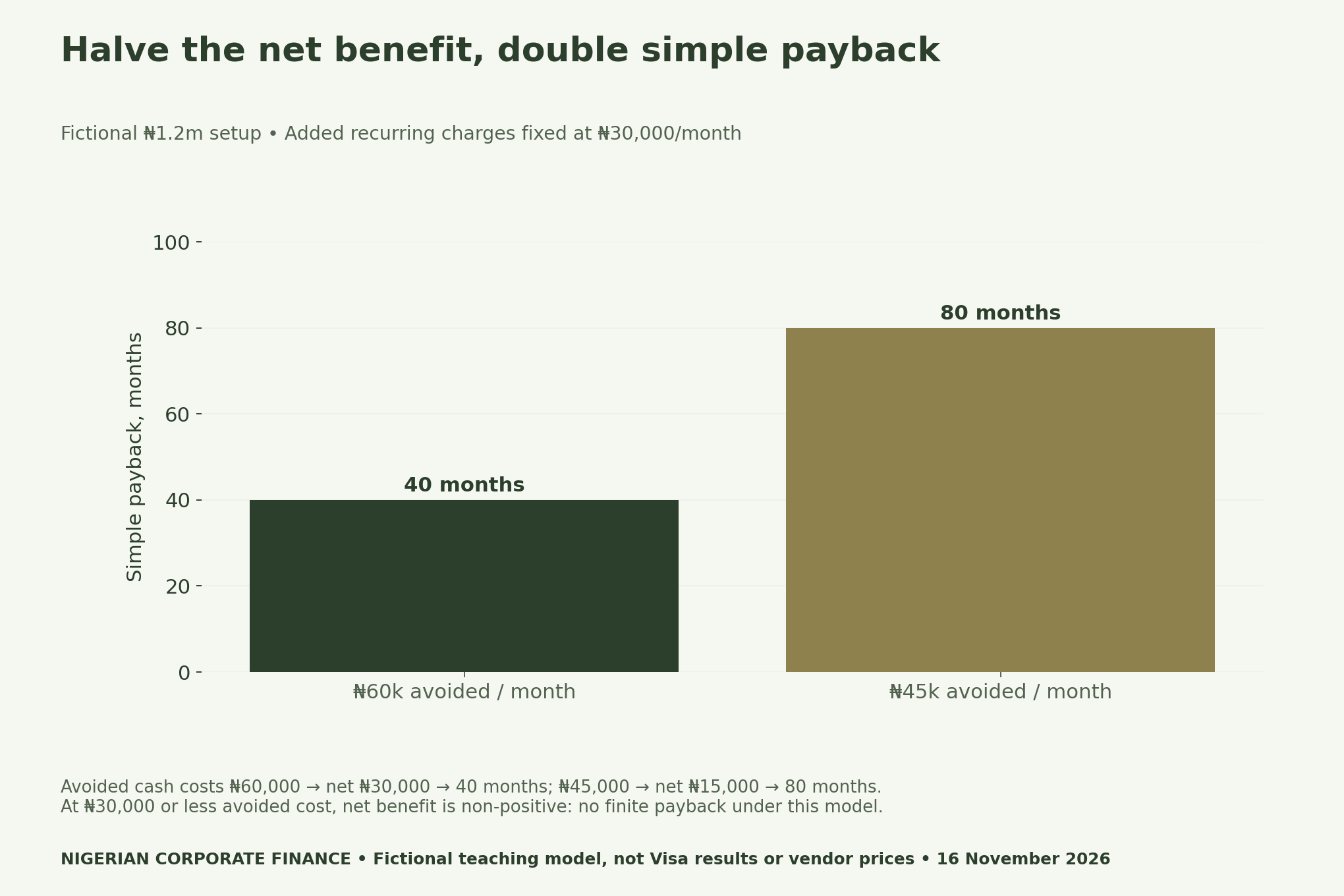
If avoided costs fall to ₦45,000 while charges remain ₦30,000, net benefit halves to ₦15,000. Consequently, simple payback doubles to 80 months. At ₦30,000 avoided costs, the recurring benefit is zero. Below that threshold, the recurring cash effect is negative; neither case recovers a positive setup outlay in this constant-benefit model.
| Fictional avoided cost/month | Added cost/month | Net benefit/month | Simple payback |
|---|---|---|---|
| ₦60,000 | ₦30,000 | ₦30,000 | 40 months |
| ₦45,000 | ₦30,000 | ₦15,000 | 80 months |
| ₦30,000 | ₦30,000 | ₦0 | No finite payback |
| ₦20,000 | ₦30,000 | −₦10,000 | No finite payback |
Try the teaching payback checker
Use the checker to explore assumptions without entering personal or confidential business information. It calculates only constant-benefit simple payback. It does not value staff hours, forecast vendor performance or recommend a purchase.
Fictional payback arithmetic
Press Calculate to display fictional payback.
Simple payback is a screening measure, not a full return
ACCA’s payback guidance explains the recovery-period approach and its limits. Simple payback ignores the time value of money and cash flows after recovery. Therefore, a short recovery period alone does not establish overall value or a percentage ROI.
Before using a real business case, match the analysis horizon to the expected useful life and contract. Document benefit timing, later costs, tax treatment and uncertainty. A discounted cash-flow extension needs a justified rate and complete dated cash flows; this report invents neither a Nigerian standard rate nor an acceptable payback threshold.
Plan a bounded pilot and preserve the exit route
A proposed pilot can compare a documented baseline with a permissioned trial at a stated volume. Log reconciliation time, exceptions, actual charges and evidence of any cancelled cash payment. Also record changed demand or staffing, because a before-and-after difference alone may have other causes.
Set success criteria and a stop decision before the trial begins. Check permissions, security, data export, continuity and supplier dependence separately from the financial calculation. No pilot has run for this report. The blank log supports planning; it contains no measured performance results.
Our broader guide to digital transformation and financial efficiency discusses system changes. This report adds an evidence-to-cash test for a specific buying decision, rather than assuming integration itself creates a return.
Methods, limitations and free CSV tools
The survey chart preserves the published bases and rounded percentages without deriving counts. The numerical model is entirely fictional: monthly net benefit equals cash costs avoided less added recurring cash costs. Positive constant net benefit divides into the positive setup cost; zero or negative benefit produces no finite recovery in this model.
The four files separate reported survey measures, invented calculations and blank planning tools. They do not contain supplier quotes, private business data, a completed pilot or verified savings. Obtain appropriate financial, contract and security review before a real implementation decision.
- Survey measures, bases and source (CSV)
- Fictional payback scenarios and calculations (CSV)
- Blank integration cash-case worksheet (CSV)
- Proposed blank pilot evidence log (CSV)
Suggested citation: Nigerian Corporate Finance, “Nigerian Payment Integration ROI: Separate Cash Savings From Staff Time Released”, 16 November 2026. Dated first-party survey release plus separate fictional editorial calculations.


