







The Airtel Africa November 2026 buyback limit for the remaining board programme is 12,033,748 ordinary shares. A separate, broader shareholder authority has 352,727,390 shares remaining. Do not add these limits or treat the larger number as a commitment for this tranche. Neither number, on its own, establishes completed purchases or actual cash spent.
Airtel’s 5 November announcement provides an issuer-specific control map: general authority, the narrower programme, broker arrangements, purchases and cancellations. For Nigerian analysts, it also makes an important venue distinction. The notice explicitly says no repurchases will occur on NGX. A Nigerian listing is not evidence that buyback orders will be placed on that exchange.
Research checked on 8 November 2026. This educational reading guide analyses announcement terms, not trading opportunities or a completed execution audit. It does not assess legal compliance or generalise this UK-incorporated issuer’s arrangements into Nigerian company law.
Read the Airtel Africa November 2026 buyback limit by scope
The official commencement notice hosted by NGX describes a programme originally announced on 22 May 2026, covering up to 1% of issued capital at that date. After its initial tranche, the remaining board programme authority permits up to 12,033,748 shares. The company describes that as 0.33% of issued capital at 22 May. Keep the historical reference date attached to the percentage.
| Remaining limit | Ordinary shares | Scope / reference |
|---|---|---|
| Board programme | 12,033,748 | Programme announced 22 May; remaining on 5 November |
| General shareholder authority | 352,727,390 | Broader authority approved at 9 July AGM; remaining on 5 November |
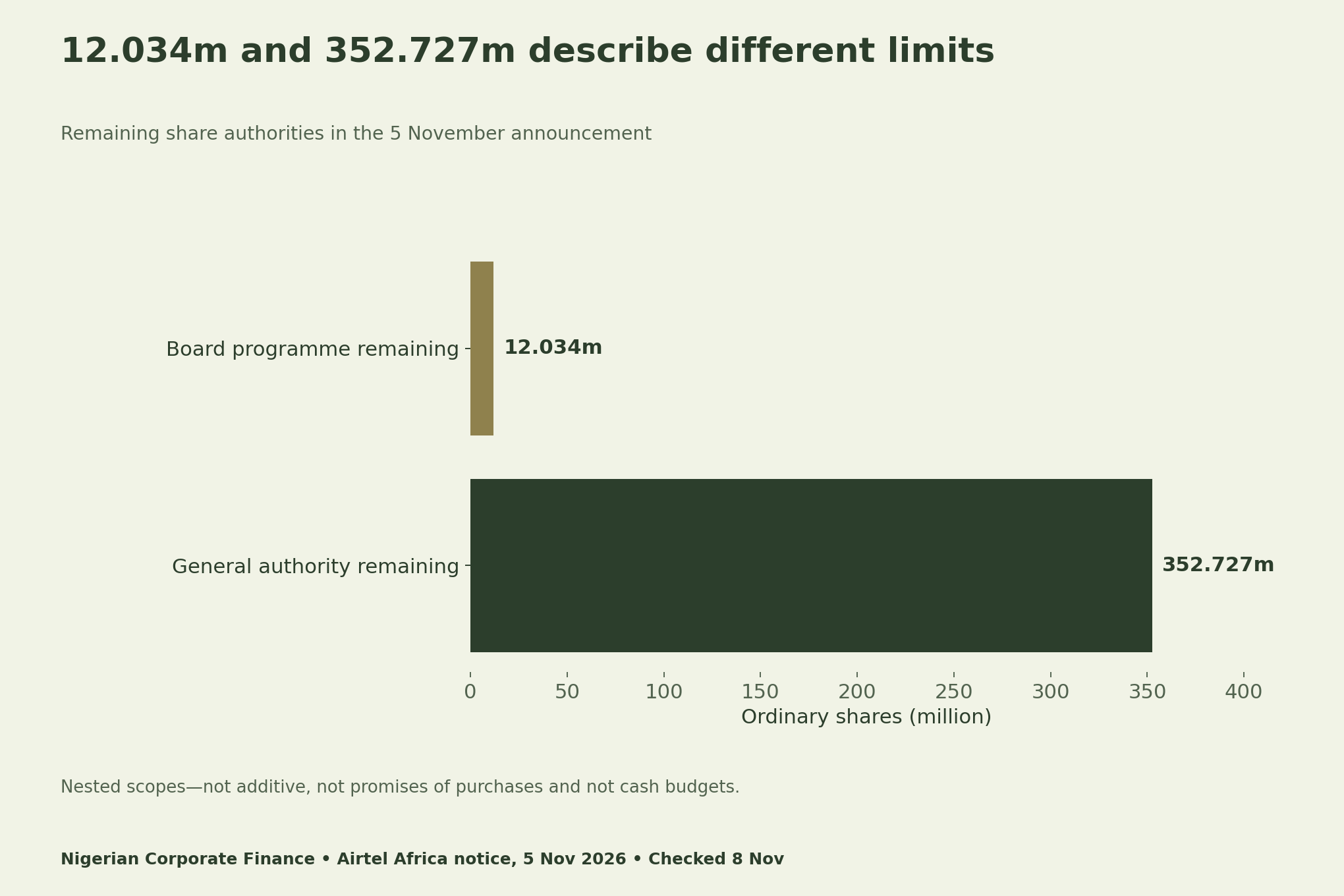
A useful register has one row per permission and a field describing what that permission covers. Otherwise, a spreadsheet can combine unlike figures simply because both use shares. A larger general ceiling does not override the narrower programme terms or promise that the company will use all available authority.
Keep the general-authority bridge within one definition
The notice states an original general shareholder authority of 364,577,234 shares and a remaining amount of 352,727,390. Subtraction gives 11,849,844 shares. This is an arithmetic reduction in that stated general authority. It is not a full reconciliation of every programme purchase, cancellation or share-capital movement.
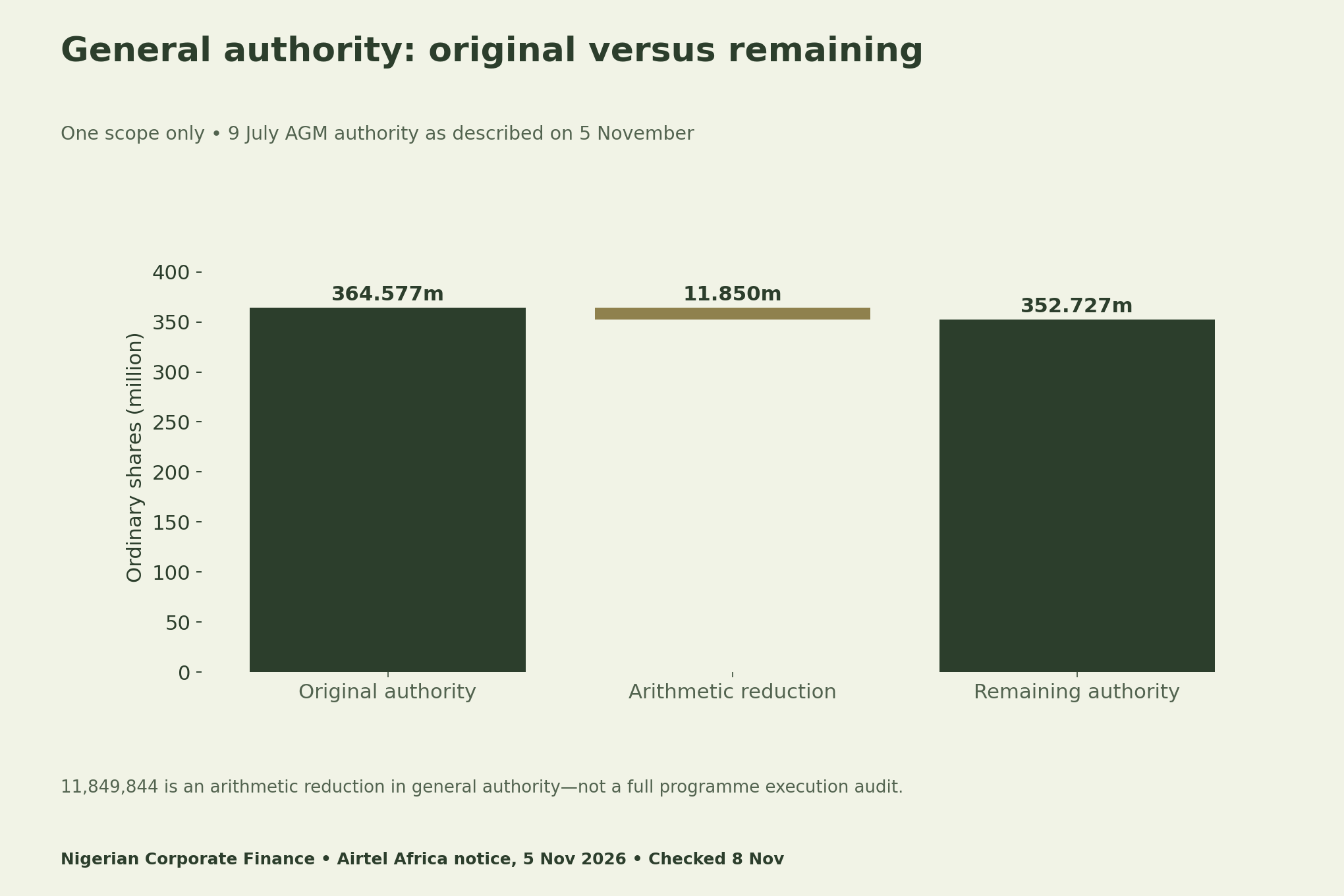
To reconcile purchases properly, identify each transaction period, the authority used and subsequent capital evidence. A prior transaction may relate to an earlier tranche or reporting interval. Keep those records separate until the definitions and dates match. The blank execution register supports that work but contains no invented transactions.
Follow the layers from permission to cancellation
Airtel says it entered agreements with Citi for the further tranche. Citi acts as riskless principal under the issuer’s arrangements. The notice describes two parallel elements: one with independent trading decisions by Citi and another under which the company may provide purchase instructions subject to the stated conditions. These are issuer descriptions, not a universal legal rule for buybacks.
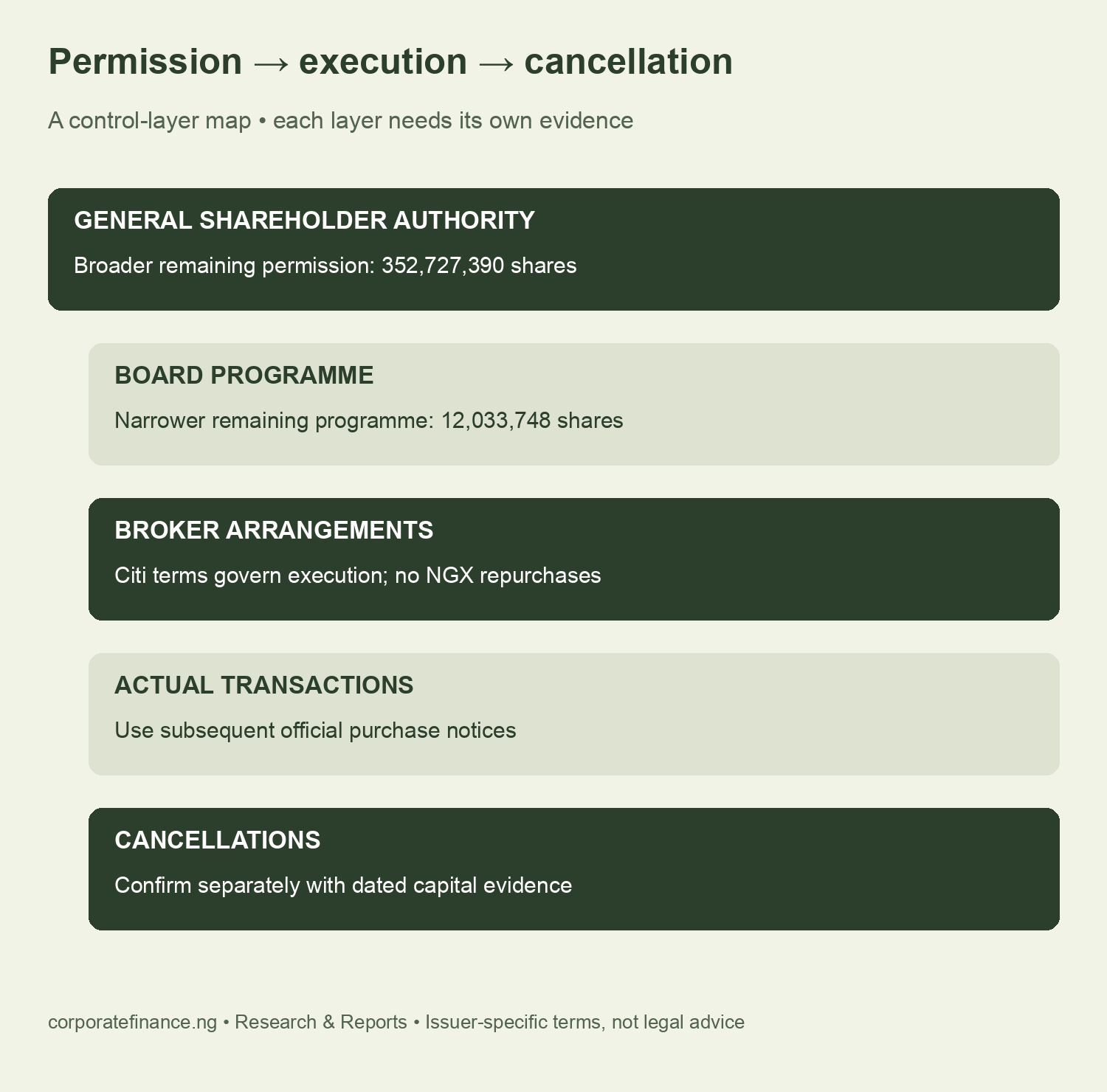
The announcement expects the agreements to terminate no later than 22 December 2026, unless ended earlier under their terms. It says programme purchases will be cancelled to reduce capital. An announced intention to cancel is different from evidence that a particular purchase and cancellation have already occurred. Track each with its own source and date.
The notice also describes arrangements that may allow autonomous operation during closed periods. Readers applying those terms need the actual agreements and current professional advice. This article does not test a trade against market-abuse rules, interpret broker obligations or advise anyone to transact.
A share limit does not establish a cash budget
Cash required depends on the number of shares actually purchased and their actual prices, with any applicable costs. The cap alone supplies neither. To demonstrate that distinction, our sensitivity uses the entire remaining programme cap and deliberately hypothetical prices of £2, £3 and £4 per share. These are editorial assumptions, not observed prices or forecasts.
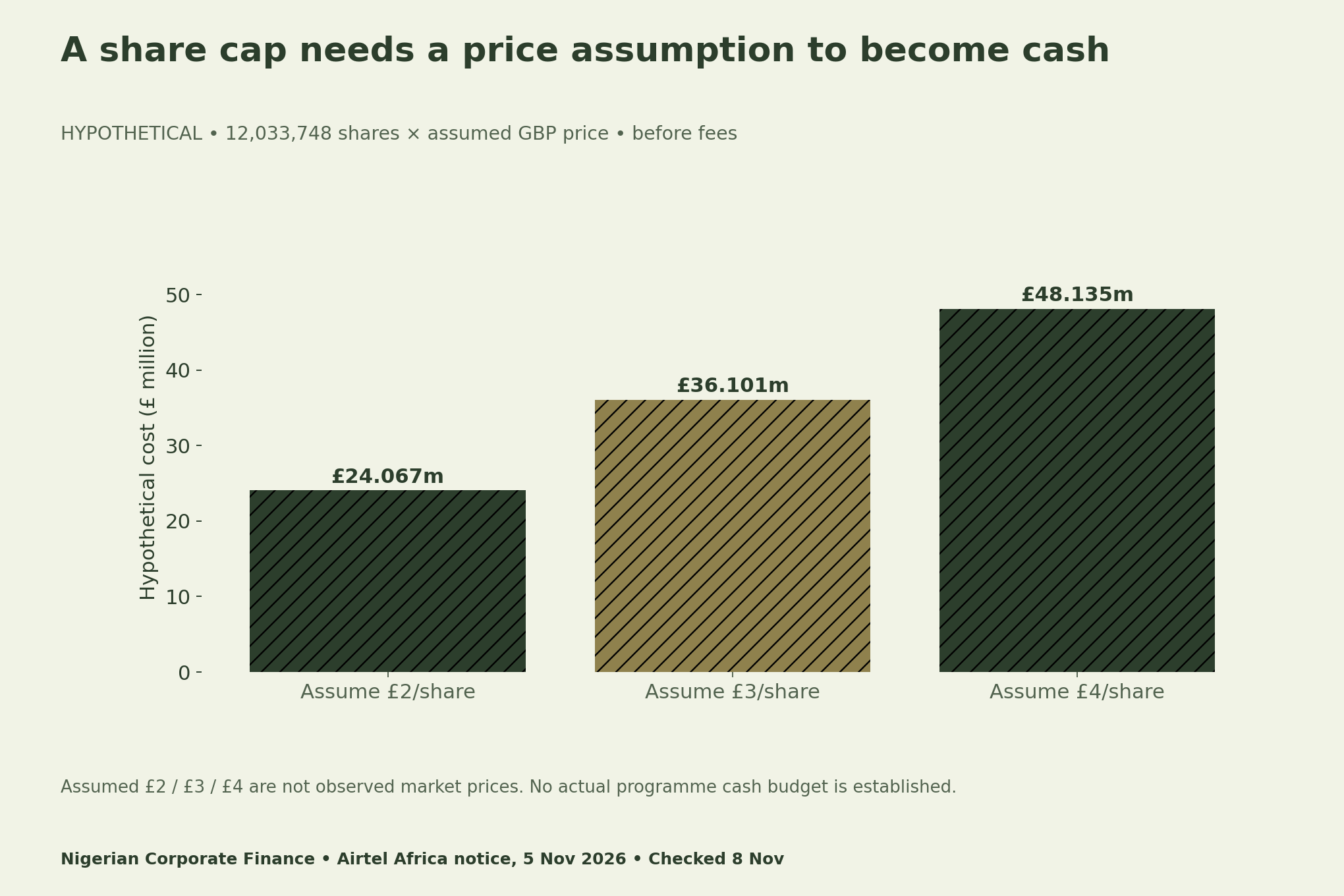
If only part of the cap is used, the arithmetic changes. If execution prices differ across transactions, a single assumed price will not reproduce actual spending. A proper cash reconciliation therefore needs the issuer’s subsequent purchase disclosures and any relevant cost information, with currency and price units kept explicit.
Build a source-led execution register
Record the transaction-notice date separately from the purchase date. Add the official source, shares purchased, price currency and units, disclosed cash amount where available, programme scope and cancellation evidence. Leave unavailable fields empty with a note. A blank field is not a claim that purchases or expenditure were zero.
This report has not completed a subsequent-transaction audit. Its register is a blank tool, not a live tracker. Populate it only after reading official notices and reconciling their periods. Do not combine a weekly disclosure with daily rows covering the same trades, or treat a voting-rights denominator as interchangeable with total issued capital.
For another example of separating a financial ceiling from a specific cash obligation, see our Cardinal Torch maturity analysis. Our dividend currency checklist also shows why the relevant venue, currency and reference date belong beside each figure.
Download the Airtel Africa buyback limit evidence tools
The authority table preserves scope and reference dates. The hypothetical cash file labels every price assumption. The execution register and control checklist provide blank fields for a reader’s documented work. They do not certify legal compliance, predict a share-price effect or represent executed trades.
- Authority scopes and remaining share limits (CSV)
- Blank official-transaction execution register (CSV)
- Explicitly hypothetical GBP cash sensitivity (CSV)
- Permission-to-cancellation evidence checklist (CSV)
Methodology, limitations and citation
We transcribed the issuer’s 5 November notice, calculated the difference between original and remaining general authority, and multiplied the remaining programme cap by three labelled hypothetical prices. The three charts answer scope, authority-bridge and cash-assumption questions. Additional statistical charts would imply execution evidence that we have not verified.
The notice establishes announced terms, not actual purchases, current share-price support, future earnings per share or a guaranteed capital return. The quoted 0.33% retains the issuer’s 22 May denominator. No trading recommendation, cash-budget claim or legal-compliance conclusion follows from this analysis.
Suggested citation: Nigerian Corporate Finance (8 November 2026), “Airtel Africa’s November Buyback: Which Limit Applies?”, using Airtel Africa’s 5 November 2026 commencement notice. Keep authority scopes and hypothetical assumptions explicit when reusing the tables.


