





An African instant payment corridor assessment starts with the route your business actually needs. A continental coverage headline can guide research, but it cannot confirm that a named sending provider reaches a particular recipient. Nigerian treasury and expansion teams need evidence about both ends, the currency and the service terms before treating a route as usable.
African instant payment corridor assessment: start with the units
AfricaNenda’s SIIPS 2026 executive summary reports 39 live instant payment systems providing functionality for 43 countries as of July 2026. The system total comprises 35 domestic and four regional systems. Its demand-side research covers 1,403 individual and MSME digital-payment users across 15 markets. The report page provides the source publications and overview.
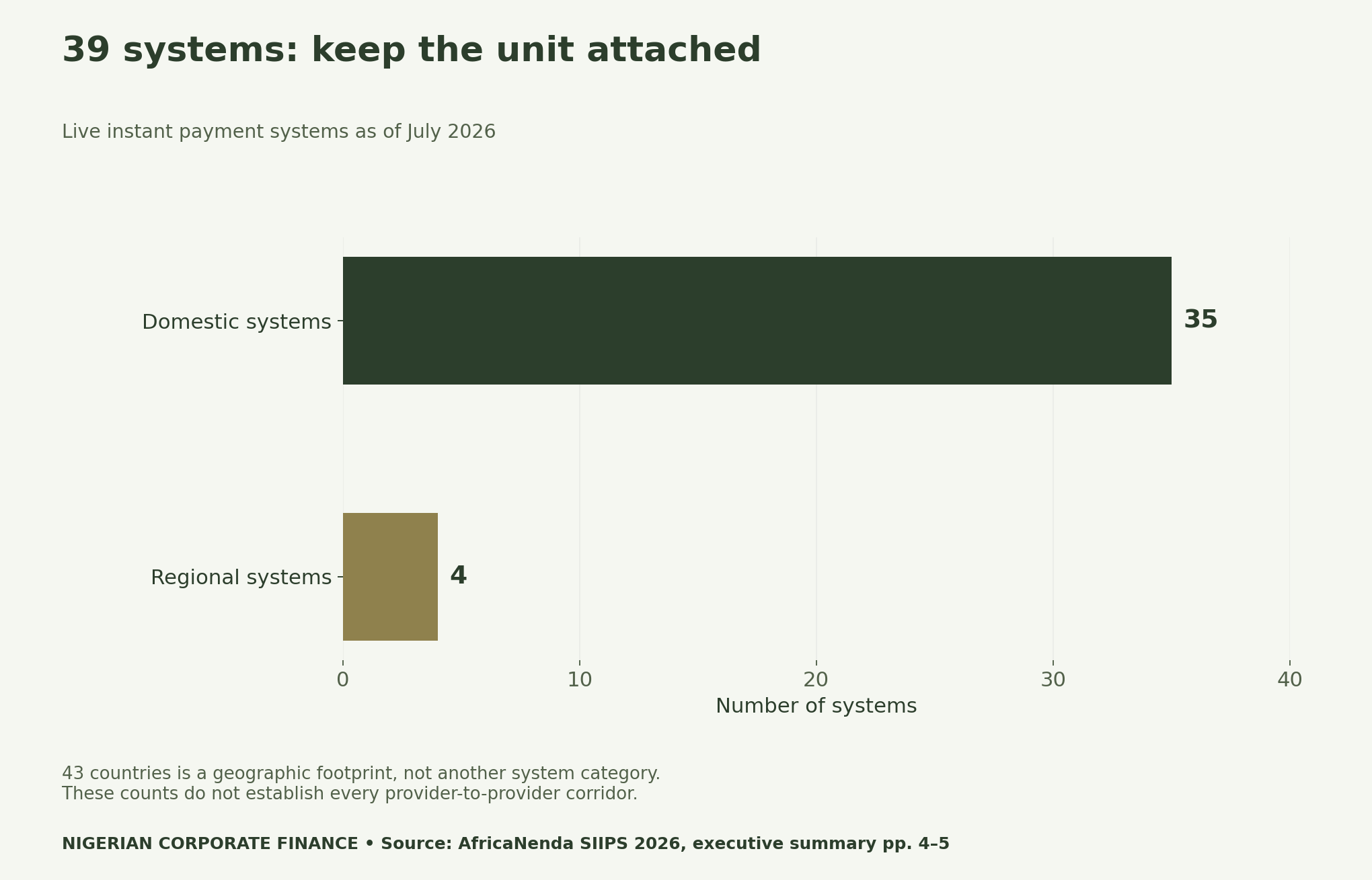
Keep three fields together in a briefing: the number, its unit and its reference date. A November publication does not turn a July landscape into a real-time directory. Nor should a survey’s market count become the denominator for system coverage. These distinctions prevent a striking headline from answering a different question.
Define the corridor before checking coverage
Write down the origin market, destination market, sending provider and receiving provider. Add the intended recipient account type and the business use case. A supplier invoice, a refund and a payroll payment may need different eligibility checks even when their country pair is the same.
Then ask which documented service connects those participants. Do not assume that two countries appearing in a footprint share one route, or that two providers use every available system. A regional arrangement can extend functionality without establishing every possible combination of providers, accounts and currencies.
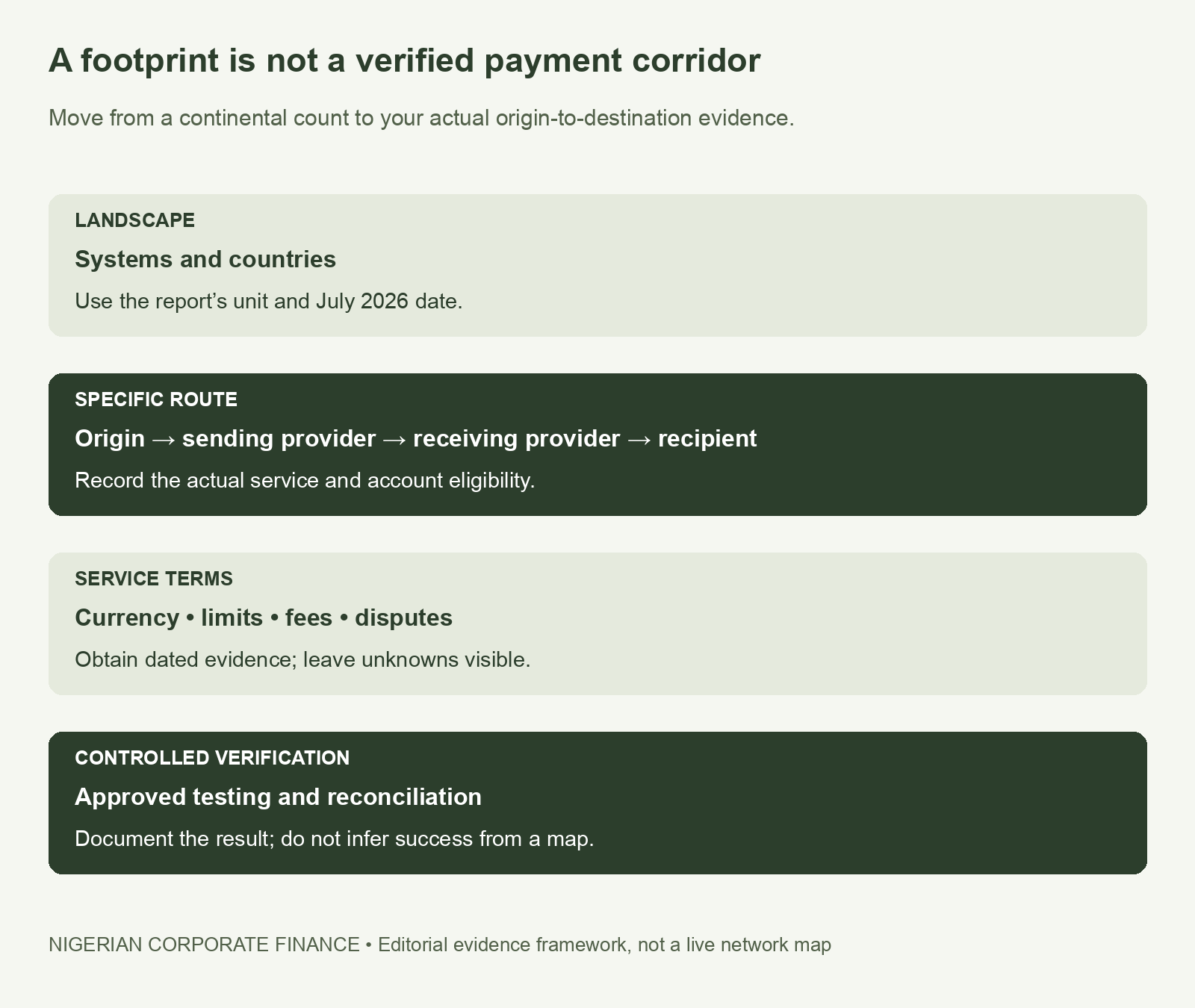
Use six distinct checks for a working evidence pack
Our original worksheet separates provider participation, accounts and recipients, currency, limits, fees and disputes. These are documentation questions, not an official certification model. For each one, record the relevant document, its date, the service it covers and the next action if evidence is missing.
Provider participation needs both ends of the chain. Account and recipient checks should specify the eligible account type without copying personal identifiers into a general research sheet. Currency evidence should distinguish the sending currency, receiving currency and any conversion arrangement. Limits need a value, a period and the applicable service or account tier.
Fee evidence should cover the complete quoted arrangement rather than one attractive charge. A route can have sending, receiving or conversion terms that need separate confirmation. Dispute evidence should identify the process for a failed, delayed or misdirected payment, the responsible contact and the records needed for investigation.
Read four out of six as documentation status
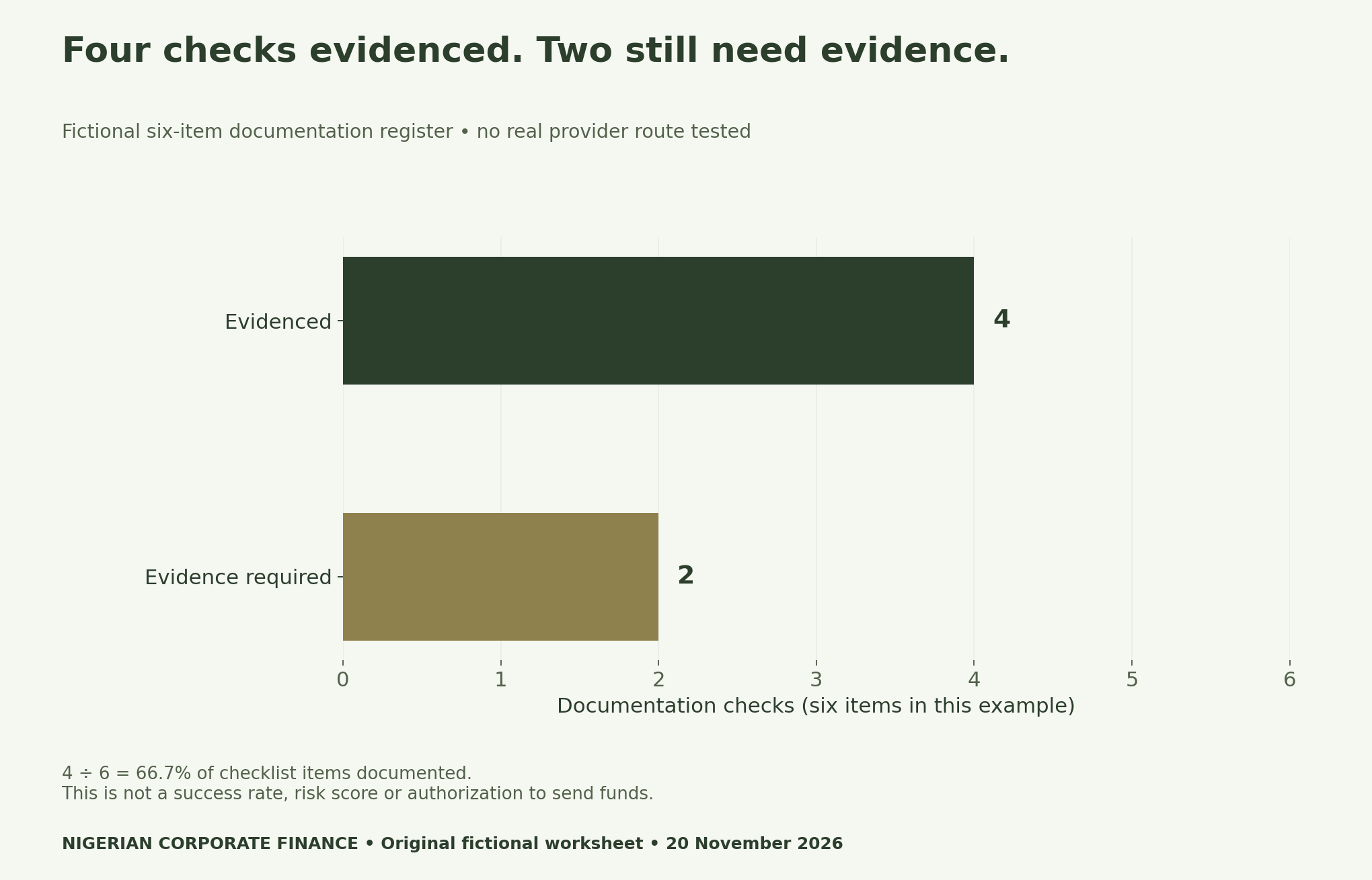
In the fictional DEMO-ROUTE-01 example, four of the six fields have example documents. Two remain open. The arithmetic is 4 ÷ 6 × 100 = 66.7% of documentation items. It does not mean that a payment has a 66.7% chance of success, or that the route is two-thirds approved.
A simple count also gives each item equal weight. That is a worksheet convenience, not a statement that missing fee terms and missing recipient eligibility create equal risk. Review the content of the open items. Do not use the percentage as a substitute for deciding whether the evidence is sufficient for the actual business process.
Keep testing and reconciliation separate from the headline
A completed document register is only one stage. Any operational testing should follow the organisation’s own approvals and controls. Record the service version, date, result and any unresolved exception. This article does not initiate transactions or recommend sending money through an unverified route.
After an approved test or live payment, compare the instruction, provider result and receiving evidence. Our Paystack reconciliation guide explains why a successful transaction status and matched bank cash are different records. The payment-integration ROI worksheet separately distinguishes cash savings from staff time released. Neither measure should be inferred from continental coverage.
Download the coverage and corridor tools
- SIIPS headline counts and measure dictionary (CSV)
- Fictional six-check corridor evidence example (CSV)
- Blank six-check payment corridor register (CSV)
- Checklist calculations and claim boundaries (CSV)
Methodology and limits
We checked the executive summary and report page on 20 November 2026. The system split reproduces the source counts; it does not estimate transaction volumes or a network of country pairs. The separate register is an original fictional teaching example. Its labels and synthetic route ID do not identify real providers or customers.
This African instant payment corridor assessment does not establish universal connectivity, guaranteed foreign-exchange savings or unrestricted treasury cash. It is an evidence-planning tool for a specific question. Recheck current provider documentation and applicable requirements before making operational decisions.


