





Access Holdings employee share vesting is a units question before it becomes an expense or dilution question. We added the 56 rows in the company’s November notice and obtained 20,567,292 disclosed units. That total is our calculation, not an issuer-printed aggregate.
The result gives finance teams a reproducible starting point. However, it does not establish the shares newly issued, the expense recognised or anyone’s total compensation. This report includes two charts, a three-ledger infographic and four free CSV tools. Research checked on 12 November 2026.
Access Holdings employee share vesting: what the notice measures
The three-page issuer notice dated 11 November 2026 lists employee share units with a common vesting date of 1 July 2026. We retain source row numbers and pages in the extraction. Public charts omit personal names because the useful question is how the disclosed units reconcile.
There are two relevant dates, and neither should replace the other. One is the stated vesting date; the other is the notice date. Their difference is 133 elapsed calendar days. We have not tested a disclosure deadline, so this subtraction cannot establish late reporting or a breach.
| Item | Result | What it describes |
|---|---|---|
| Rows extracted | 56 | Employee rows in this notice |
| Units summed | 20,567,292 | Disclosed cohort only |
| Four largest rows | 11,189,872 units | Rows 1, 2, 3 and 46 |
| Other rows | 9,377,420 units | Remaining 52 rows |
| Date interval | 133 days | 1 July to 11 November 2026 |
Reconcile the complete cohort before using a percentage
First, sum every row exactly once. Then identify the largest values without dropping tied rows. Here four rows each show 2,797,468 units. Their combined 11,189,872 units divided by 20,567,292 gives 54.41%, rounded to two decimals. The other 52 rows represent 45.59%.
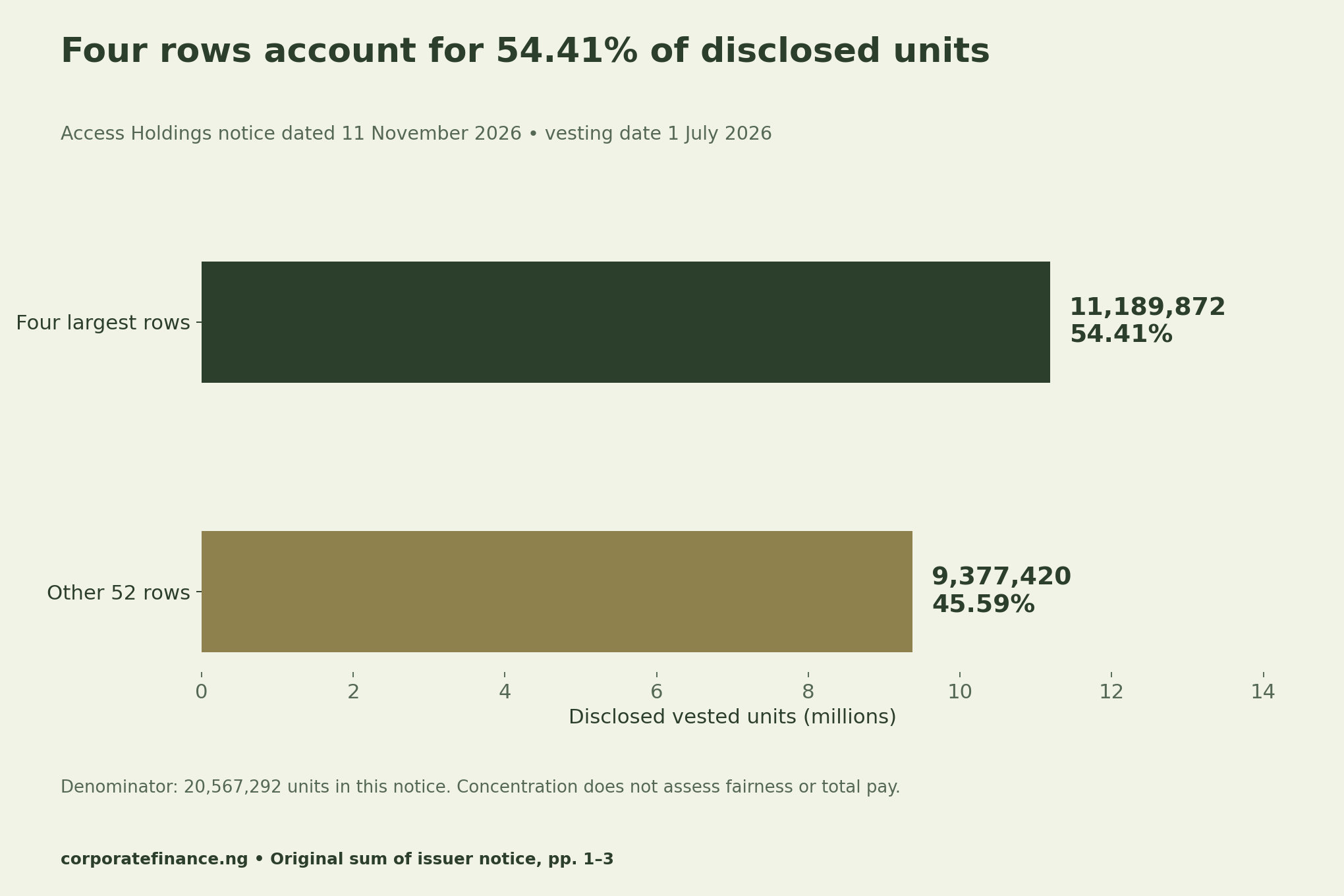
A concentration statistic describes an allocation in a defined dataset. It cannot establish whether pay is appropriate, whether performance conditions were met or whether anyone benefited improperly. Those questions need scheme terms, role context and other evidence that the list does not provide.
For the same reason, do not divide this total by a convenient share count and call the result dilution. The list does not establish a new share issue. Shares might be delivered through different arrangements, and the relevant capital records must answer that question.
Use the source-row chart to spot transcription issues
The second chart displays every source row. Gold highlights the four equal largest entries; green shows the others. Its horizontal axis is logarithmic because the values span a wide range. Equal visual gaps therefore represent ratios, not equal numbers of units.
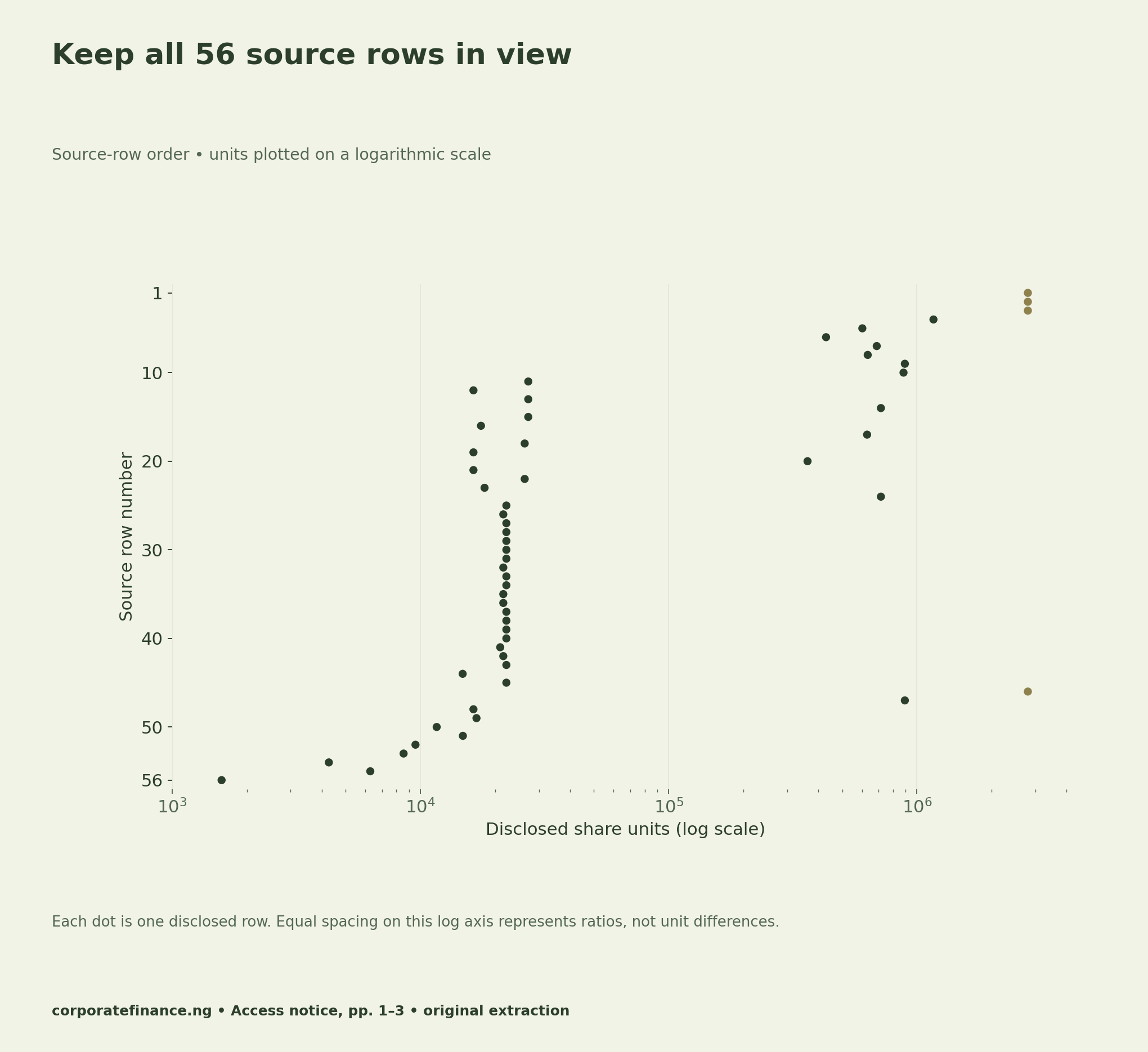
When checking an extraction, inspect page boundaries carefully. A row can be omitted where a PDF text parser joins the end of one page to the next. Compare the source row, amount and date, then confirm that no row was duplicated. A total alone will not reveal two offsetting transcription mistakes.
We checked the retained extraction against the rendered notice after transcribing the values. This was an agent verification pass, not an independent human review. The source PDF remains the controlling document if a reader finds a discrepancy; retain any correction as a new version instead of silently changing an old result.
Keep vesting, settlement and expense in separate ledgers
The three-ledger structure below prevents one disclosure from answering three different questions. A vested-unit record states the units and their stated vesting date. A settlement and capital record tracks what was delivered and whether capital changed. An accounting record links the transaction to a reporting period and recognised amount.
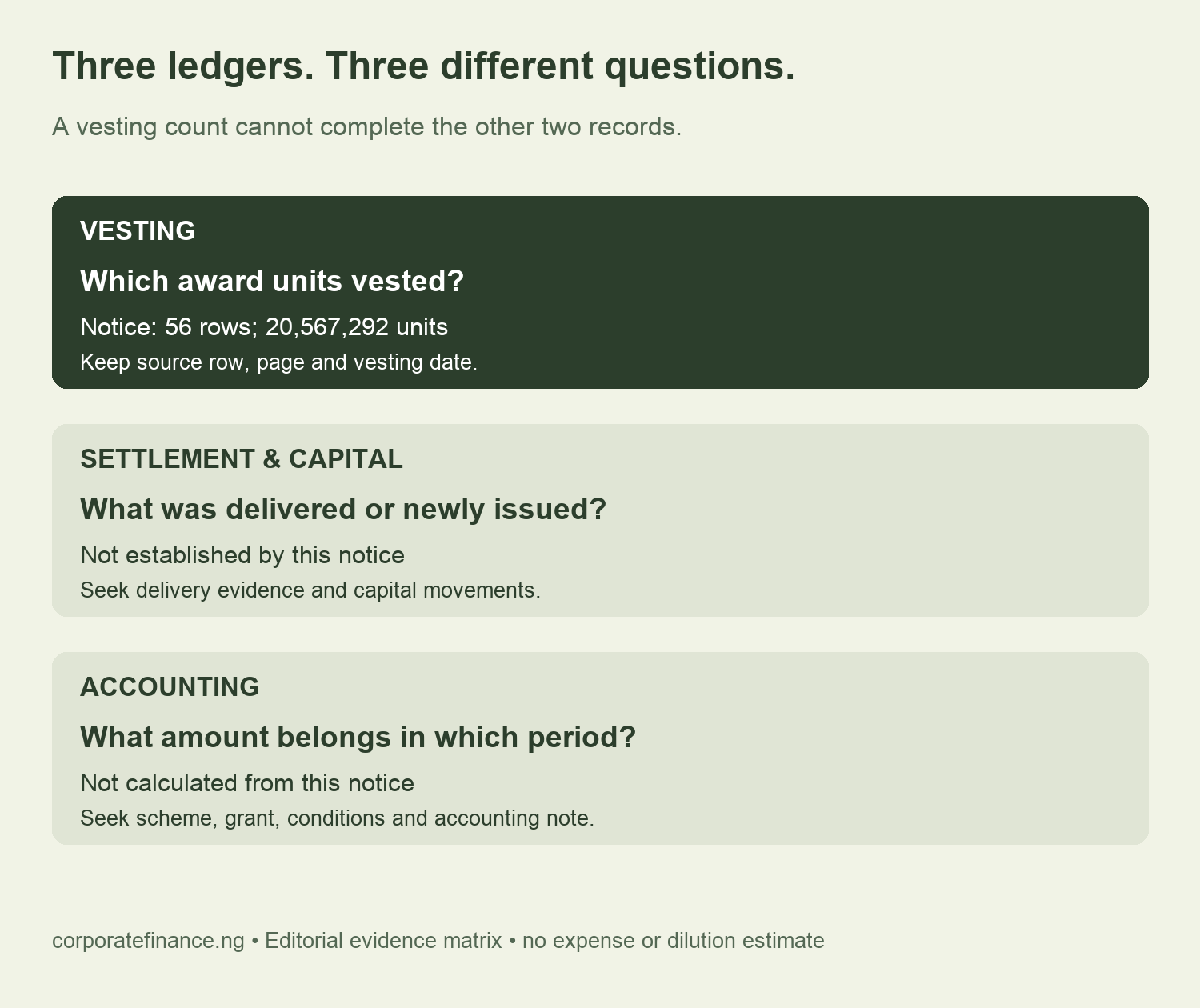
A blank field in a working paper should stay blank until evidence supports it. For example, the settlement mechanism cannot be inferred from the word “vested”. Likewise, a delivery date and a notice date can differ. Label each date by its actual purpose rather than combining them under a general transaction-date heading.
| Ledger | Evidence to request | Avoid this shortcut |
|---|---|---|
| Vesting | Current notice, award reference and conditions | Treating one notice as the whole programme |
| Settlement and capital | Delivery records, share register and capital movements | Assuming every unit is newly issued |
| Accounting | Scheme, grant records, relevant conditions and reporting note | Multiplying units by announcement-day price |
Why announcement-day price does not answer the expense question
The IFRS Foundation’s IFRS 2 overview provides the reporting framework for share-based payments. It covers financial-statement effects, including employee-related expenses. That framework is background, rather than a new November rule or a conclusion about this particular scheme.
To assess an actual charge, a finance team needs the applicable arrangement and its measurement and recognition evidence. A market price observed on the notice date does not replace those inputs. We therefore leave the expense, market value, tax liability and dilution calculations unperformed.
Keep ownership analysis separate as well. Even a correct count of newly issued shares would need the appropriate capital denominator and date before an ownership percentage could be calculated. This notice’s cohort total cannot establish a participant’s overall holding or total remuneration.
Build a committee evidence pack that can be checked
Start with the original notice and its version. Attach the row-level extraction, derived measures and reconciliation checks. Then use the evidence checklist to request scheme approvals, grant records, settlement documents, capital changes and the relevant accounting note. Assign an owner and keep unresolved questions visible.
Next, compare records using a stable award reference where one is available. Do not join two lists only because their totals look similar. If the company publishes a correction, preserve the earlier extraction and document which rows or definitions changed. This makes the research reusable without hiding its history.
Our MTN board-cohort analysis uses the same discipline of retaining the correct denominator. The NBET transaction-evidence guide similarly separates an announced event from the later record needed to establish a different financial conclusion.
Download the extraction and four working tools
- 56-row source extraction (CSV)
- Totals, cohort shares and date arithmetic (CSV)
- Share-awards evidence checklist (CSV)
- Blank three-ledger awards register (CSV)
The blank register deliberately contains no calculated expense or dilution. Add company records only within the permissions and controls that apply to your work. The public files contain source row numbers rather than employee names, and the checklist records questions rather than presumed answers.
Methodology, limitations and suggested citation
We transcribed all 56 unit values from pages 1–3, kept integers throughout and summed them without rounding. The four-largest share uses the complete notice total as its denominator. Date arithmetic excludes the start date in an ordinary elapsed-day calculation. It is not a legal deadline assessment.
This is one notice, not necessarily the group’s complete awards programme. We did not inspect scheme rules, settlement records, share-capital movements, tax records or a scheme-specific accounting note. Consequently, the analysis makes no finding about expense, dilution, compliance, fairness or investment value. Company-specific interpretation needs the relevant records and professional judgement.
Suggested citation: Nigerian Corporate Finance (12 November 2026), “Access Holdings Employee Share Vesting: Reconcile the Units”, original extraction and calculations from Access Holdings’ 11 November 2026 notice, pages 1–3. Cite the notice alongside any reused derived figures.


