





The Cornerstone holding company structure needs an entity map before a capital conclusion. A parent can oversee several insurance businesses without making every subsidiary’s cash freely available to the group. The 18 November 2026 notice identifies the proposed operating arrangement and approval stages, but it does not supply entity-level capital or cash amounts.
Cornerstone holding company structure: read the notice’s boundary
The issuer notice filed with NGX describes Cornerstone Insurance Plc becoming Cornerstone Plc, with three insurance businesses: Cornerstone Life Assurance Limited, Cornerstone General Insurance Limited and Hilal Takaful Insurance Limited. It also states that the evolution remains subject to final NAICOM approval.
Keep the announcement date and status together. A diagram can make a proposed or conditional structure look complete unless its caption says otherwise. Our map follows the selected changes described in this notice. It is not a full historical group chart or proof that every transfer and approval step has finished.
Map the named businesses and their roles
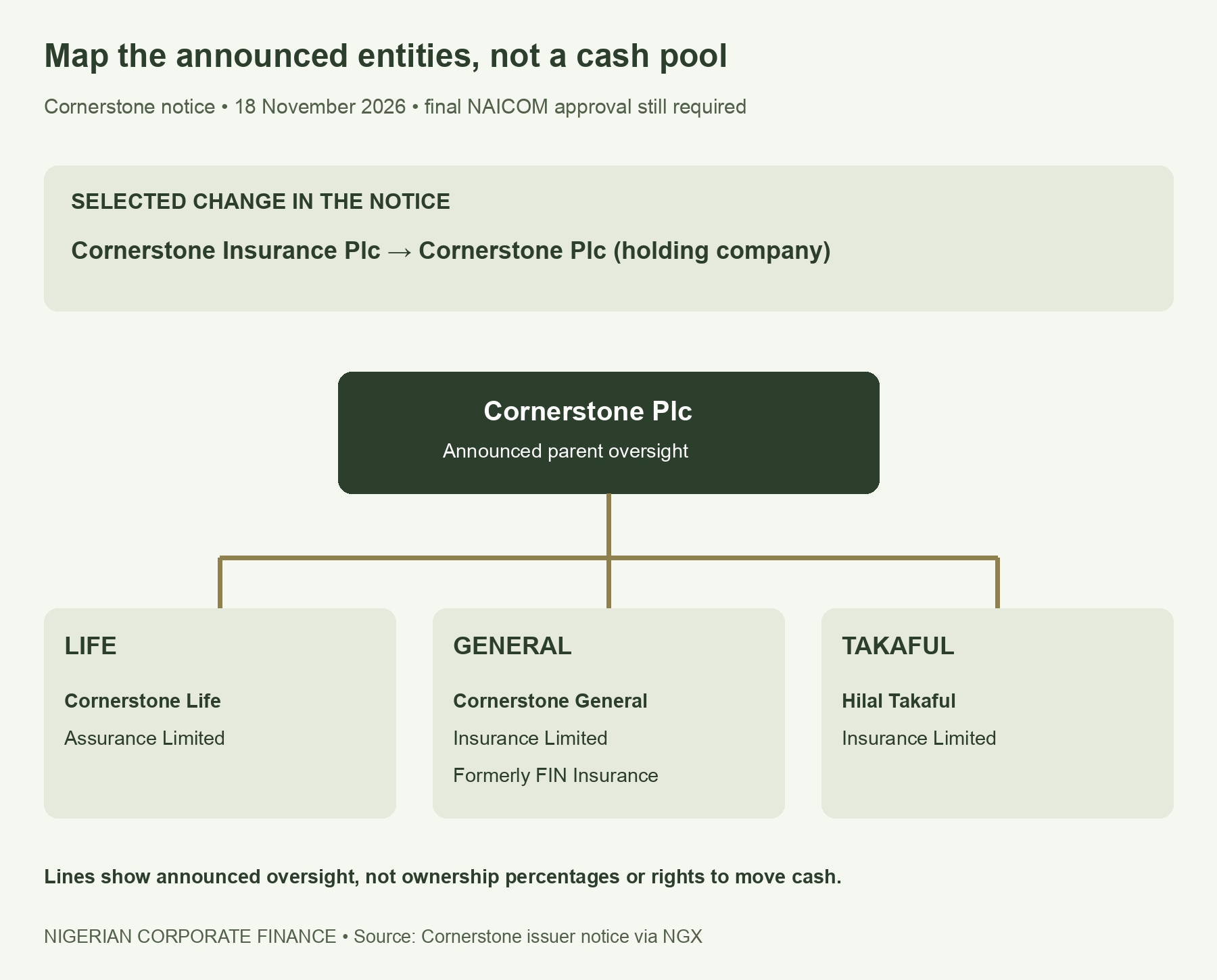
The notice assigns life operations to Cornerstone Life Assurance Limited. General operations sit with Cornerstone General Insurance Limited, formerly FIN Insurance Company Limited. Hilal Takaful continues the Takaful business. A register should keep the legal name, any former name and the described business together so a name change does not become a mistaken duplicate entity.
Names are only the beginning of the analysis. For each entity, ask which business it conducts, which obligations it is expected to hold and which document supports that view. Do not replace those questions with an assumption that all obligations sit at the listed parent.
Trace assets, liabilities and undertakings as a package
The notice describes life assets, liabilities and undertakings transferring to the life company, and general assets, liabilities and undertakings transferring to the general company. Those are paired business-boundary statements. They are not numerical schedules showing the final value or cash position of either recipient.
For a working review, retain the source wording and mark the amount field as not disclosed in this notice. If later financial information arrives, add its date, unit and measurement basis. Do not fill an empty amount cell from an unrelated group total merely to make the entity map look more detailed.
Separate approval in principle from final approval
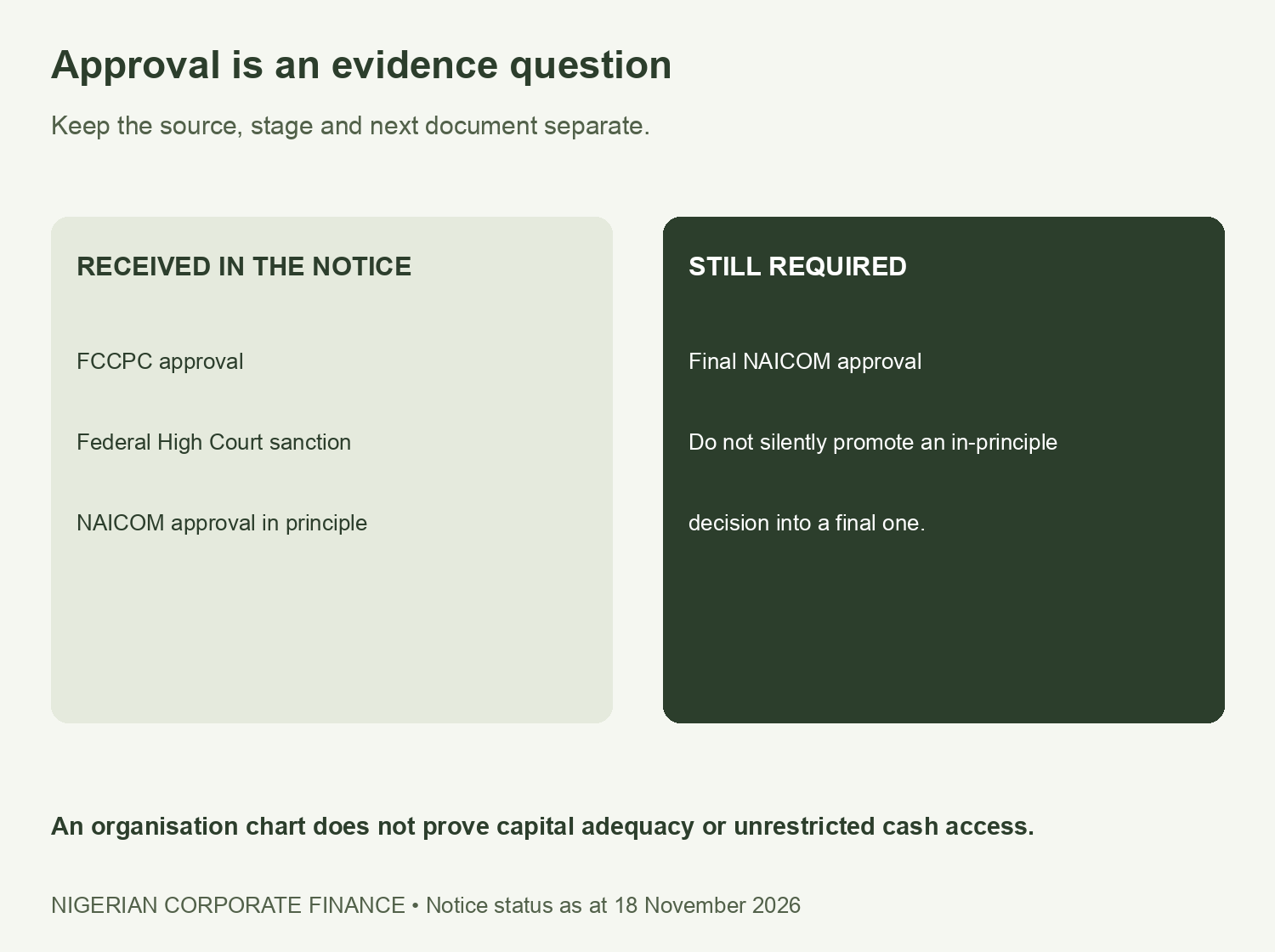
The notice reports FCCPC approval, Federal High Court sanction and NAICOM approval in principle. Its next-steps section still refers to final NAICOM approval. Read those statements together. Completing one stage does not justify changing another stage’s status to complete without evidence.
Use a dated status register rather than a single green approval flag. A reviewer should be able to see the authority, the stage, the evidence date and the document needed next. This makes an update straightforward when a later filing changes one part of the position.
A group total does not identify an entity’s usable cash
A consolidated total and a legal entity’s resources answer different questions. Before making a cash-availability claim, identify the account holder, restrictions, obligations and the basis for any distribution or transfer. Group oversight alone supplies none of those amounts or permissions.
Likewise, an entity count is not a capital-adequacy test. Three named operating businesses do not establish their individual funding needs or compliance position. We therefore avoid a capital bar chart: the notice gives no comparable entity-level figures to plot. The structure chart and evidence registers are the appropriate assets for the available disclosure.
What the shareholder statement actually says
The notice says existing shareholders retain their shares and current holdings, while the listing ticker remains CORNERST. That statement should stay separate from an investment conclusion. Retained holdings and an unchanged ticker do not prove that risk, valuation or future returns are unchanged.
For a reporting pack, place shareholder continuity in one field and entity obligations in another. Mixing them can make a corporate structure announcement sound like a capital allocation or return forecast. The evidence register is designed to prevent that jump.
Use the register to plan the next document review
Start with the announced entity names and business scopes. Then check the transfer description, the approval stage and the monetary information still missing. Assign the next evidence request to a reviewer rather than silently resolving an unknown with an estimate.
Our UAC disposal analysis demonstrates the same need to preserve accounting dates and boundaries. The Fidelity metric checker shows why the unit and measurement type must travel with a number. Those controls remain useful when later Cornerstone financial disclosures become available.
Download the entity and approval evidence tools
- Announced entities, roles and undisclosed amount fields (CSV)
- Life and general transfer evidence register (CSV)
- Dated approval-stage evidence register (CSV)
- Blank entity capital and cash review with example (CSV)
Methodology and limits
We checked the 18 November notice on 20 November 2026 and mapped only its named entities, selected transfers and approval statements. No ownership percentages or capital values were inferred. Blank monetary fields mean evidence is required, not that an amount is zero. The graphics explain relationships and status rather than statistical performance.
This Cornerstone holding company structure guide is educational document analysis. It is not a legal opinion, a capital-adequacy assessment or an investment recommendation. Use subsequent official disclosures and appropriately qualified review for decisions about actual obligations, approvals or capital movements.


