





The Champion Breweries HoldCo share swap proposes a change in the ownership vehicle. A one-for-one ratio explains share quantities. It does not establish equal market value, move every borrowing or prove that the restructuring has finished. This guide separates those questions with an entity map, a chart and four free CSV tools.
Research checked on 12 November 2026. This is an evidence-mapping case study. It does not supply a fixed implementation timetable, voting threshold, personal entitlement advice or a recommendation on the proposed vote. The full current scheme was not located in the reviewed public issuer materials.
Champion Breweries HoldCo share swap: what the notice proposes
The court-meeting notice dated 6 November refers to a 5 November scheme and court order. Its proposed exchange covers 11,323,611,233 brewer shares for the same number of Champion Brands Limited shares. The stated ratio is one HoldCo share for each eligible brewer share. These are proposed resolutions, not evidence of completed allotment.
It also proposes transferring brewer-held enJOYbev B.V. interests to HoldCo, subject to required approvals, and taking steps to delist the brewer. The notice schedules consideration for 3 December; that is not a verified completion date. Readers should obtain the current complete scheme and any subsequent clarification before acting on dates or eligibility.
Reconcile the share counts without inventing a price
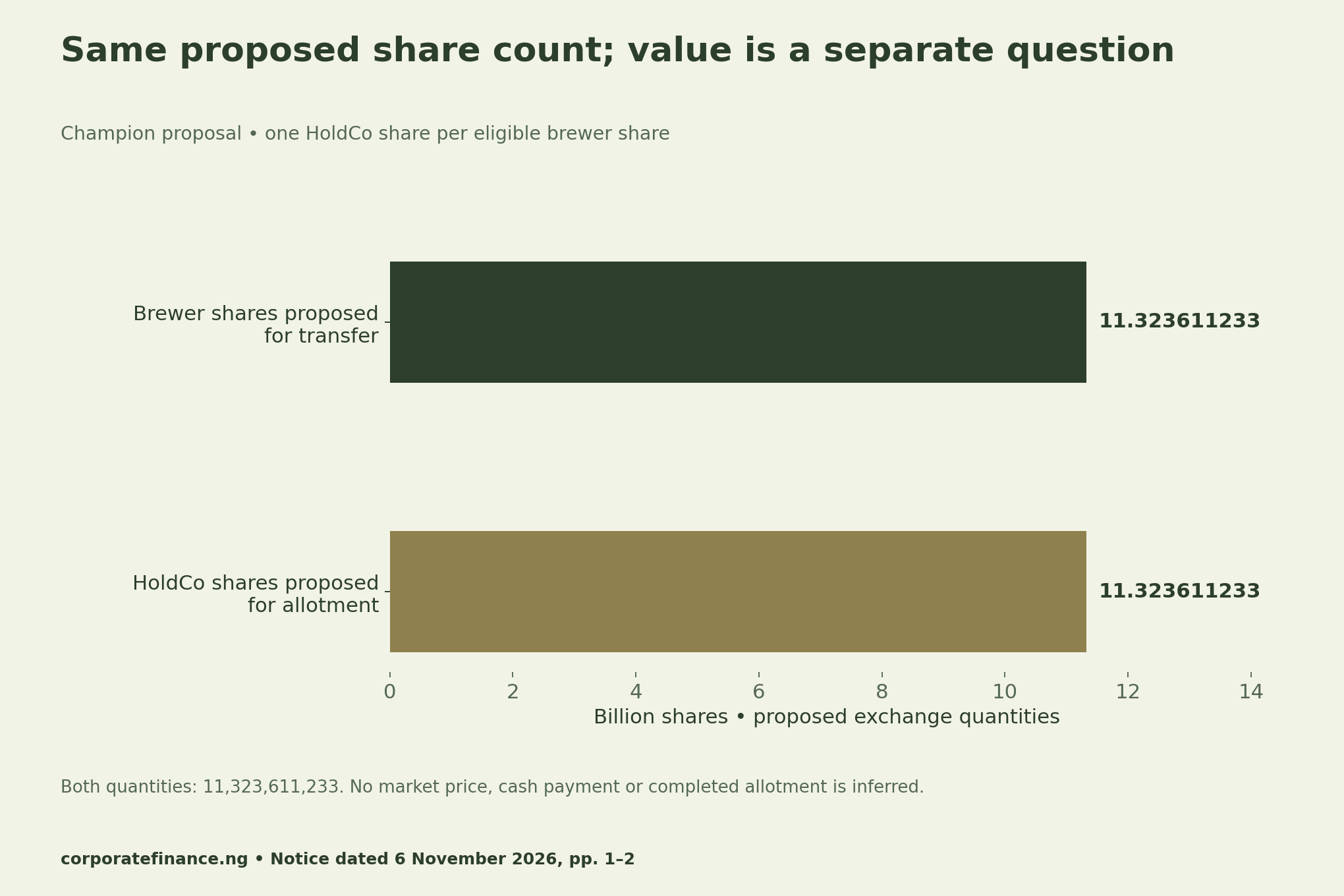
Keep the aggregate exchange quantity separate from an individual holding. Our fictional example starts with 10,000 eligible shares and applies a ratio of 1 divided by 1. The arithmetic produces 10,000 replacement units. Eligibility is an explicit assumption, not a fact checked against a registrar’s record.
The calculation is output units = eligible input units × ratio numerator ÷ ratio denominator. Leave the output unconfirmed when eligibility or the applicable terms remain unresolved. Do not use a guessed post-transaction share price to turn this worksheet into a valuation.
| Fictional input | Ratio | Calculated units | What remains unverified |
|---|---|---|---|
| 2,000 assumed eligible shares | 1:1 | 2,000 | Eligibility, value and implementation |
| 10,000 assumed eligible shares | 1:1 | 10,000 | Eligibility, value and implementation |
| 25,000 assumed eligible shares | 1:1 | 25,000 | Eligibility, value and implementation |
Map shareholders, operating interests and debt separately
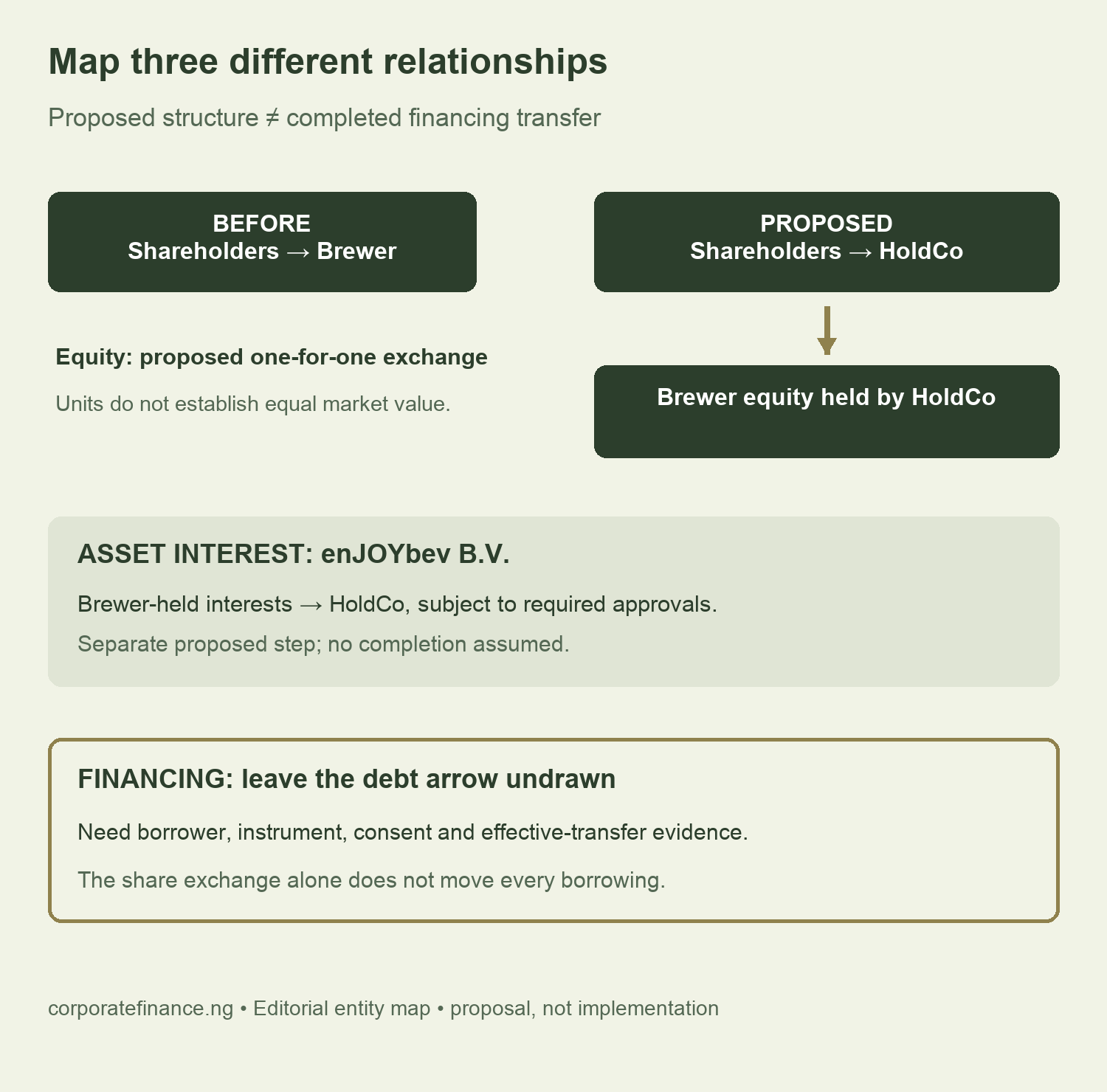
First, map the equity chain. Identify the shareholder, the entity whose shares they currently hold and the proposed replacement issuer. Record the legal names rather than using a single box called the group. A parent and an operating company answer different questions in a transaction file.
Second, map the specific asset interest. Record the entity holding it today, the proposed recipient and the approvals needed. Keep a proposed transfer separate from its effective date and supporting completion record. An ownership diagram should not silently treat every proposal as implemented.
Third, open a financing register. For each borrowing, record the named borrower, guarantor, instrument, security and any relevant consent evidence. Do not draw a completed debt-transfer arrow merely because the shareholder chain changes. The reviewed share-exchange notice does not replace the financing file.
Keep quantity, value and liquidity in different columns
Quantity is the number of units in the exchange calculation. Value requires its own basis and measurement date. Liquidity requires evidence about when and how the resulting security can be traded or otherwise realised. The ratio alone supplies none of those extra answers.
A useful review therefore keeps three fields: calculated units, valuation evidence and trading-status evidence. Mark each field independently as supported, assumed or unresolved. This prevents a correct arithmetic result from lending false authority to a separate claim about investor wealth.
Avoid treating nominal share denomination as a market price. Similarly, do not describe a one-for-one exchange as a cash acquisition when no cash payment has been established. The worksheet deliberately contains no cash-value output.
Version the documents before relying on a timetable
Use a source-version register with document date, publication date, stated milestone, status and superseding evidence. A meeting notice, an explanatory statement and an implementation announcement serve different purposes. A publication date is not automatically the effective date of a transaction.
The reviewed notice contains an unresolved page-reference field and proxy-form location/time placeholders. Those are document-quality questions to verify with a complete current pack. They do not, on their own, establish that the proposal is invalid. We do not fill in the missing fields or provide procedural instructions from them.
Where subsequent coverage offers different timing expectations, preserve that uncertainty until current primary documents reconcile it. This article intentionally avoids a completion calendar, detailed voting instructions and financing-transfer conclusions. A proposed change in the listed entity should not be collapsed into an unsupported claim that the group will permanently disappear from public markets.
Download four reusable share-swap tools
- Proposed exchange source values and page references (CSV)
- Fictional one-for-one exchange examples (CSV)
- Blank source-version evidence register (CSV)
- Blank entity and financing map register (CSV)
Start with the source register, then update each relationship only when its evidence arrives. Keep assumptions visible and preserve earlier versions. The blank templates contain no investor names, account numbers or private company financing records.
For a related distinction between units and their financial consequences, read our Access Holdings vested-units analysis. Our NBET transaction evidence map also separates a financing milestone from a creditor’s cash receipt.
Methodology and limits
We visually checked all three pages of the public notice and retained the exact exchange count. The chart converts shares to billions only for display. The examples multiply assumed eligible units by one; they are fictional and are not valuations. The diagram distinguishes proposed equity ownership, proposed asset-interest transfer and unverified financing consequences.
Searches of the issuer’s investor-relations page and news directory did not locate the full current scheme or a clarification resolving every implementation question. This is a limited public-source search, not proof that no later document exists. Obtain the complete current pack before making a shareholder, legal or financing decision.
Suggested citation: Nigerian Corporate Finance (12 November 2026), “Champion Breweries HoldCo Share Swap: Separate Equity, Assets and Debt”, original evidence map and unit arithmetic from the court-meeting notice dated 6 November 2026, pages 1–3. Retain the proposed status and the limitations when reusing the chart.


