







Briclinks Africa Q3 2026 debt analysis needs a source-quality check before a ratio. The NGX-hosted unaudited filing reports a long-term loan of ₦7,189,780,000 and total equity of ₦150,053,433 at 30 September 2026. Their quotient is about 47.91 times. That narrowly defined calculation does not establish total debt/equity, a covenant breach or a probability of default.
Source caveat: PDF page 10 still contains an instruction to insert the board-approval date and authorised signatures before formal issue. On 8 November 2026, the reviewed official NGX disclosure table and issuer page linked to that same Q3 document; we did not identify a later replacement there. This is a cautious source-reading exercise, not a certified assessment of financial health.
Keep the unfinished approval disclosure visible alongside the numbers. It is a reason to seek a completed official version before substantive lending or valuation use. It is not, on its own, evidence of wrongdoing, insolvency or a particular audit opinion. No issuer contact or confidential-record request was undertaken for this report.
Briclinks Africa debt analysis: preserve the Q3 labels
Page 5 of the NGX-hosted financial statements reports three separate balances: long-term loan ₦7.189780 billion, director’s current account ₦628.874237 million and short-term borrowing ₦6.570000 million. The director balance is presented among non-current liabilities. Its label does not make it equity or establish that it is an interest-bearing bank loan.
| Reported label | 30 September 2026 (₦) | Presentation / boundary |
|---|---|---|
| Long-term loan | 7,189,780,000 | Non-current; no detailed contractual schedule identified |
| Director’s current account | 628,874,237 | Non-current; preserve the related-party label |
| Short-term borrowing | 6,570,000 | Current; exact repayment dates not established |
| Total equity | 150,053,433 | Denominator of the narrow ratio below |
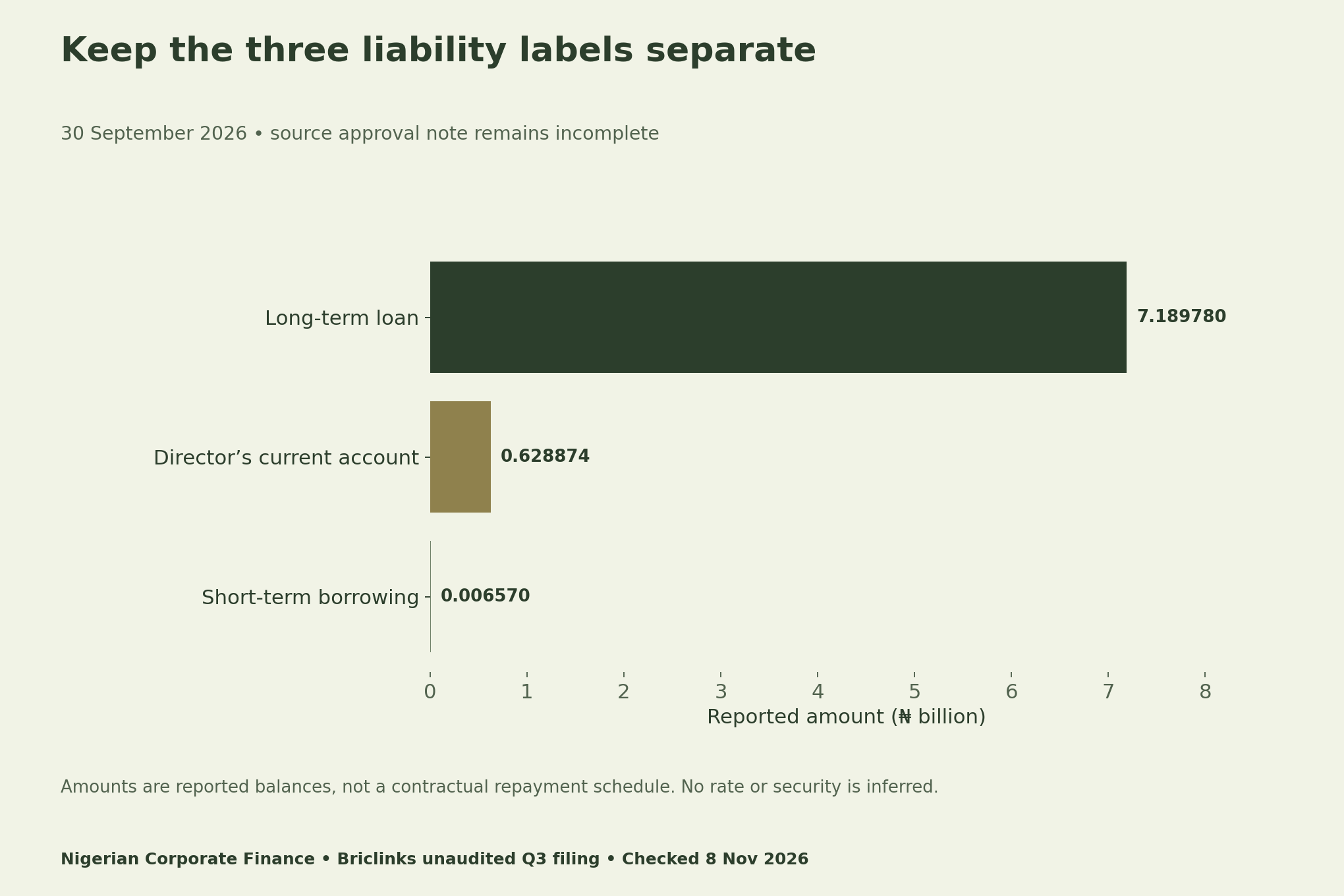
A financing inventory should retain the reporting date, classification and source page beside the amount. Then add contractual fields only when evidence supports them. “Not disclosed in the reviewed filing” is different from “none”. For example, an unavailable security description does not prove that a loan is unsecured.
Define the ratio before interpreting it
Our numerator is the single long-term-loan line. Our denominator is reported total equity on the same balance-sheet date. Dividing ₦7,189,780,000 by ₦150,053,433 gives approximately 47.91. We have not silently added the director balance or short-term borrowing, nor selected a different equity base to change the headline.
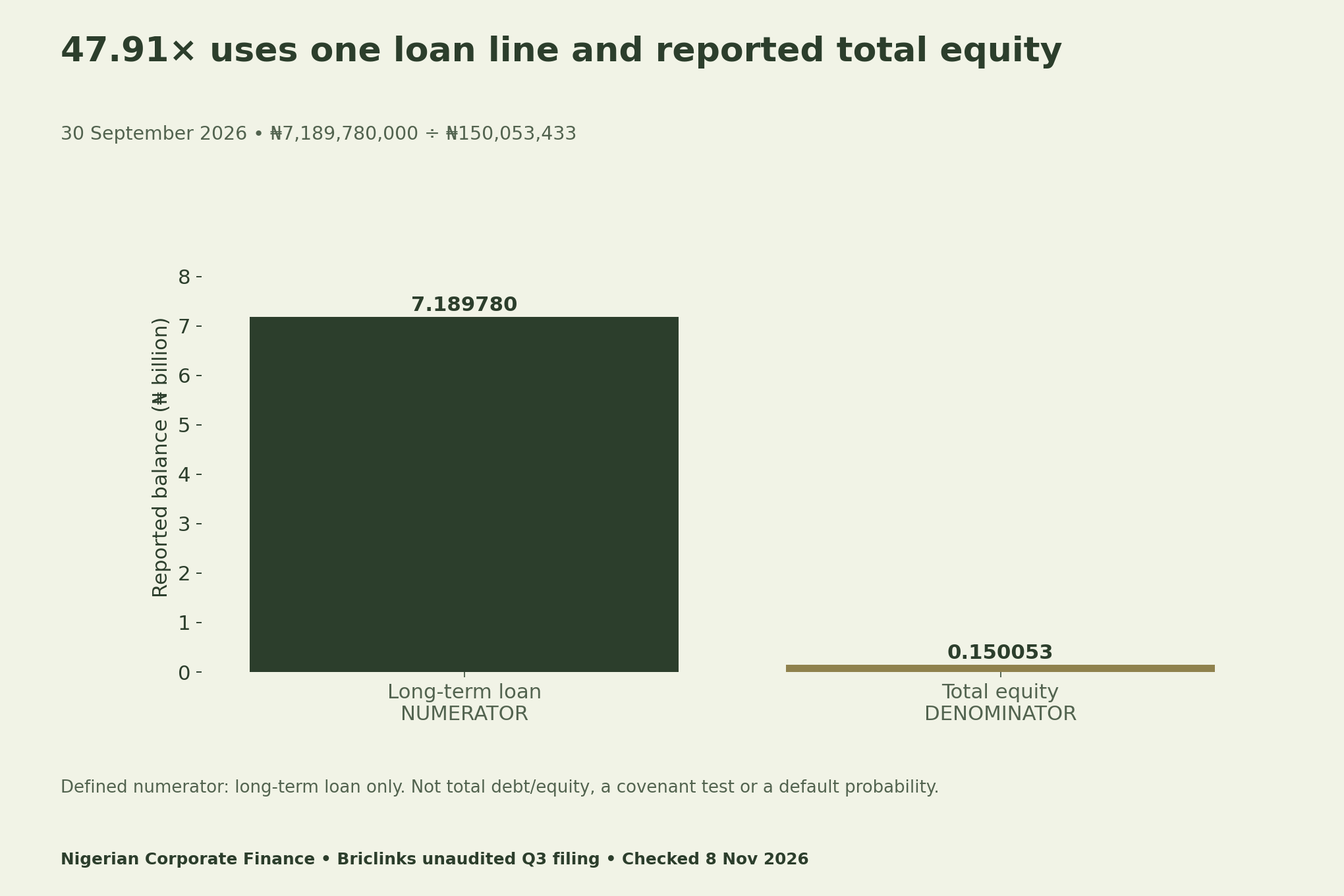
A covenant assessment would require the actual covenant definition and the facts needed to test it. A repayment model needs contractual amounts and dates. A default-probability estimate requires a separately justified model and inputs. The displayed quotient provides none of those additional pieces of evidence.
Therefore, use it to frame questions rather than announce a verdict. Who is the lender? What is due, when, and under which terms? Are there amendments, support arrangements or subordination provisions? This report leaves those unanswered where the reviewed document does not establish them.
Match the comparator date before describing a change
The main statement on page 5 compares 30 September 2026 with 30 September 2025. Several detailed notes on page 9 instead compare September 2026 with June 2026. Those bases can produce opposite descriptions of the same balance. Do not call a September-to-September movement a quarterly change.
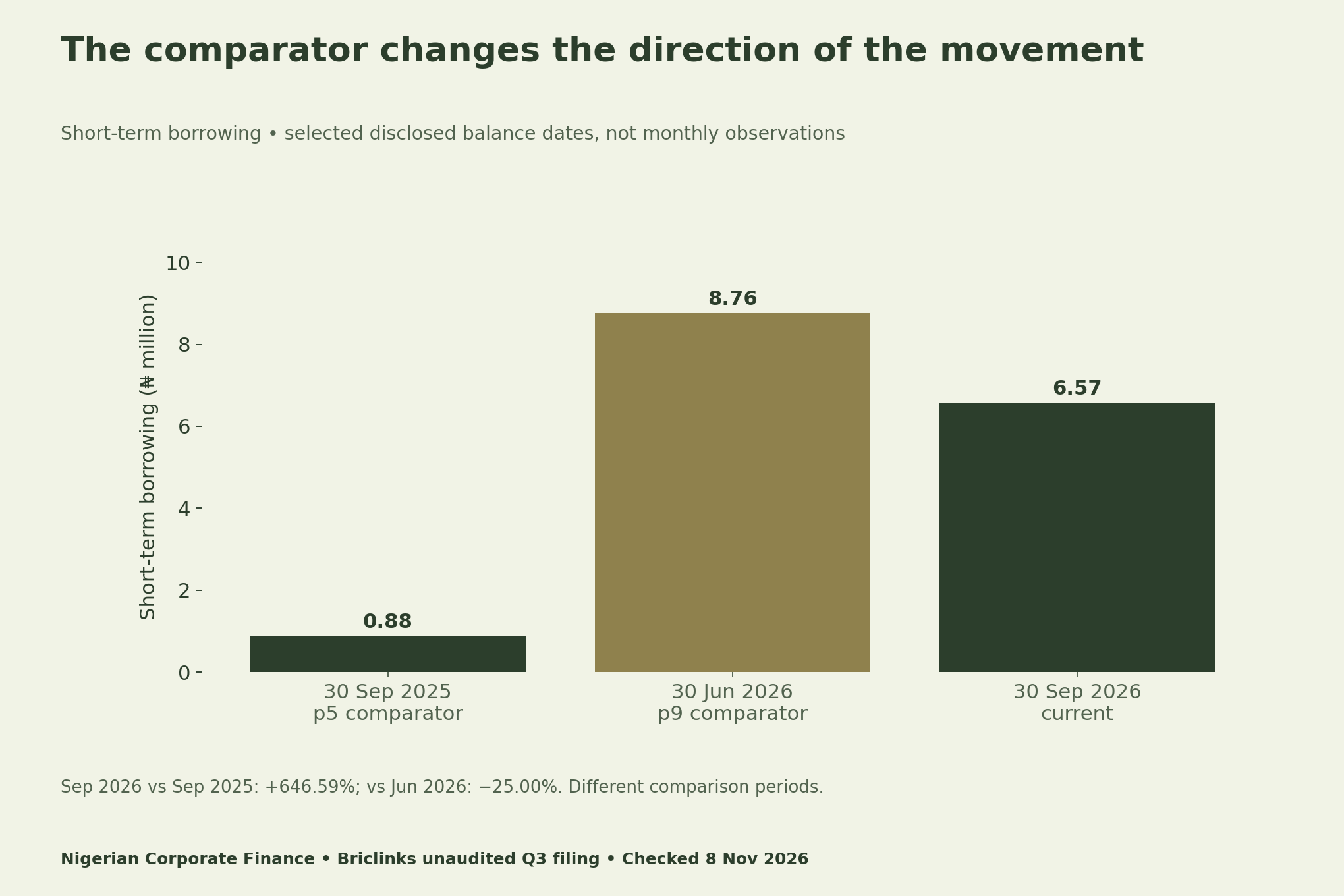
For short-term borrowing, the ₦6.57 million current balance is 646.59% above the ₦880,000 September 2025 comparator. It is also 25% below the ₦8.76 million June 2026 note comparator. Both calculations can be arithmetically correct while answering different questions. Neither explains the contractual reason for the movement.
Build a disclosure-gap matrix before a repayment forecast
The reviewed filing does not provide a detailed repayment schedule, interest terms and security description for the balances used here. The note’s within-one-year and after-one-year labels add broad classification context, but they do not supply an exact series of cash dates. Keep those distinctions in the inventory.
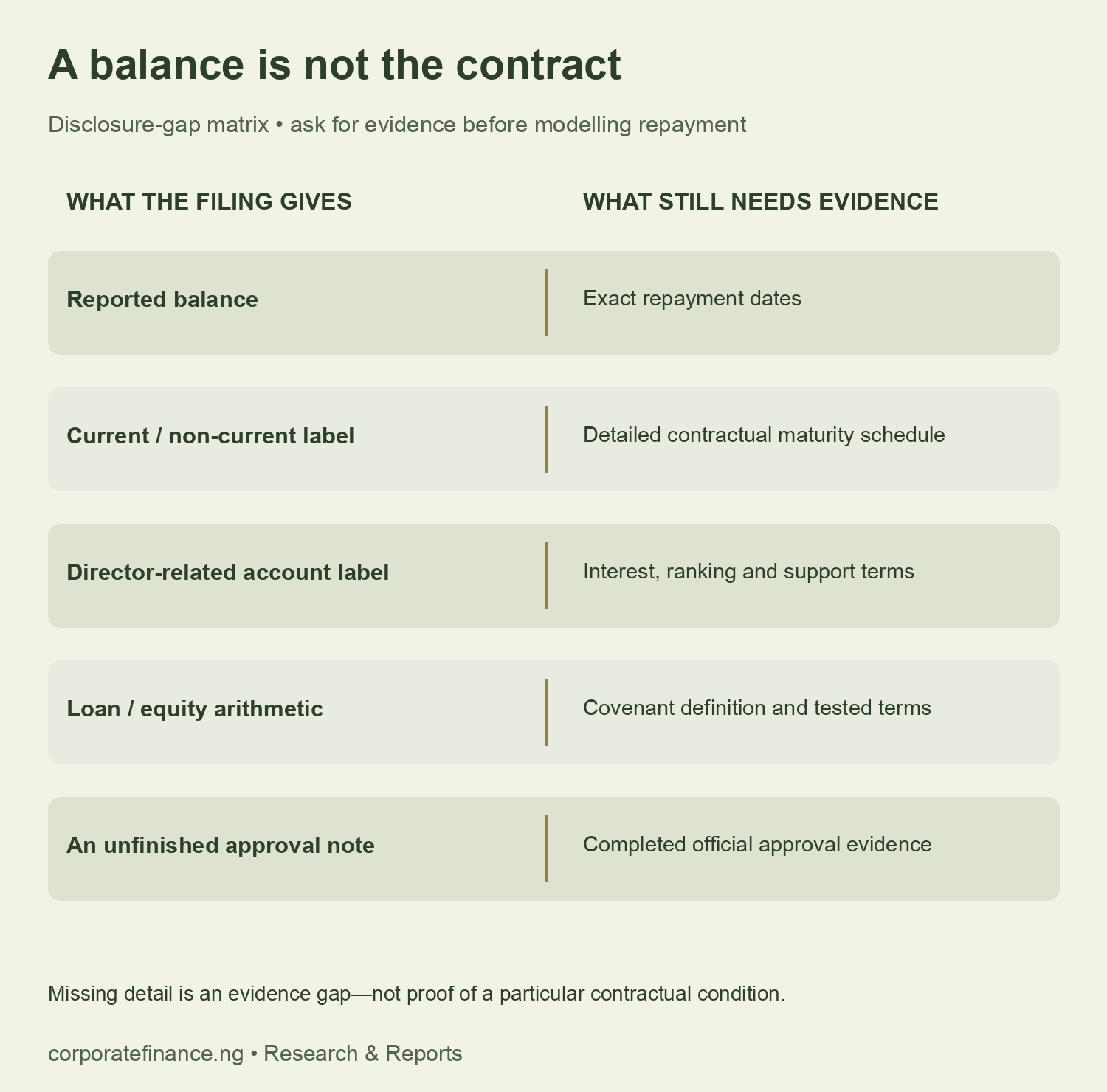
An authorised analyst could use the blank request worksheet to specify the document needed, its owner and review status. That is a proposed diligence process, not a claim that the issuer refused to supply information. Actual requests require the appropriate authority and confidentiality arrangements. This article has not sent them.
Treat the unfinished approval note as a verification gate
The official NGX issuer page was checked for a current Q3 filing. The linked PDF still retains the approval instruction. Our exception register records that unresolved issue and the comparator-date differences. It does not claim an exhaustive search of every possible archive or privately circulated version.
Before using the figures in a credit decision, obtain and check a completed official version. Compare its amounts, dates and notes with this retained source. If an authoritative replacement changes an input, recalculate the affected ratios and update the citation. Do not treat an old downloaded file as permanently current.
Our maturity-ladder study illustrates the different evidence needed when exact cash dates are available. The cash-definition report also explains why a financial-statement label needs a precise definition before comparison.
Download the Briclinks Africa debt analysis tools
The inventory preserves source labels and marks unavailable contractual fields. The ratio file states formulas and comparator dates. The exception register records source-quality gates. The request worksheet is a blank template for authorised work; it contains no confidential issuer correspondence or completed credit rating.
- Reported financing inventory and disclosure gaps (CSV)
- Narrow ratio and dated comparator calculations (CSV)
- Source-quality exception register (CSV)
- Blank contractual-evidence request worksheet (CSV)
Methodology, limits and citation
We transcribed the selected balances from PDF pages 5 and 9, calculated the narrow ratio with decimal arithmetic, and used (current ÷ comparator − 1) × 100 for the two short-borrowing comparisons. We checked the current exchange disclosure list and issuer page on 8 November. Three charts answer inventory, definition and date-base questions; none estimates undocumented debt service.
The statements are unaudited and retain an unfinished approval instruction. This report does not establish a covenant breach, solvency status, repayment failure, borrowing capacity or investment value. Missing contractual detail remains missing. The examples are educational and do not replace a qualified review of complete, current evidence.
Suggested citation: Nigerian Corporate Finance (8 November 2026), “Briclinks Africa Q3 Debt: What the Ratio Cannot Tell You”, source analysis of the NGX-hosted Q3 2026 filing. Retain the approval-note caveat, ratio definition and comparator dates whenever reusing its figures.


