




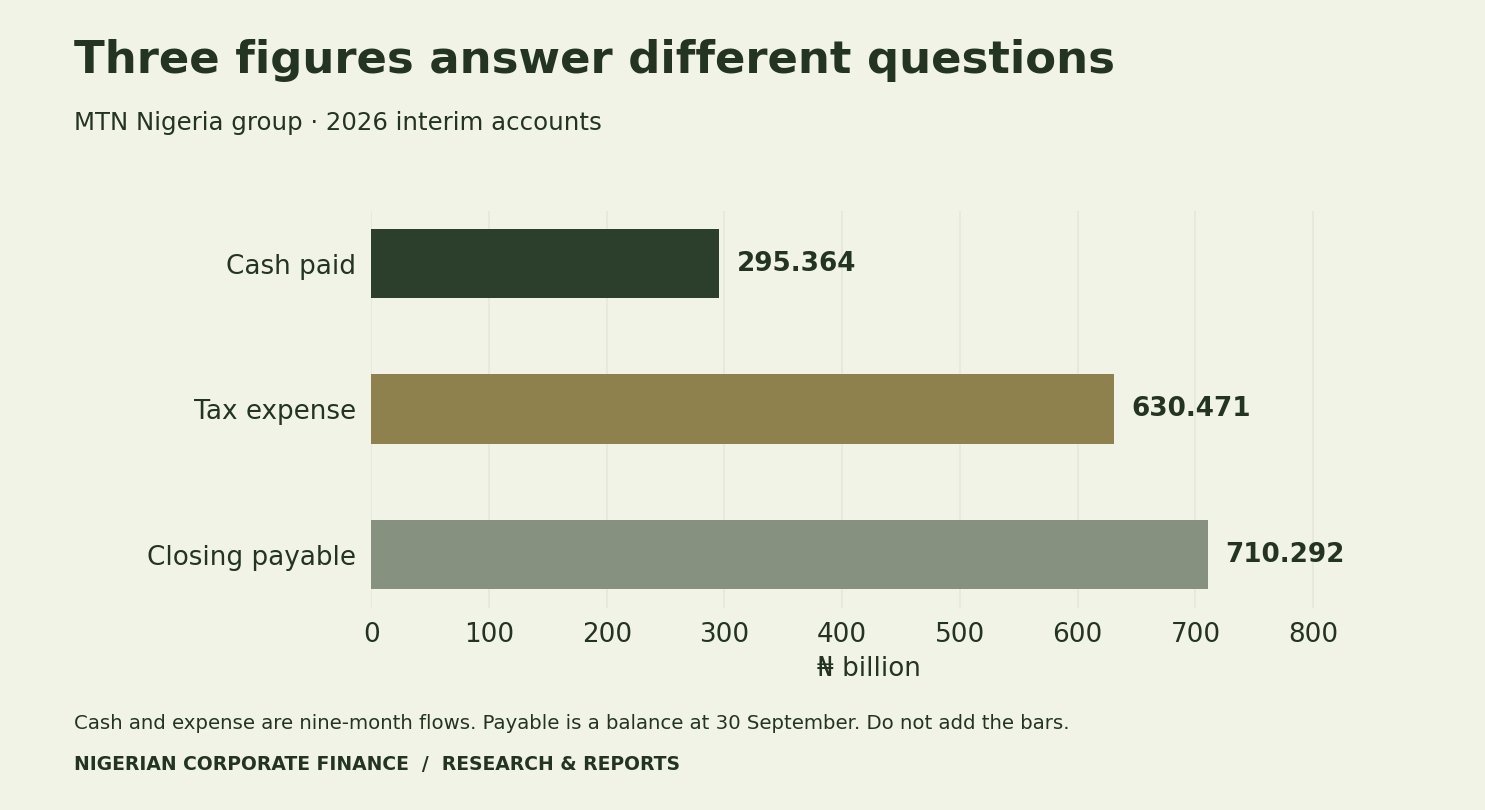
MTN Nigeria’s group accounts show ₦295.364 billion in cash tax paid and ₦630.471 billion in tax expense for the nine months to 30 September 2026. Current tax payable at that date was ₦710.292 billion. The MTN Nigeria cash tax reconciliation for 2026 explains how all three figures can be right.
Cash tax measures payments during the period. By contrast, tax expense measures the charge in profit or loss. On the balance sheet, current tax payable measures the obligation at the reporting date. Start with the group column and build the expense and payable bridges separately.
Why the cash payment rose so sharply
The unaudited group interim accounts compare the same nine-month periods. For example, the cash-flow statement shows tax paid of ₦21.546 billion in 2025 and ₦295.364 billion in 2026. In both cases, we show the outflow magnitude as a positive number for comparison.
That produces an increase of ₦273.818 billion, or about 1,270.9% of the earlier amount. Because the 2025 base was low, the percentage is large. Meanwhile, total tax expense rose from ₦376.256 billion to ₦630.471 billion, an increase of about 67.6%. As a result, the two percentages describe different movements.
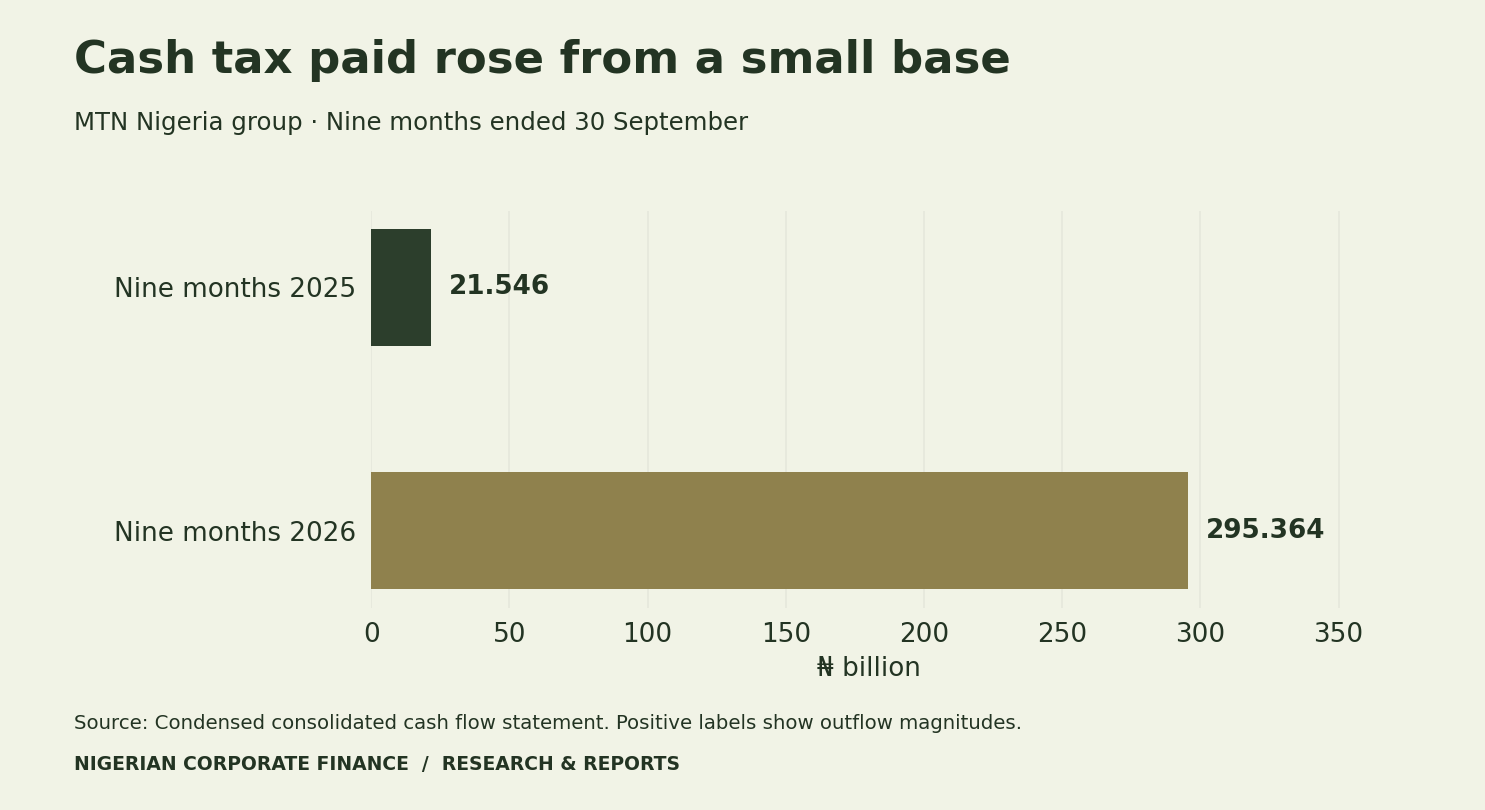
For cash planning, use the actual payment and verify which periods it settles. A large change in cash paid alone cannot tell you how efficiently the company manages tax or which amounts became payable during the current period. Our cash-flow management guide covers a separate review of cash timing.
Reconcile the tax charge in Note 14
First, Note 14 reports a current tax expense of ₦675.828 billion. This comprises ₦581.931 billion in company income tax and ₦93.897 billion in development levy. Next, a deferred tax credit of ₦45.357 billion reduces the current charge to a total tax expense of ₦630.471 billion.
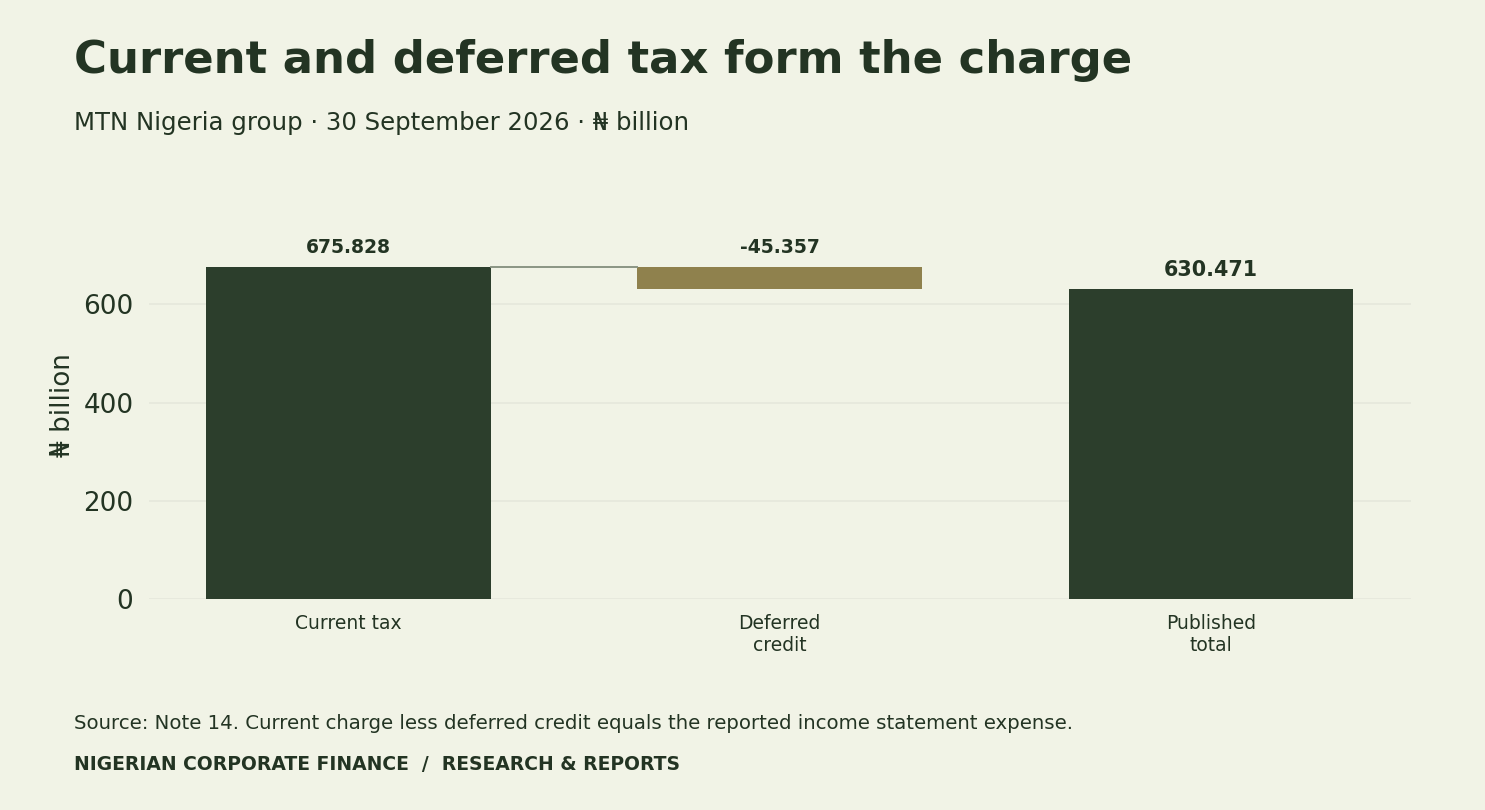
Keep the current and deferred lines visible. A deferred credit changes the reported charge in this bridge. However, it does not settle the current tax liability. To explain the payable, move to Note 35 and start from the opening balance.
Reconcile the current tax payable in Note 35
At the start of the period, the group had ₦355.175 billion of current tax payable. Add the two current provisions, deduct the cash tax payment and the two credit lines, then add the other adjustment. For this calculation, use the filing’s original unit, millions of naira.
| Movement | Signed ₦ million |
|---|---|
| Opening current tax payable | 355,175 |
| Company income tax provision | +581,931 |
| Development levy provision | +93,897 |
| Cash tax paid | −295,364 |
| Road-investment tax credit used | −23,948 |
| Withholding tax credit used | −1,545 |
| Other adjustment | +146 |
| Closing current tax payable | 710,292 |
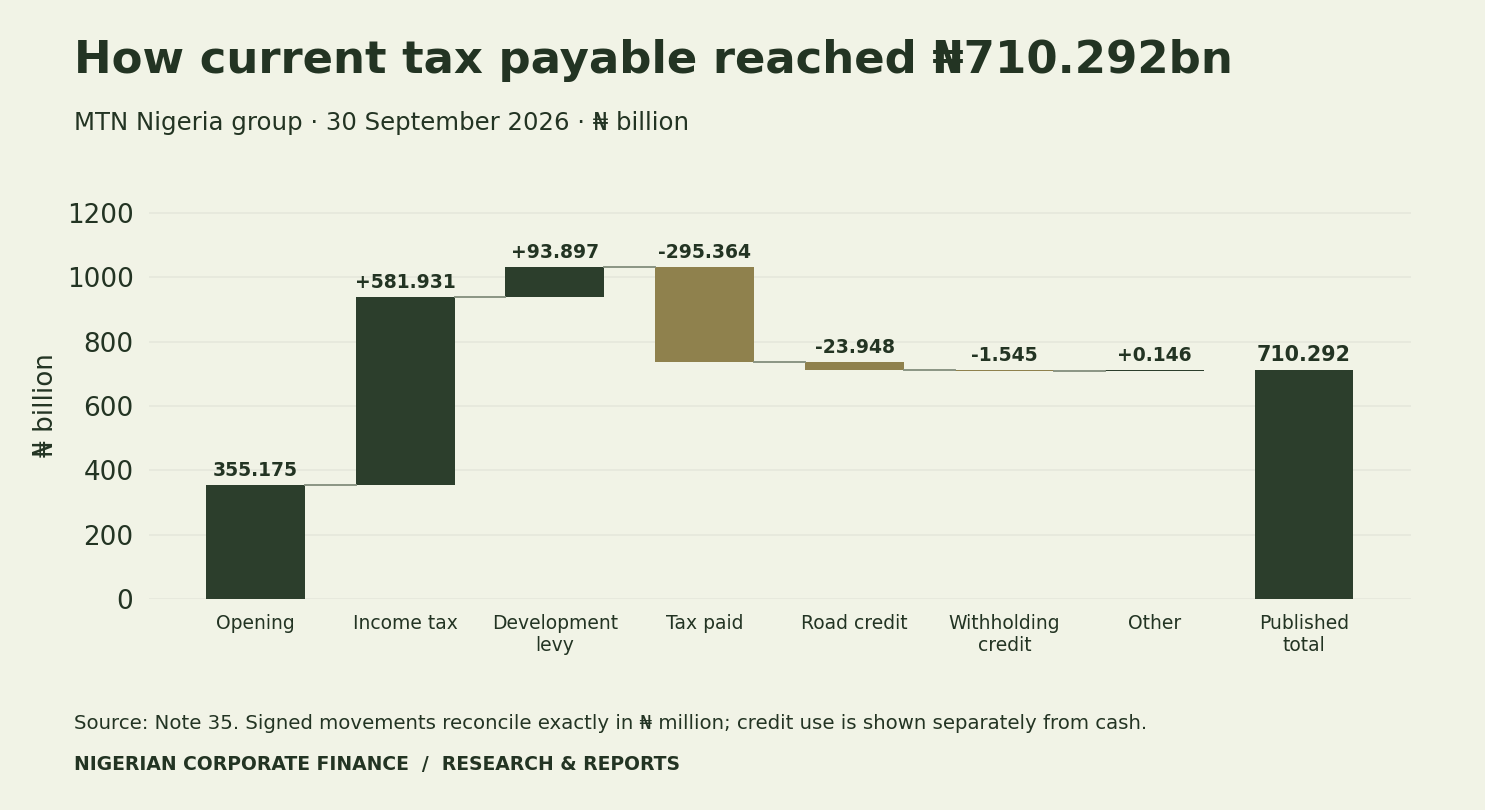
Note 35 attributes the ₦146 million other adjustment to prior-year tax adjustments from MoMo PSB that the group recognised this year. In total, the bridge reconciles to the published closing balance. Even so, it does not show whether a particular amount is overdue.
Keep credit use separate from cash payments
In addition to its cash payment, the group used ₦23.948 billion of road-investment credits and ₦1.545 billion of withholding credits against the current payable. Together, they reduce the liability by ₦25.493 billion. Accordingly, Note 35 lists the credits separately from the ₦295.364 billion cash payment.
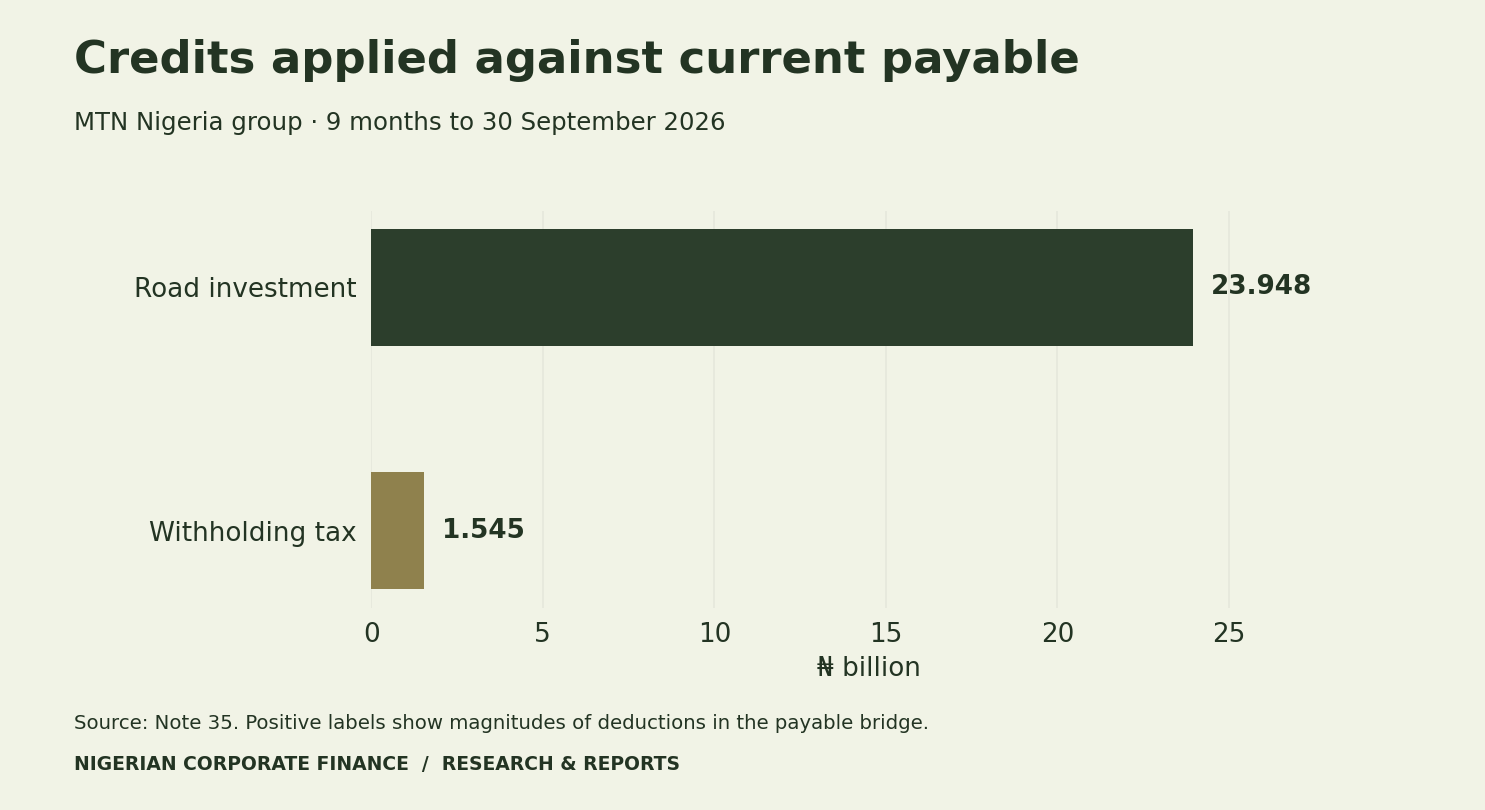
By contrast, the cash-flow statement lists a prepaid road-investment tax credit cost under investing activities. Therefore, compare that line with the credit used in Note 35 before making any cash adjustment. Do not add the credit used to the operating tax-paid line simply because both relate to tax.

Build a review schedule with separate evidence
Start with the prior-period closing liability and tie it to the opening balance in the current schedule. Then list each current charge, payment, credit and other adjustment with its own sign. In particular, keep the accounting period and payment period in separate columns. If they differ, add the reason and retain the evidence.
For example, a fictional team might record an accounting charge in September and a bank payment in October. In that case, the September schedule would track the charge and carry the balance forward. In October, the cash schedule would record the payment. This example illustrates timing without assuming a deadline.
Finally, reconcile the expense bridge to profit or loss and the liability bridge to the balance sheet. If a difference remains, ask the reviewer to explain it before closing the schedule. The financial-controls guide offers related context for documenting those checks.
Method, limitations and downloads
We use the consolidated group figures, not the separate company column, from the unaudited nine-month report. We reproduce the cash-flow amounts, Note 14 and Note 35 in millions of naira. For presentation, we convert the figures to billions. The 30 October board notice records approval on 29 October.
The analysis reconciles reported accounting amounts. It cannot establish assessment status, deadlines, a tax position for another company or when the closing balance will settle.


