




The Coronation Insurance scheme of arrangement 2026 update reports a renewed application, a conditional price rule and outstanding implementation steps. It does not establish a completed buyout or a payment date. Our event register calculates 1,036 calendar days from shareholder approval on 22 December 2023 to the notice dated 23 October 2026.
For transaction teams and company secretaries, the useful question is what each document proves. This report separates historical events, issuer-described regulatory communications and conditions that still need evidence. It supplies a dated register and a reusable review worksheet, without speculating about the final consideration or completion probability.
Research checked on 27 October 2026, using the issuer’s two-page NGX-hosted update and cautionary notice. The transaction status below is the status stated in that 23 October notice. We have not independently verified later completion documents or the underlying SEC correspondence.
Coronation Insurance scheme of arrangement 2026: the timeline
According to the notice, shareholders approved the scheme at a court-ordered meeting on 22 December 2023. The proposal concerns Coronation Capital (Mauritius) Limited and related parties acquiring the shares of the company’s other shareholders. An initial application to the Securities and Exchange Commission followed on 27 December 2023.
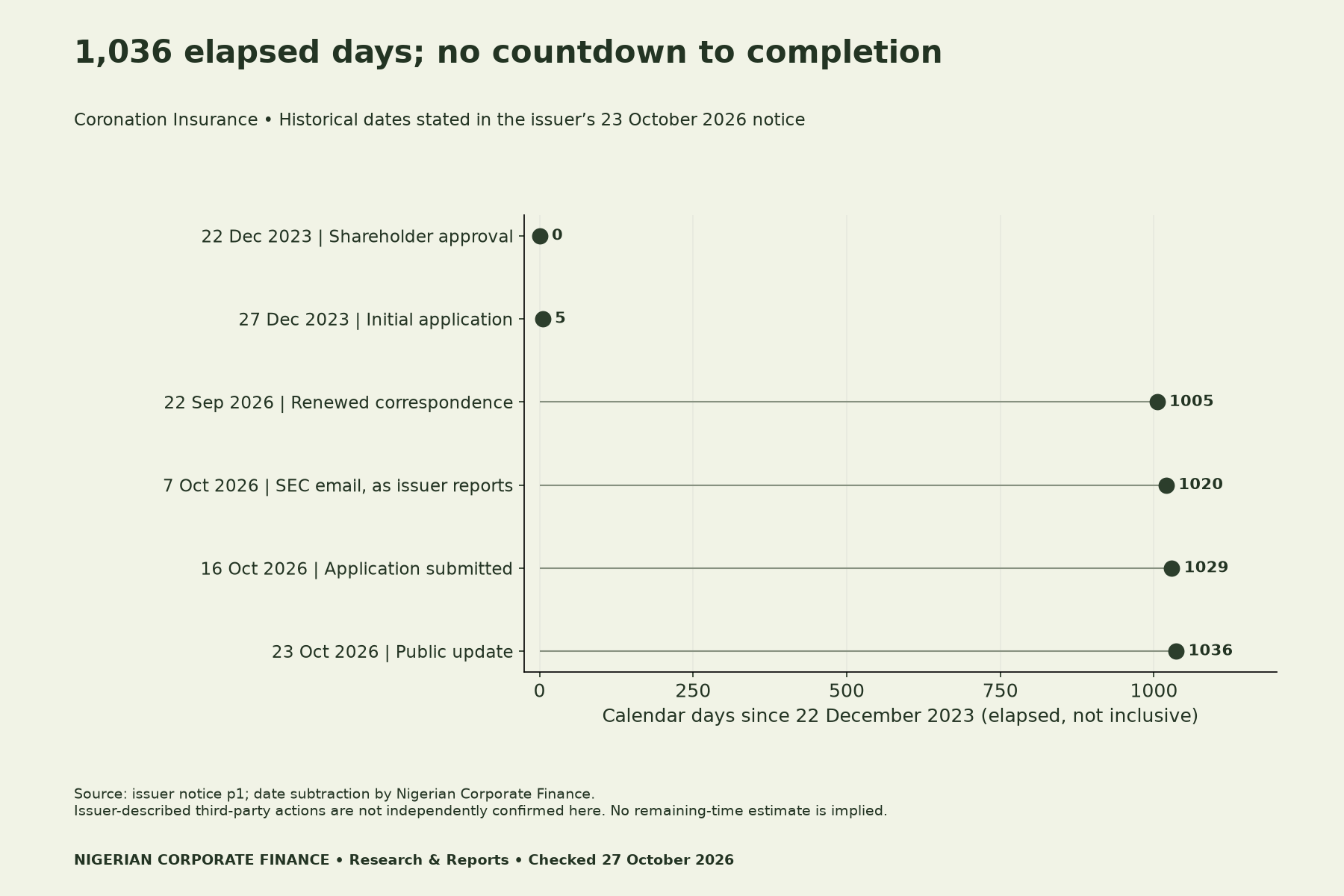
The company says pending matters prevented the SEC from proceeding with its review. It reports writing again on 22 September 2026 after those matters were resolved. The notice then describes a 7 October SEC email acknowledging their conclusion and requesting an application with documents. A new application was submitted on 16 October, the issuer says.
| Date | Event stated by issuer | Evidence scope |
|---|---|---|
| 22 Dec 2023 | Shareholder approval at court-ordered meeting | Historical event reported by issuer |
| 27 Dec 2023 | Initial SEC application | Historical submission reported by issuer |
| 22 Sep 2026 | Renewed correspondence to SEC | Issuer correspondence reported by issuer |
| 07 Oct 2026 | SEC email acknowledgment and request for application | Third-party action described by issuer; no independent SEC confirmation obtained |
| 16 Oct 2026 | Formal application submitted | Submission reported by issuer; not approval |
| 23 Oct 2026 | Scheme update and cautionary notice | Dated issuer public notice |
These statements have different evidence scopes. The public notice directly establishes what the issuer announced. However, its description of a regulator’s email is not independent confirmation from the regulator. Likewise, an application submission is distinct from formal approval. A transaction log should preserve that distinction in its status column.
What the 1,036-day interval does—and does not—measure
We subtract 22 December 2023 from 23 October 2026 using calendar dates. This is elapsed time, excluding the starting day, rather than an inclusive count of both endpoints. Five adjacent intervals sum to the same 1,036 days, providing a simple cross-check.
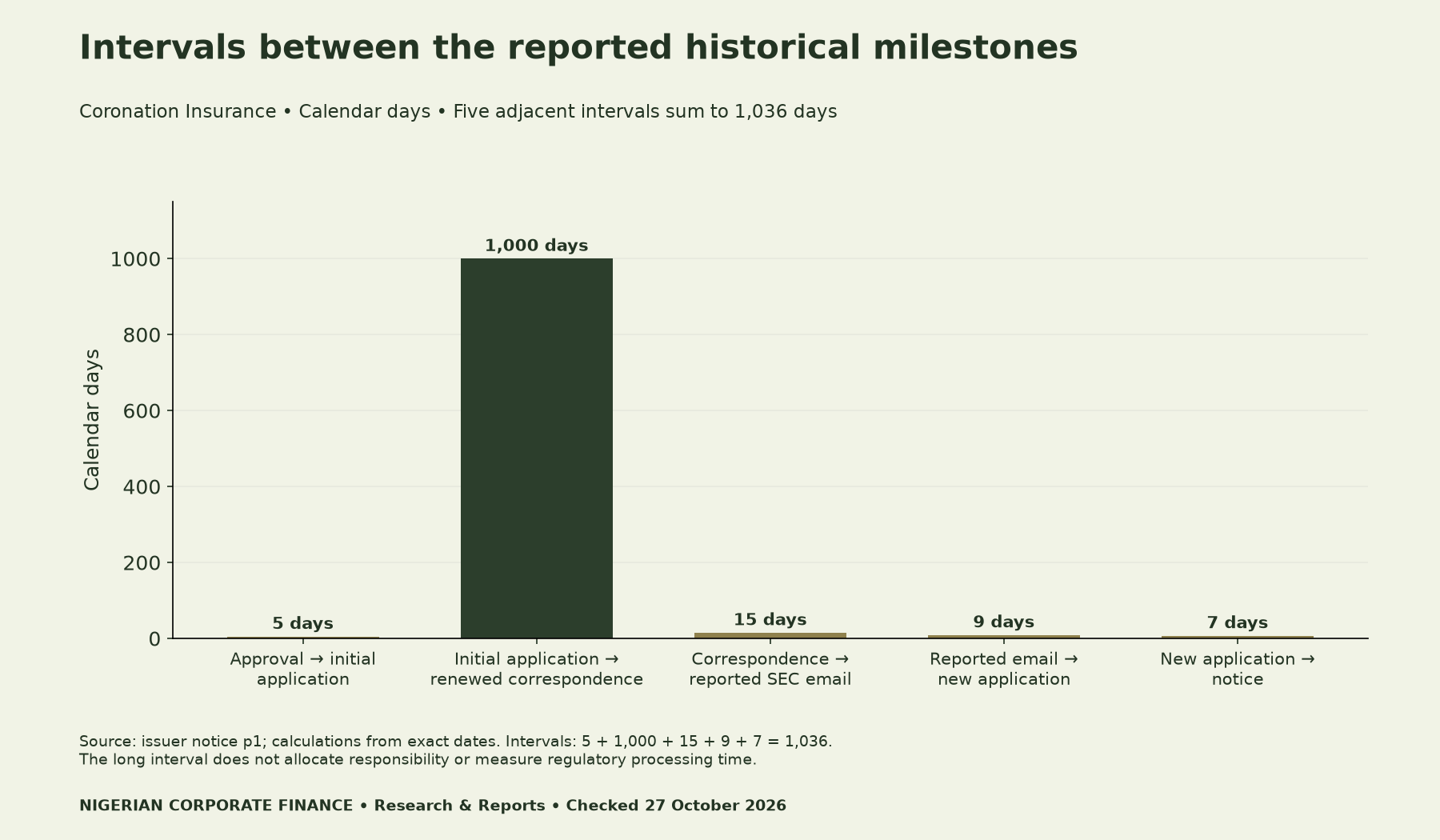
The interval from the initial application to renewed correspondence is 1,000 days. The other adjacent intervals are 5, 15, 9 and 7 days. These values describe the reported sequence. They do not identify which party controlled each day or measure regulator processing time. We make no finding of regulatory fault.
Nor does the historical duration estimate the remaining time. Dividing the elapsed period by a count of milestones would imply a pace the evidence does not support. Transaction stages can depend on different documents and decisions, so this report provides no countdown.
Six outstanding actions, each with its own evidence
Page 1 identifies six outstanding actions: formal SEC approval, a Federal High Court sanction order, filing the certified order with the Corporate Affairs Commission, consideration payment, a delisting application and actual delisting. We keep the last two separate because applying to the exchange is not the same event as removal from trading.
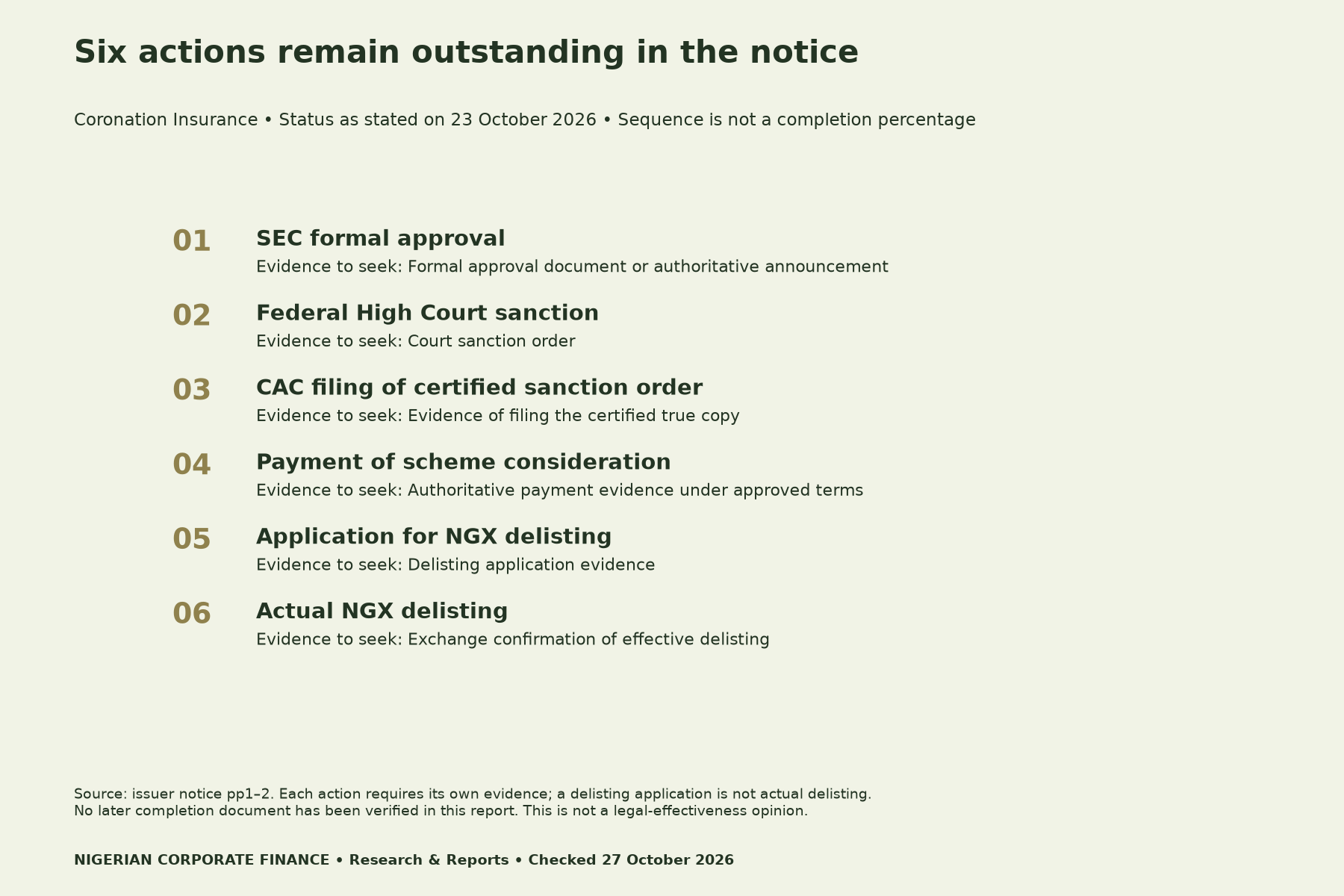
The cautionary statement on page 2 specifically retains SEC approval, court sanction and the CAC filing as completion conditions. Our map is an evidence checklist, not a legal opinion on effectiveness. It also avoids a misleading percentage-complete gauge: six listed actions do not necessarily represent six equally weighted units of work.
For each future update, record the issuing authority, exact document, date, scope and any conditions. A reported intention should remain an intention until a more specific document supports a status change. The worksheet leaves verification fields blank so a reader can add actual evidence rather than inherit an unsupported “complete” label.

The price rule is conditional; a naira price is not established
The issuer describes consideration based on the highest NGX trading price in the six months preceding the notification, subject to required regulatory approvals. The reference notice is dated 23 October 2026. That statement is a calculation rule, rather than a verified naira amount in this report.
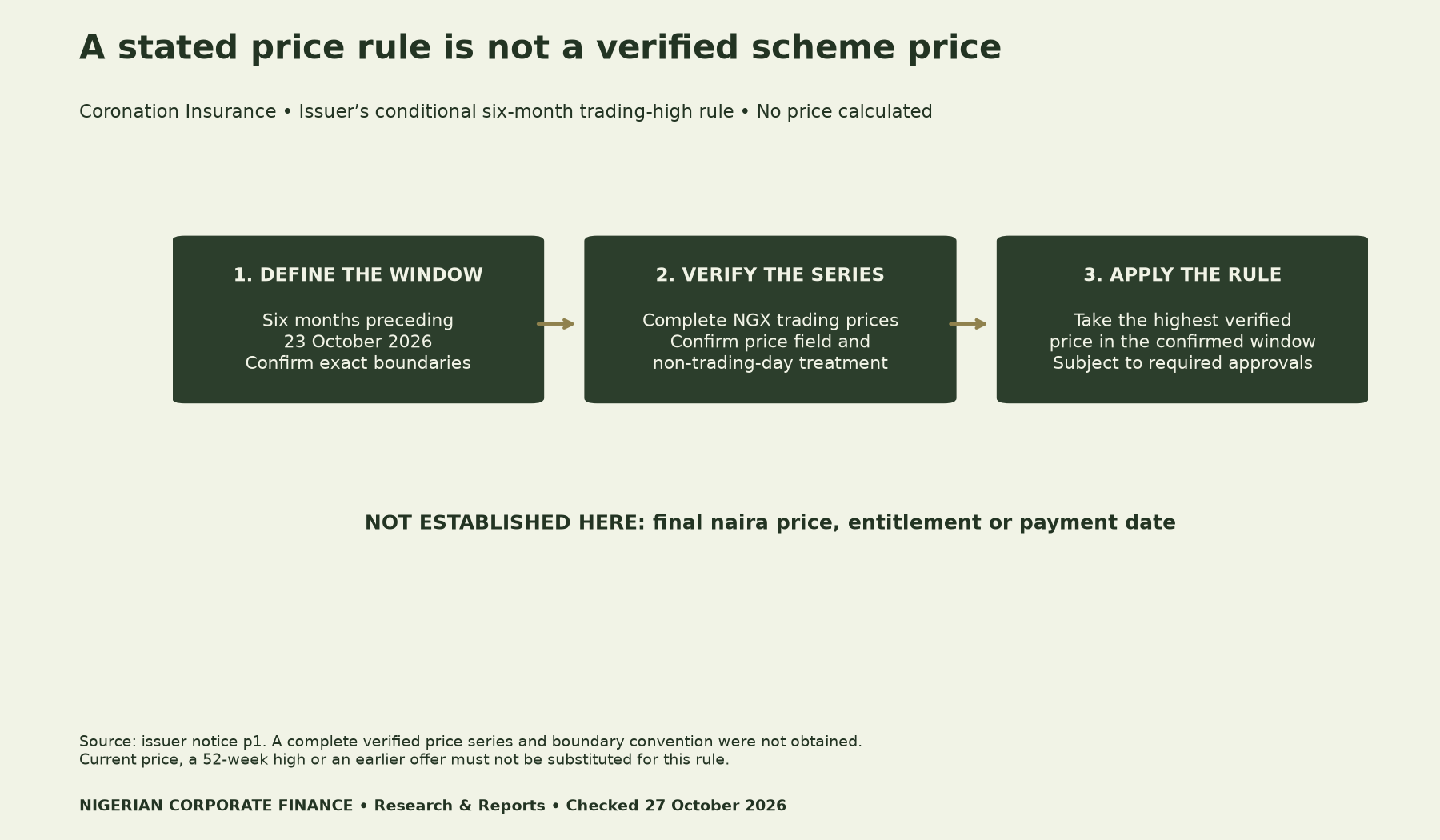
Before calculating anything, a team needs a complete verified exchange price series and a confirmed boundary convention. It must also establish the relevant price field and how non-trading dates are treated. We have not obtained those inputs and therefore publish no calculated scheme price.
A current market quote, a 52-week high or a historic offer should not silently replace the stated six-month measure. Nor does the rule by itself establish a particular reader’s entitlement, the applicable record date or payment mechanics. Those questions need the approved terms and appropriate transaction-law review.
An illustrative delay-cost worksheet, separate from this issuer
A finance team may still want to model its own administration costs while conditions remain unresolved. For illustration only, assume a hypothetical organisation incurs ₦5m per 30-day month in fixed administration costs. Another 30, 60 or 90 days would then imply ₦5m, ₦10m or ₦15m in additional costs.
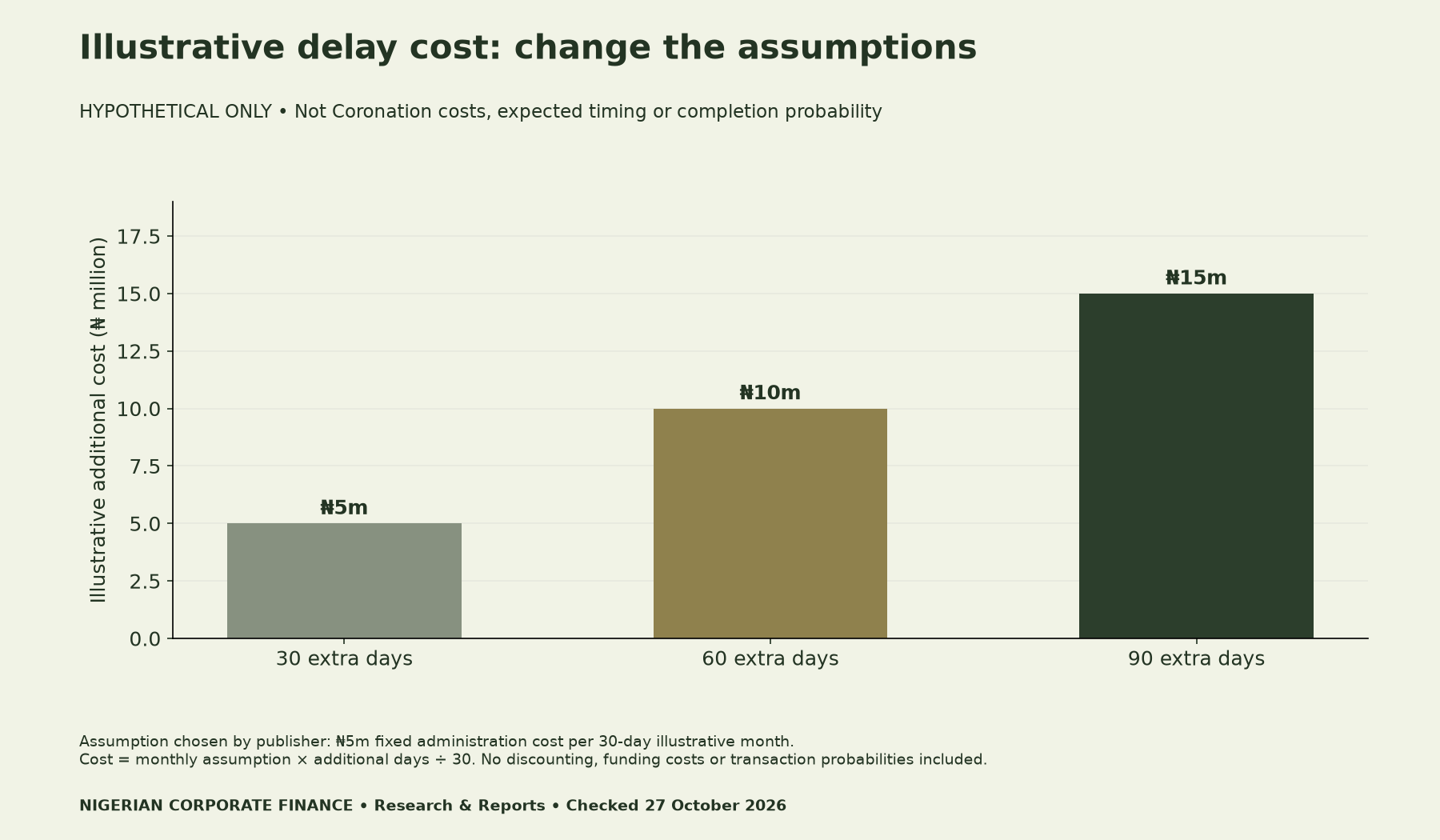
These amounts and periods are publisher-chosen assumptions. They are not Coronation Insurance’s costs, expected timing or completion probabilities. The formula is monthly cost × additional days ÷ 30. It excludes financing costs, discounting, taxes and possible changes in activity. Users should replace the assumptions with their own verified inputs.
An update protocol for the next official document
First, preserve the previous record and the new source. Then identify exactly which status the document changes. Finally, distinguish a new application, an approval with conditions, a court order, a filing receipt, payment evidence and an exchange notice. Do not update every downstream stage because one earlier milestone changes.
Our public-listing strategy guide provides broader corporate-finance context. For a related lesson in definition control, see the Transcorp Power cash presentation study. The First HoldCo earnings bridge shows a separate analytical safeguard: reconcile the whole picture before interpreting a headline.
Methods, limitations and reusable downloads
We transcribed six dated events and six outstanding actions from the issuer notice, then calculated elapsed calendar-day differences. The event register preserves source page and evidence scope. The figures use the same retained data and scripts. No market-price series, completion probability or private transaction information was supplied.
This is a document-based transaction-governance case, not legal, tax or investment advice. The issuer’s account does not independently establish every third-party action. The notice itself advises caution pending further announcements. No final consideration, entitlement, payment deadline or completed acquisition is inferred here.
Download the Coronation scheme event register (CSV) with six dated rows, calculated intervals, evidence scope and the primary-source link.
Use the transaction-evidence review worksheet (CSV) for six action checks and six price/scenario inputs. Empty verification fields are deliberate; they do not indicate completed checks.
Suggested citation: Nigerian Corporate Finance (27 October 2026), “Coronation Insurance’s 2026 Buyout Update: Price Rule, Approval Gates and Execution Risk,” event calculations and document analysis from Coronation Insurance Plc’s notice dated 23 October 2026, pages 1–2.


