




Transcorp Power cash equivalents for Q3 2026 show why treasury teams must define a metric before interpreting its growth. The issuer’s release highlights approximately ₦10.3bn, while Note 19 reports ₦7.138bn after an adjustment. Both relate to 30 September. They should not be treated as interchangeable measures.
Our source-linked reconciliation follows the gross subtotal, the adjustment and the note total. It also checks the borrowing disclosure and preserves small differences elsewhere in the accounts. The result is a reusable definition audit, rather than an allegation of misstatement or a verdict on liquidity.
Research edition: checked 27 October 2026. The accounts are unaudited and cover January–September, with balance comparisons against December 2025. “Q3” identifies the filing; the cash figures are point-in-time balances, not October cash generation.
Transcorp Power cash equivalents Q3 2026: start with the source
The issuer release dated 23 October 2026 reports cash and cash equivalents of ₦10.3bn, up 365%. The company’s web version displays 22 October. We use the dated exchange-hosted release as the news anchor and retain the webpage’s different date in the source register.
The primary financial statements provide the detail behind the rounded headline. Page 9 shows ₦10,314,271,000 as cash and cash equivalents. Note 19, on page 21, then presents a gross subtotal followed by a deduction and a different total. Reading the note matters before importing the headline into a dashboard.
Reproduce the gross-to-net bridge
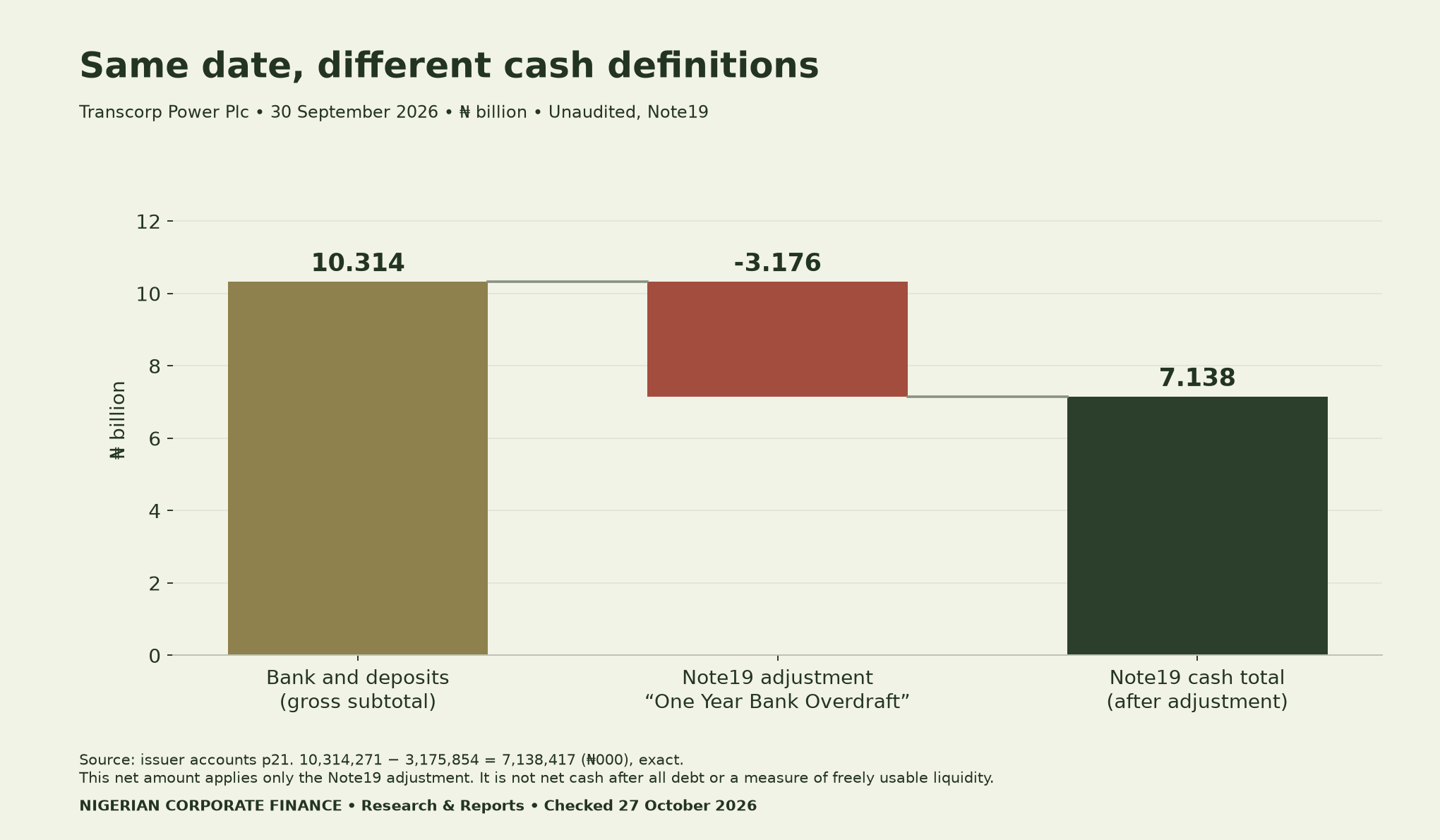
| Note19 line | Sep2026 (₦000) | Dec2025 (₦000) |
|---|---|---|
| Cash at bank | 712,786 | 2,219,513 |
| Bank deposits | 9,601,485 | 0 |
| Gross subtotal | 10,314,271 | 2,219,513 |
| Note19 deduction: One Year Bank Overdraft | -3,175,854 | 0 |
| Note19 adjusted total | 7,138,417 | 2,219,513 |
In original naira-thousand units, 712,786 plus 9,601,485 equals 10,314,271. Deducting 3,175,854 gives 7,138,417. This Note 19 arithmetic reconciles exactly. Our terms gross and adjusted total describe the positions within that published bridge.
Here, net does not mean cash after every borrowing or liability. Nor does either presentation establish unrestricted, immediately usable funds. A dashboard needs a written definition of what was included and deducted, alongside the balance date and source.
The growth calculation depends on that definition
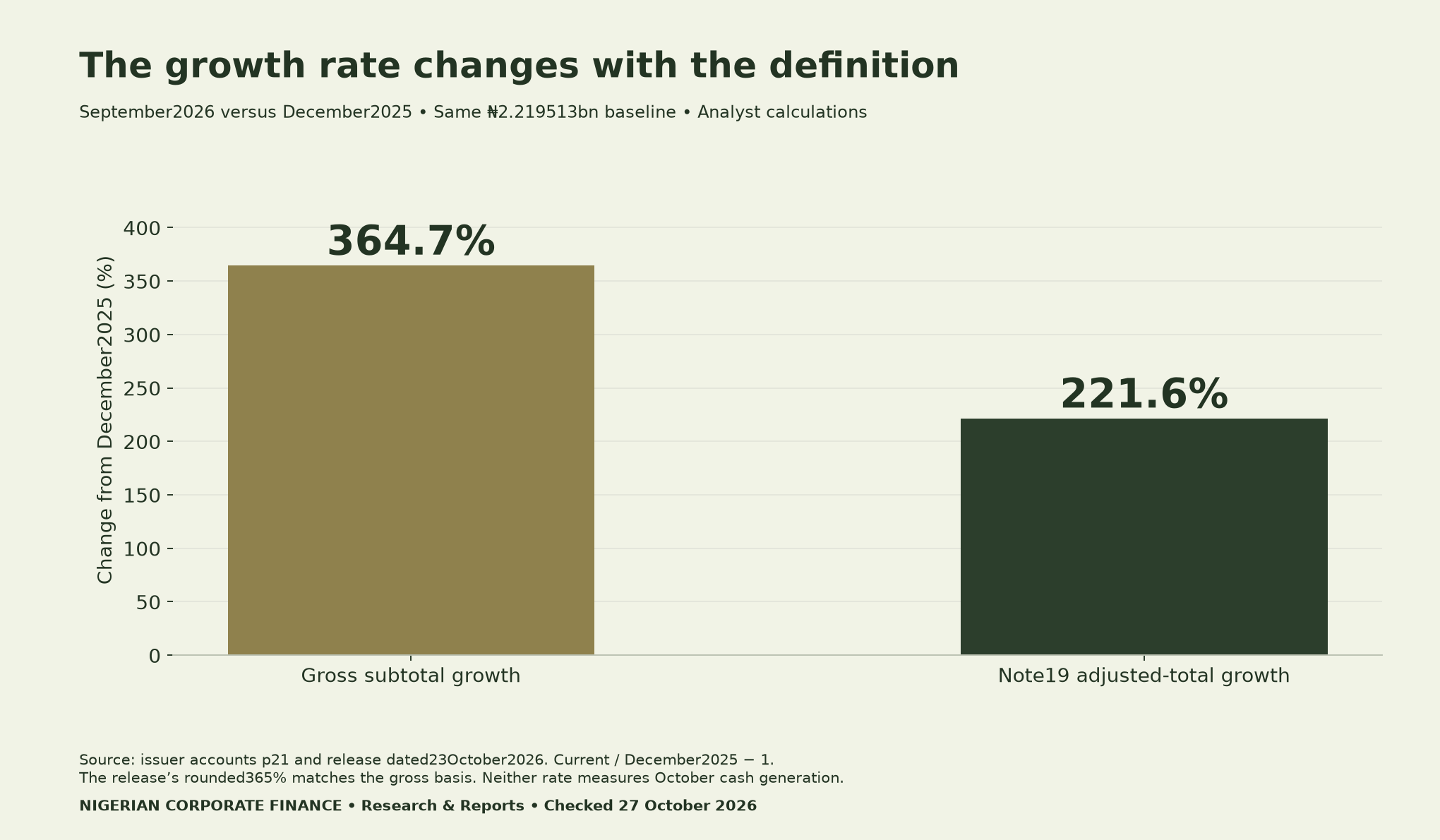
December 2025’s Note 19 baseline is ₦2.219513bn. Comparing the September gross subtotal with that base gives growth of 364.7%, which rounds to the release’s 365%. Comparing the adjusted Note 19 total with the same base gives 221.6%.
Both calculations use current balance divided by prior balance, minus one. The difference follows from the numerator’s definition. It does not prove that one percentage is a better measure of cash generation, financial resilience or an investor’s prospective return.
For a management scorecard, lock the basis across periods. If a team changes from gross to adjusted cash, restate the comparison where evidence permits or mark the change clearly. Do not place the two percentages on one trend line as though nothing changed.
Compare the statement, note and cash-flow presentation
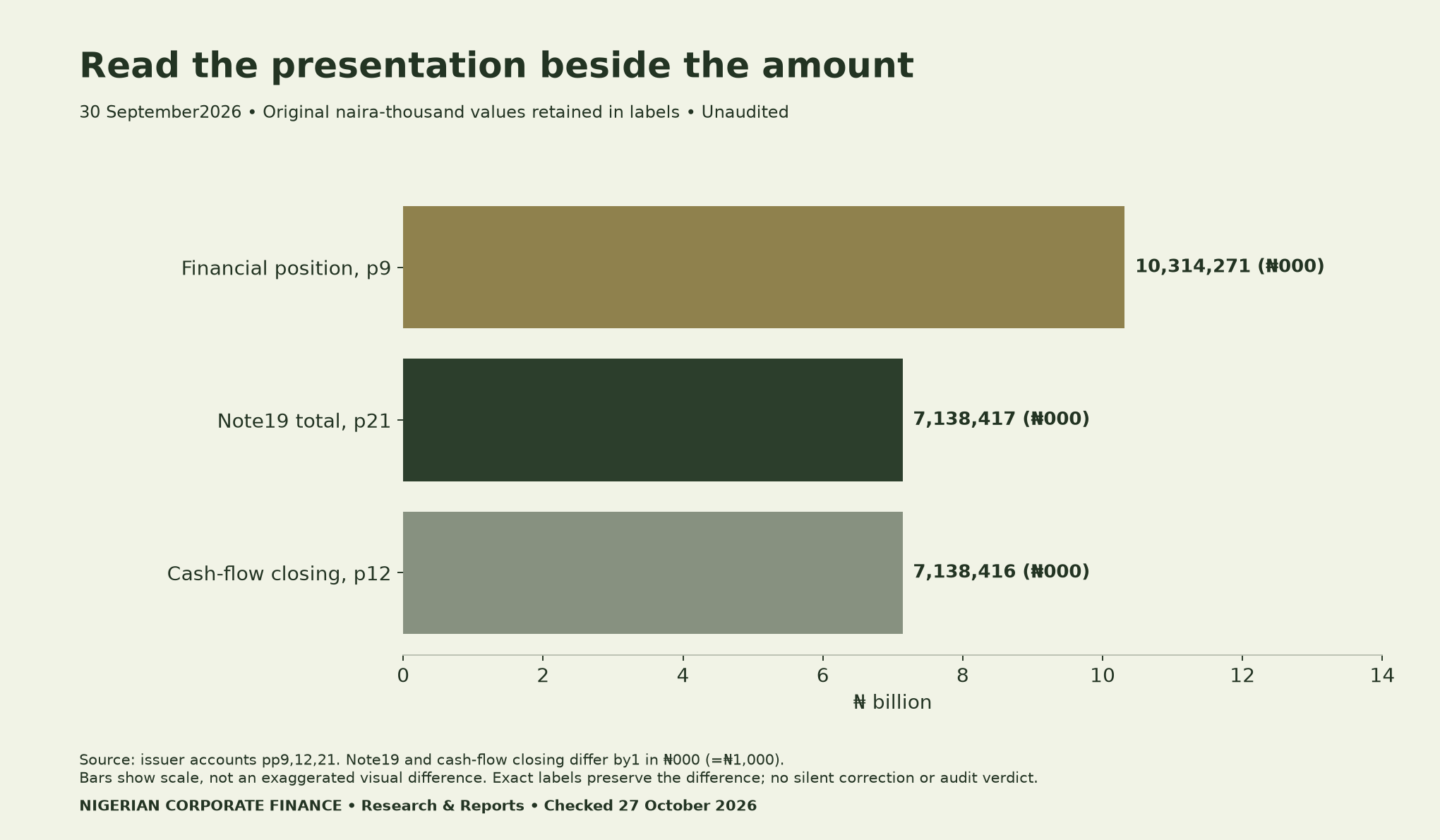
The financial-position statement reports the gross ₦10.314271bn balance. Note 19’s total is ₦7.138417bn. The cash-flow statement closes at ₦7.138416bn. The last two values differ by one naira-thousand unit, or ₦1,000. We retain each original amount rather than silently replace one.
The chart keeps a zero-based scale, so it does not exaggerate the tiny difference between the last two bars. Exact labels and the downloadable audit provide the precision that a billion-naira display hides. The observed difference is not an explanation of its cause or an accounting-compliance judgement.

Trace the adjustment without subtracting it twice
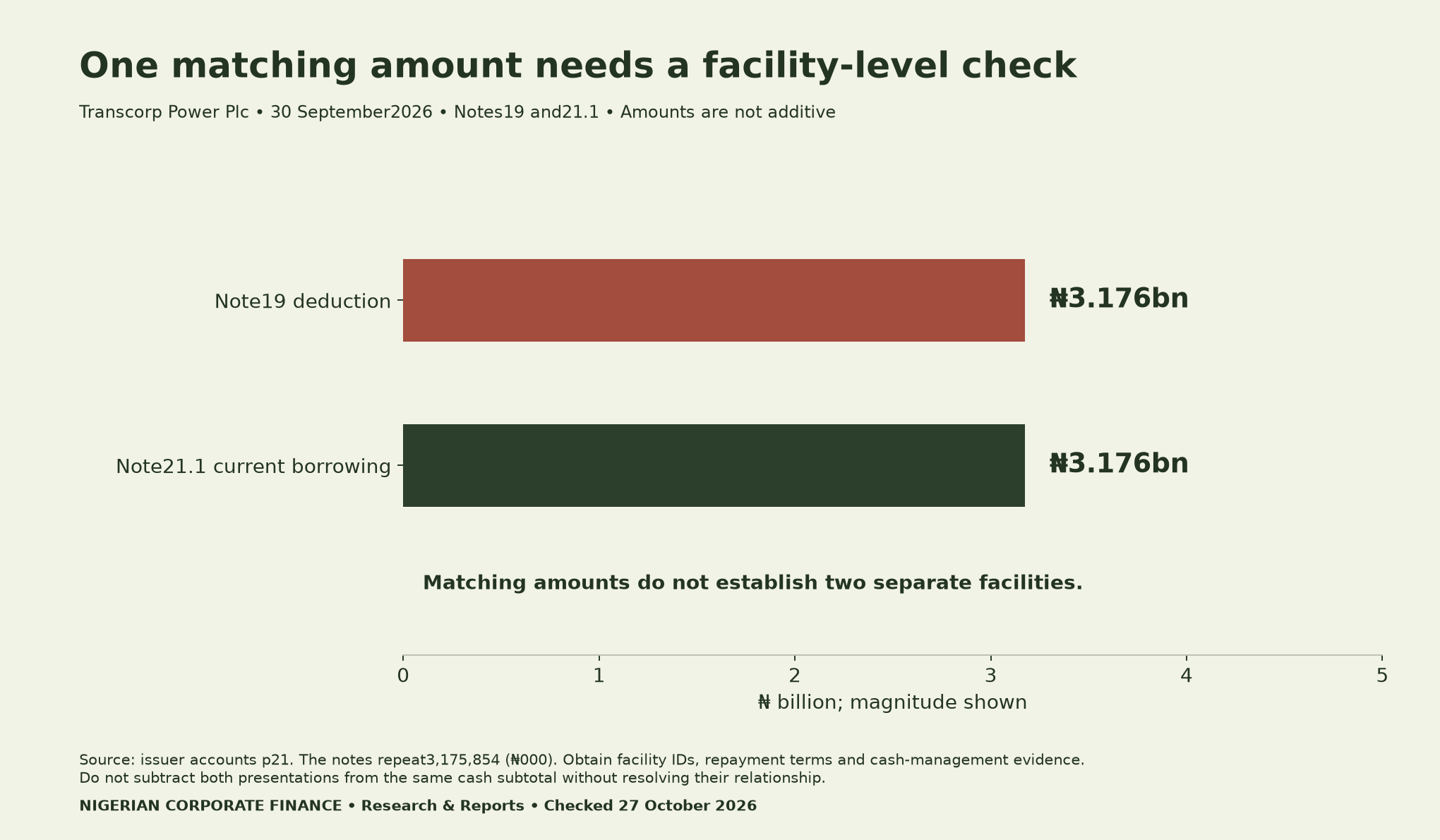
Note 19 labels its ₦3.175854bn deduction “One Year Bank Overdraft”. Note 21.1 presents the same amount as current borrowings within total interest-bearing loans and borrowings of ₦73.445053bn. Matching amounts warrant a tracing question; they do not independently establish two facilities.
Accordingly, we do not subtract the adjustment and then deduct the repeated current amount again from the same cash subtotal. First obtain facility identifiers, contractual terms and cash-management evidence. The public labels alone do not establish repayability on demand or the basis for the presentation.
Page 22 discusses term-loan facilities and their purposes. However, that narrative is not a complete facility-level mapping of the Note 19 deduction. We therefore leave the relationship and classification questions open. Stronger conclusions need the underlying terms and appropriate accounting review.
Keep original-unit differences visible
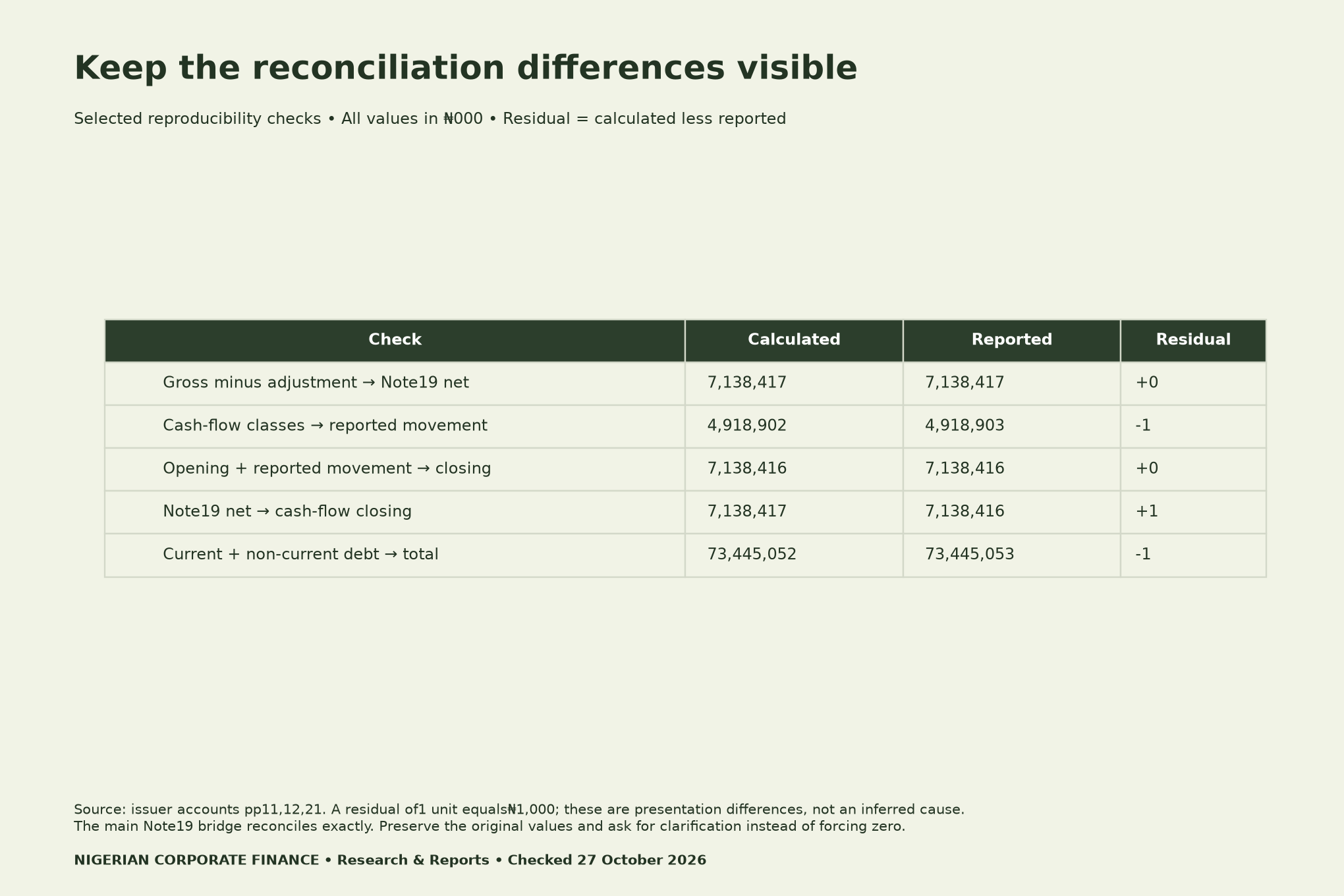
Our audit checks more than the headline bridge. The three reported cash-flow class totals sum to 4,918,902 in naira-thousand units, while the reported net movement is 4,918,903. Opening cash plus that reported movement matches the cash-flow closing balance of 7,138,416.
Similarly, the current and non-current borrowing components sum to 73,445,052, while the note’s stated total is 73,445,053. These one-unit differences remain visible in Figure 5 and the source CSV. We have not invented a rounding adjustment, changed a published input or inferred materiality.
This distinction helps a reviewer reproduce the work. The main Note 19 bridge has a zero residual; selected cross-statement checks do not. Reporting both outcomes is more useful than labelling the whole filing reconciled or treating every small difference as proof of a wider problem.
Build a definition-controlled treasury dashboard
Use a metric dictionary with fields for entity, balance date, reporting units, included bank accounts, deductions and a unique facility identifier. Record restrictions and maturity evidence separately. Keep available undrawn commitments separate from cash balances; they are not cash already held.
For example, a hypothetical business could show gross bank balances, restricted amounts and an adjusted internal availability measure as distinct rows. Such a management measure needs its own formula and supporting evidence. It must not be relabelled as a reported accounting total or imported into this company’s figures.
Before a committee relies on the dashboard, assign an owner to unresolved classifications. A short list of questions is practical: which balances can be accessed now, which deductions map to which facilities, and what contractual conditions affect access? A growth headline cannot answer them.
Download the Transcorp Power cash-equivalents audit tools
- Transcorp Power cash metric audit with original values and source pages (CSV)
- Blank private treasury metric-definition worksheet (CSV)
The audit preserves gross and adjusted figures, the December baseline, cash-flow presentation and borrowing-note values. The blank worksheet helps teams document their own definitions without sending confidential inputs to this website.
Our Unilever cash-funding case illustrates a different issue: separating period cash generation from accumulated liquidity. For internal implementation, see automated financial controls.
Methodology and limits
We transcribed the same unaudited filing’s original naira-thousand values and compared the release with pages 9, 11–12 and Notes 19–21.1. Calculations precede rounding. The analysis concerns Transcorp Power Plc, not the parent group or Transcorp Hotels. The script retains all selected residuals.
This is a metric-definition audit, not an independent financial audit, an IFRS-compliance verdict or an assessment of insolvency. Facility terms, restrictions and immediately usable funds remain unresolved. Cite Nigerian Corporate Finance, analysis of Transcorp Power Plc’s September 2026 unaudited accounts and release dated 23 October; checked 27 October 2026.


