





AfDB Sterling Bank loans and the trade finance guarantee belong in different parts of a financing analysis. The announced US$102 million package contains US$72 million of loan or credit components and a US$30 million guarantee. That headline does not establish how much a particular Nigerian business can draw, or whether it has received any cash.
Our original analysis reconciles the four components, calculates their shares of announced face value and translates the distinction into a fictional cash forecast. Two charts, a facility-status infographic and four CSV tools help an SME finance lead record evidence without turning an institutional approval into assumed bank cash.
AfDB Sterling Bank loans and trade finance guarantee: read the components
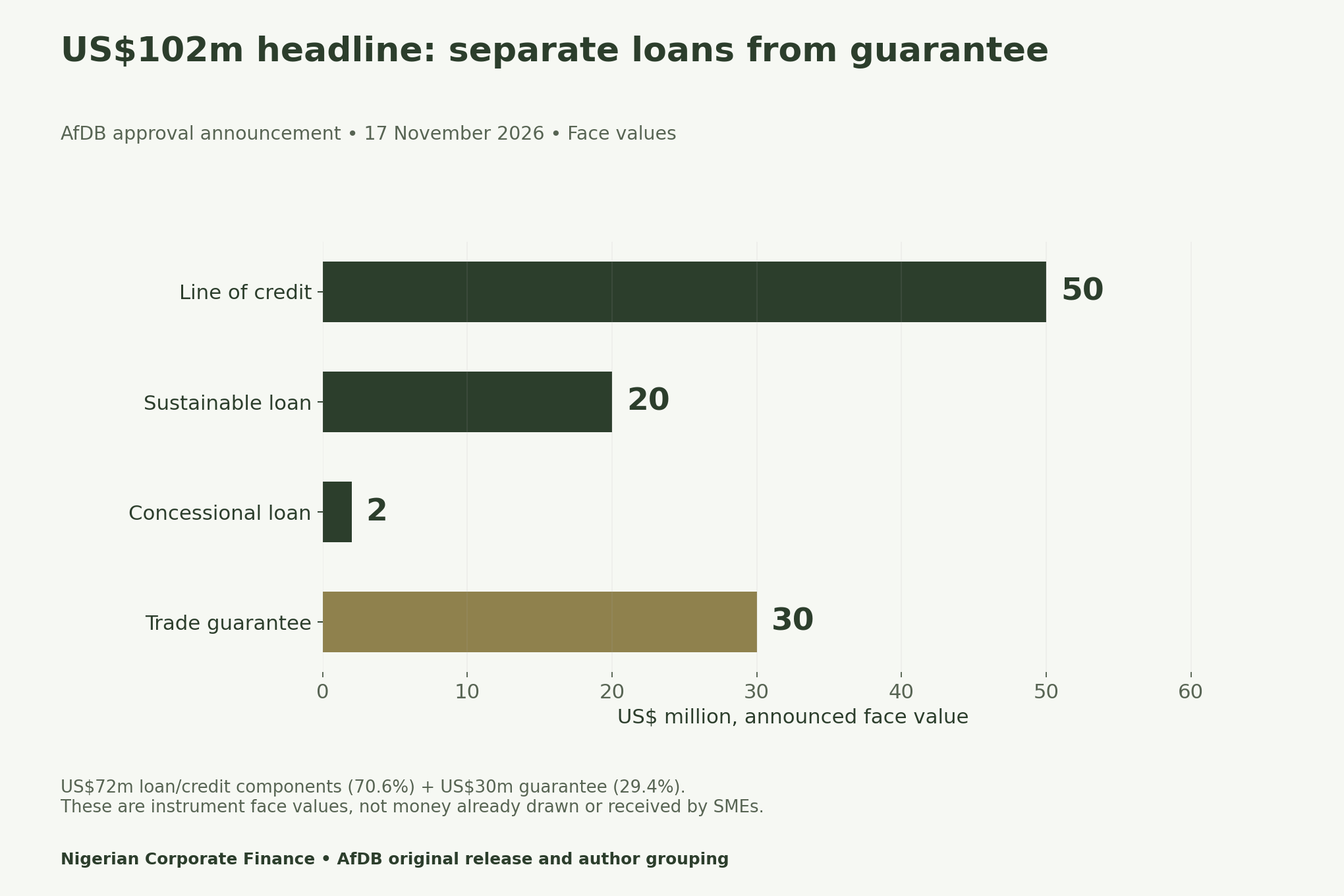
The AfDB’s original 17 November release records Board approval. Its components are a US$50 million line of credit, US$20 million sustainable loan, US$2 million concessional loan and US$30 million trade-finance transaction guarantee. The first three total US$72 million; all four total US$102 million.
Dividing 72 by 102 gives 70.6%, rounded to one decimal place. The guarantee’s 30 divided by 102 gives 29.4%. These percentages allocate headline instrument face value. They are not percentages of funds drawn, end-borrower receipts, realised trade or cash already available to SMEs.
Keep the earlier assessment’s scope separate
An earlier AfDB environmental and social assessment describes a US$30 million unfunded transaction guarantee within a US$80 million package scope. It helps explain the instrument distinction. However, it is not the source for November’s larger aggregate, and its earlier scope should not replace the later release.
A guarantee provides risk support subject to its terms. It should not be treated as an unconditional cash deposit in the borrower’s bank account. Likewise, a loan approval is not the same as signed documentation, satisfied conditions, a usable limit or a completed draw. Each stage needs its own evidence.
Our analysis does not assume that every earlier condition carries unchanged into every November component. Obtain the final applicable documents before using a particular facility in an actual forecast. Preserve unresolved terms as unknown rather than filling them with an example from a different programme.
Build a cash forecast that assumes no unconfirmed receipt
Consider a fictional business with ₦8 million available before payments and a ₦4 million supplier payment due now. Without a documented and usable facility, include no new funding receipt. The immediate forecast is ₦8 million less ₦4 million, leaving ₦4 million cash after that payment.
Now suppose a separate, generic trade-support arrangement demonstrably defers ₦3 million of the supplier payment. In this fictional case, current supplier cash outflow becomes ₦1 million, leaving ₦7 million cash. The difference reflects payment timing. It does not mean that ₦3 million entered the bank account.
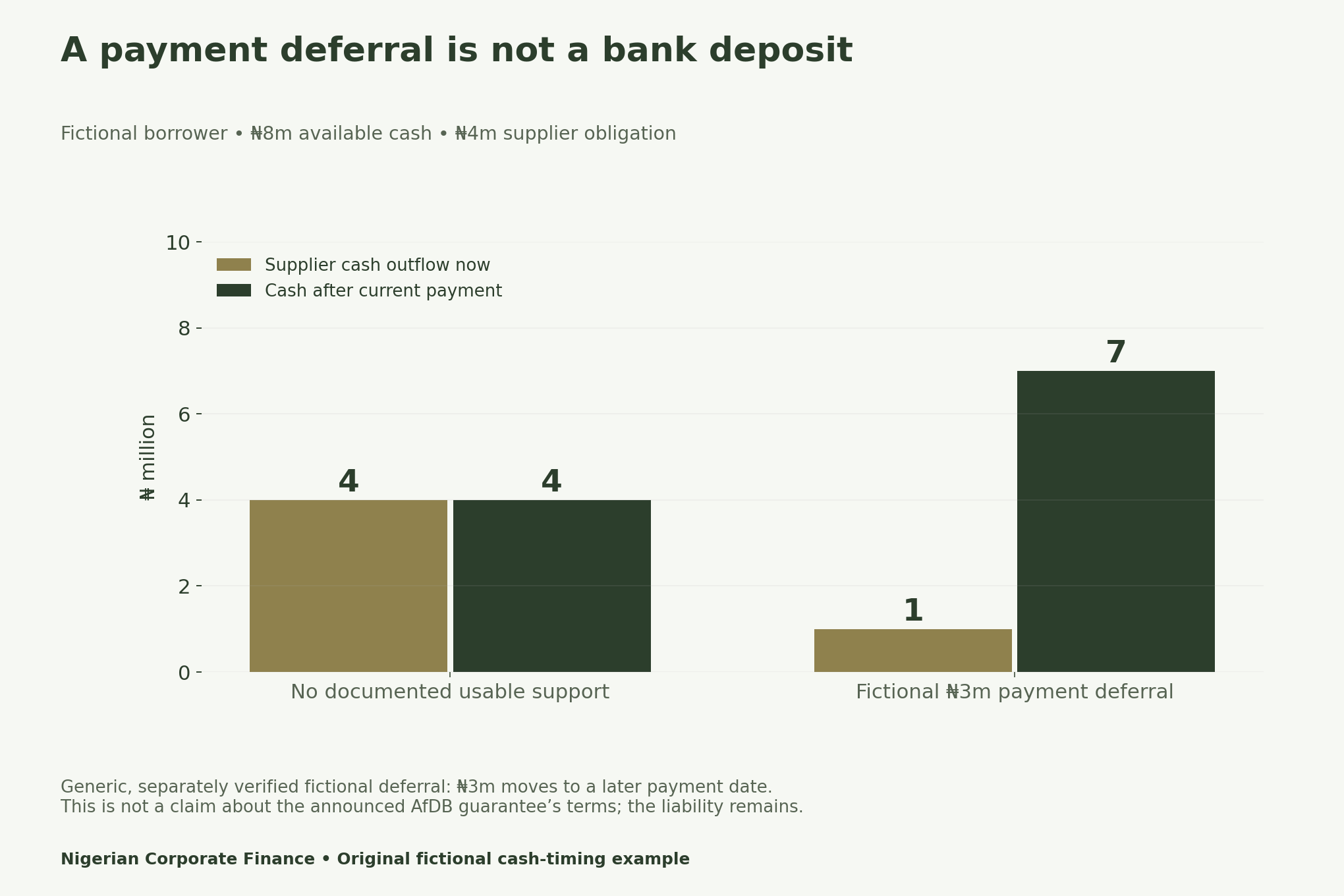
Retain the deferred obligation and its later due date in the forecast. Also record any applicable fees or conditions once verified. Do not count both an invented ₦3 million cash receipt and a ₦3 million reduction in the payment. That would double-count a benefit that the example never supplies.
The illustration contains no currency conversion from the US-dollar institutional package to a naira SME allocation. There is no per-business entitlement in this arithmetic. Keep the currency, counterparty, amount and date of any real facility tied to its own documents.
Track the facility status before the cash entry
Begin with an approval record. Then ask whether the business has signed terms, satisfied conditions and a usable facility. A cash draw and a trade instrument’s issue are different events. The next evidence should be specific enough to identify which one occurred and when.
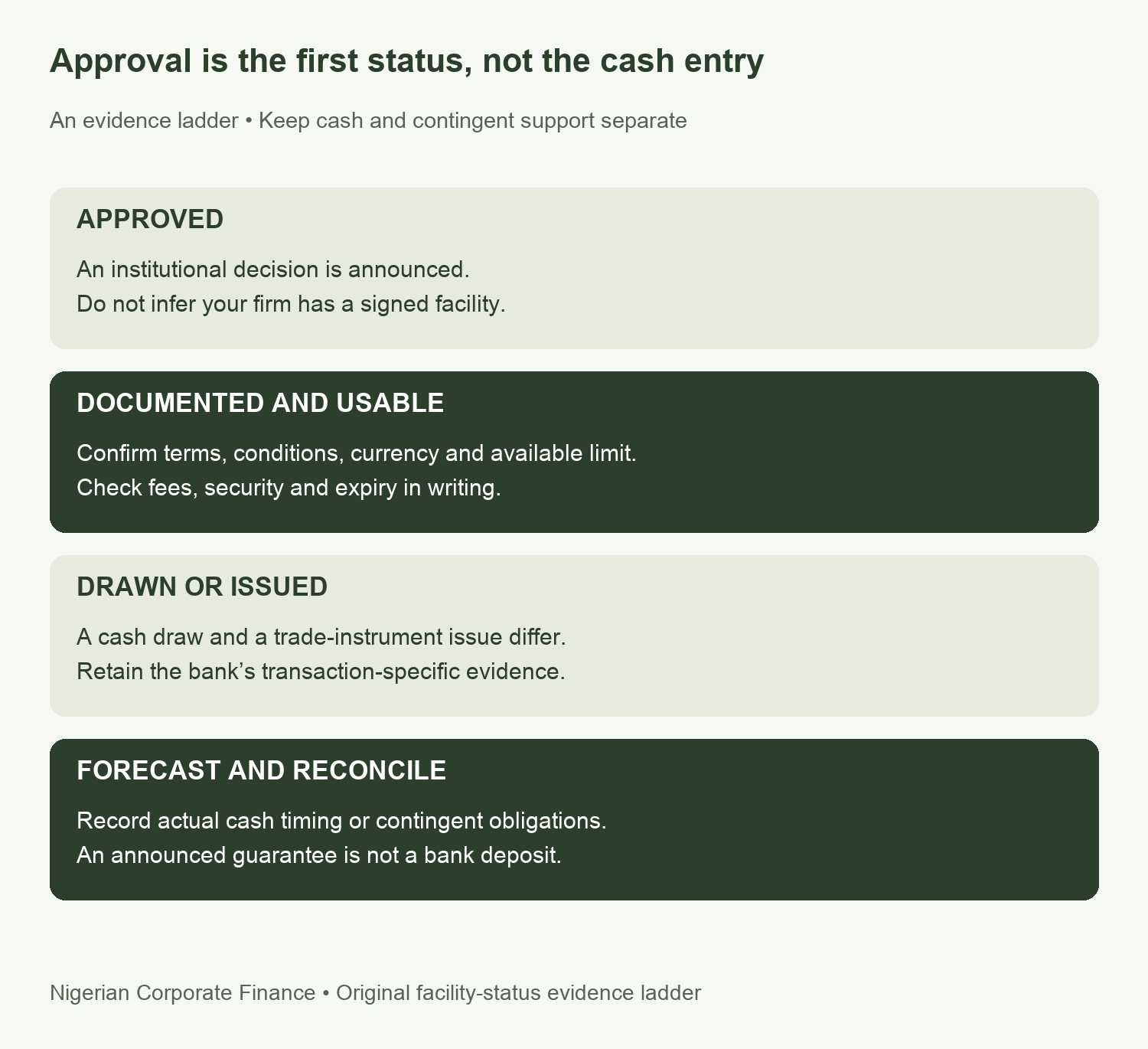
For a possible product, request written confirmation of the instrument, intended use, currency, limit, pricing, tenor, security, conditions and expiry. Also establish the application route if the bank confirms one. A named sector in an announcement does not replace underwriting or a borrower-specific decision.
Sterling’s published environmental and social risk approach describes review within its credit process. Therefore, do not treat a broad programme aim as a completed credit decision. This article does not verify current application availability or promise eligibility, terms or approval.
Separate a useful question from an unsupported financing claim
A useful management question is: which documented event changes our cash date or contingent obligation? An unsupported answer is: the package was approved, so our bank balance will increase. The status matrix makes that difference visible to a manager, accountant or finance committee.
Our trade-finance overview covers instruments more generally. This report has a narrower purpose: allocating one announced package and preventing assumed receipts in a borrower forecast. For a different financing reference, see our dated Eurobond benchmark analysis. Neither supplies an executable loan offer.
Methods, limits and four reproducible downloads
We rechecked the original AfDB release on 24 November 2026 and retained its source evidence. The component shares use only November’s four face values; the cash scenarios are wholly fictional.
No facility agreement, drawdown, guarantee issue or borrower receipt was obtained. We make no claim about actual payment deferral under this guarantee. This educational analysis is not an investment recommendation or a lender endorsement. Update the status matrix from verified bank documents before relying on a real financing forecast.
- Four approved components and instrument classification (CSV)
- Face-value shares and fictional cash-timing calculations (CSV)
- Blank facility-status and next-evidence matrix (CSV)
- Source dates, scope and cash-versus-guarantee dictionary (CSV)
Suggested citation: Nigerian Corporate Finance, “AfDB’s US$102m Sterling Package: Separate Loans from Guarantees”, 24 November 2026. Cite AfDB for its approval announcement and this article for the original grouping, calculations and evidence ladder. Explore entrepreneurial-finance research for related tools.


